From Conversation to Action: Agents Redefine Enterprise AI
If 2023-2024 was the phase when generative AI could chat, the keyword for 2026 is getting things done. Agentic AI refers to systems that can autonomously plan, call tools, execute multi-step tasks and adjust based on feedback. Rather than merely answering questions, they complete real work—auto-resolving support tickets, generating and sending reports, orchestrating business processes across systems. This leap from conversation to action is redefining what enterprises expect from AI.
Two forces drive it: first, the maturing of model reasoning and function calling gives agents a reliable execution foundation; second, enterprises' urgent productivity demand pushes AI from assistive suggestions to autonomous completion. From customer service, sales and IT operations to software development, agent use cases are expanding fast, making this the most-watched enterprise tech wave since generative AI itself.
The Adoption Wave: From Under 5% to 40%
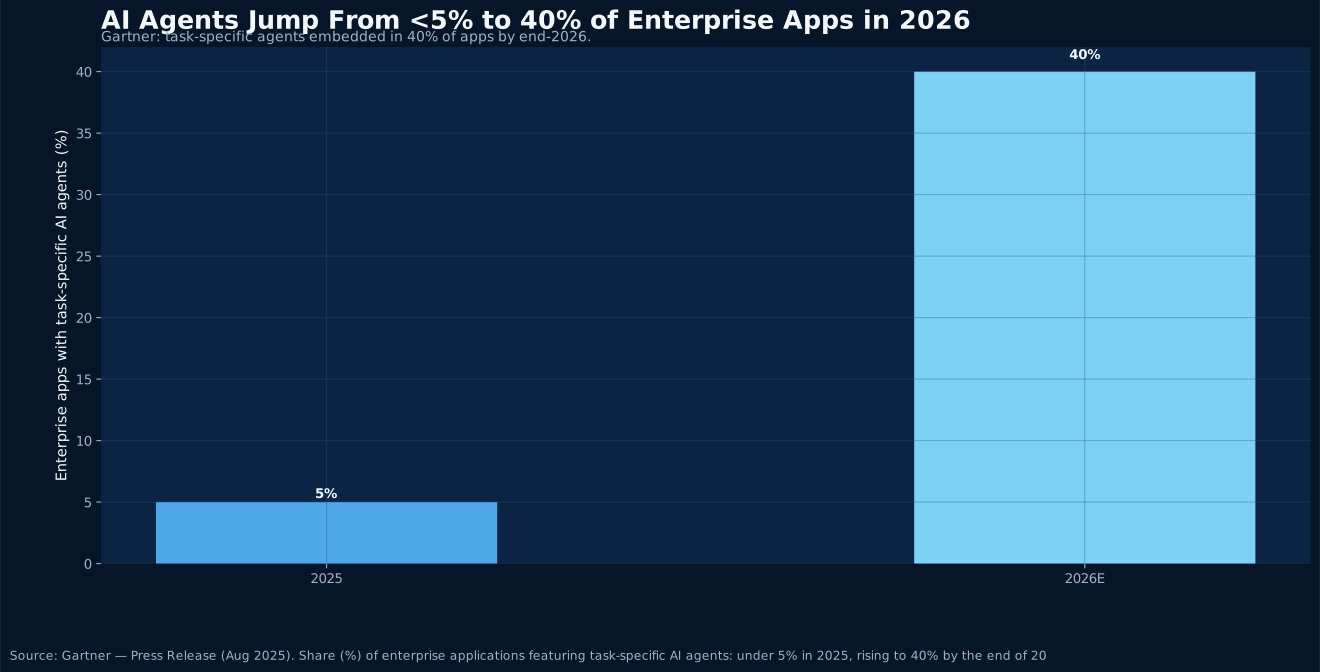
The pace is striking. Gartner expects 40% of enterprise applications to embed task-specific AI agents by the end of 2026, up from under 5% in 2025—roughly an eightfold rise in a single year. Agents are moving fast from experiments by a few frontier teams to a standard feature of mainstream software. From CRM and ERP to collaboration tools, more enterprise software now markets built-in agents as a differentiator.
Market size is expanding just as fast. Multiple firms estimate the 2026 global AI-agents market at $10.9-12.1B, growing at a 44-46% CAGR. More broadly, total global AI spending is forecast to reach about $2.59 trillion in 2026, up roughly 47% year over year, with agents seen as one of the fastest-growing and most deployable slices of that wave. The double push of capital and demand makes 2026 a genuine year one for agents.
The Deployment Gap: 79% Adopting, 11% in Production
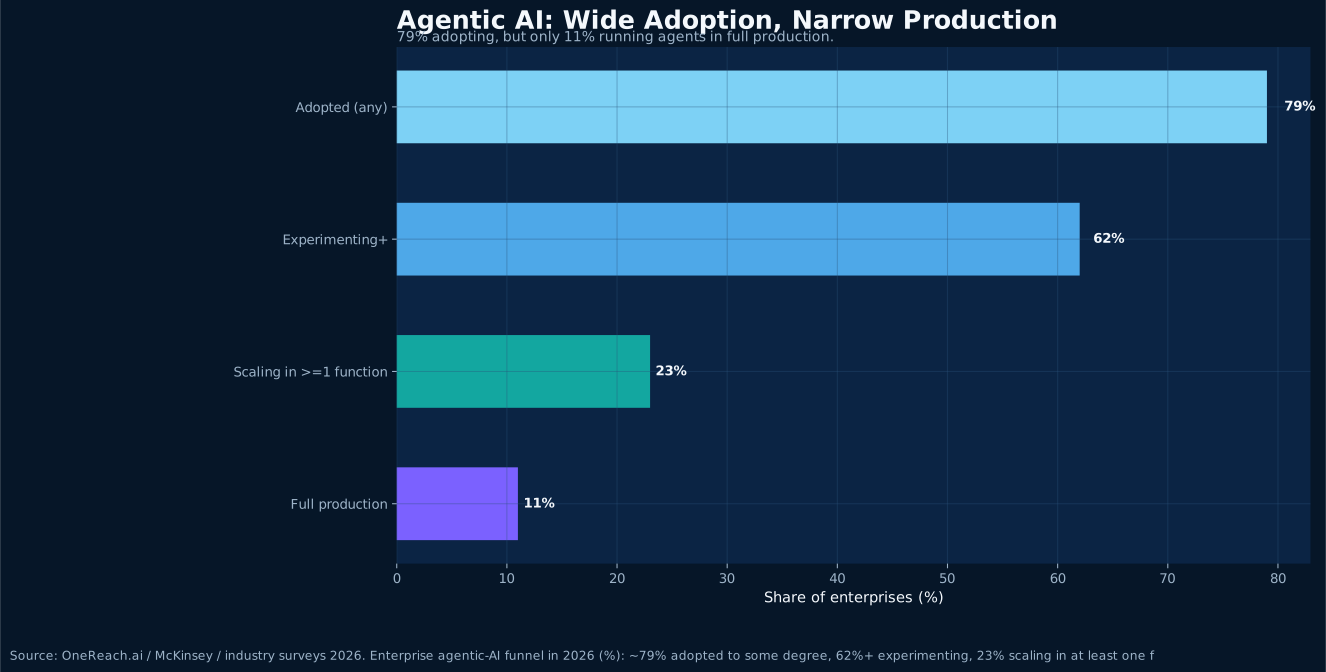
Beneath the buzz, the real deployment picture is more complex. Surveys show roughly 79% of enterprises have adopted AI agents to some degree and over 60% are experimenting or piloting, but only about 11% have reached full production—a figure that has barely moved across several quarters. In short, everyone is trying, few can ship is the truest portrait of agents in 2026. Between pilot and production lies a gap that is hard to cross.
The gap's roots are engineering and governance. Turning an agent that dazzles in a demo into a system that runs stably, safely and auditably in real business involves deep integration with existing IT, permission and data governance, error handling and human fallback, and tight cost control. A weakness in any link can leave a project as a perpetual pilot. That is why the competitive focus of enterprise AI in 2026 is shifting from can we build it to can we run it reliably.
40% May Be Canceled: Bubble or Growing Pains
A Gartner forecast has sparked wide debate: by the end of 2027, over 40% of agentic AI projects may be canceled, driven by rising costs, unclear business value and inadequate risk controls. The warning does not deny agents' value; it corrects today's AI-for-AI's-sake rush to launch. Many projects start hastily without clear ROI math or scenario fit, and are halted when inputs and outputs fall out of balance.
Seen rationally, this looks more like the inevitable growing pains of diffusion than a bursting bubble. Historically, from enterprise software to cloud computing, every tech wave came with many failed early projects, and real value often emerged only after a shakeout. The lesson for enterprises is clear: rather than chasing the concept, start from concrete, high-value, quantifiable, risk-manageable scenarios—go deep on one before going wide on many—so agents truly serve business goals rather than a technology narrative.
Implications for China-Korea Enterprises and Trade Services
For enterprises and trade-service providers in China and Korea, the agent wave is a tangible chance to re-engineer efficiency. In cross-border trade, agents can automate high-frequency yet tedious steps—inquiry responses, quote comparisons, order and logistics tracking, compliance-document checks—freeing people from repetitive work to focus on relationships and judgment. Firms that embed agents into workflows early can build meaningful advantages in response speed and operating cost.
But deployment must stay pragmatic. The advice is to start from a single, quantifiable, high-value step (such as first-round automated responses to customer inquiries), define ROI and risk boundaries, keep necessary human fallback, then expand gradually. MO-TEK is closely tracking agentic AI across the foreign-trade chain—exploring its use in customer development, market intelligence and operational efficiency—and is glad to share practice with Chinese and Korean clients to capture this enterprise-AI dividend together.