A Trillion-Dollar Wave: The AI Compute Arms Race Goes White-Hot
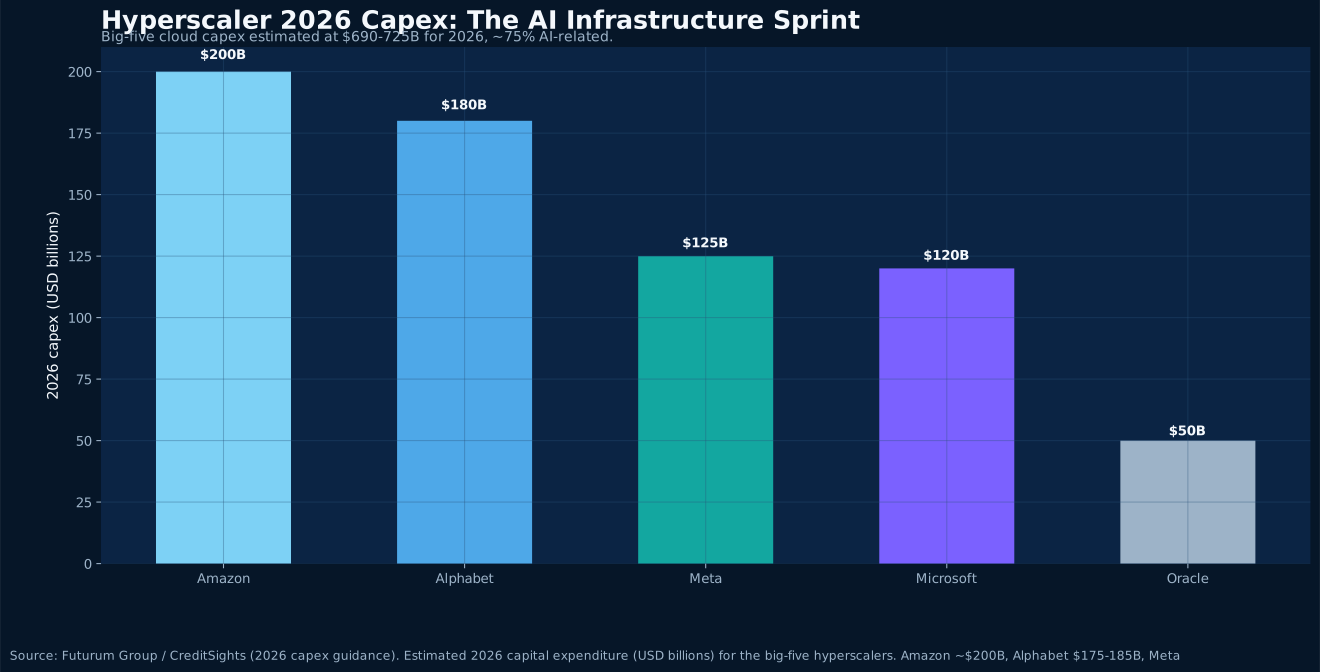
The most certain tech narrative of 2026 is the colossal investment in AI infrastructure. As training and inference demand keep climbing, the world's hyperscalers are pouring unprecedented capital into data centers, GPUs and supporting facilities. Aggregating multiple estimates, Amazon, Alphabet, Meta, Microsoft and Oracle are together expected to spend $690-725 billion in 2026 capex, up roughly 36-64% over 2025. Such growth is rare even by tech-history standards and marks a white-hot phase in the compute race.
The structure of that spend matters even more. Of these hundreds of billions, about 75%—roughly $450 billion—goes directly to AI-related infrastructure: AI servers, GPUs, accelerators and purpose-built data centers, rather than traditional cloud. AI has shifted from a frontier technology to the core engine driving capital allocation at the world's largest tech firms. Put differently, whoever builds enough compute first holds the ticket to the next stage of competition.
Five Giants in the Arena: From Amazon's $200B to Oracle's Catch-Up
Broken down by company, the scale is just as striking. Amazon's 2026 capex is seen at ~$200 billion, the largest, mostly (though not only) for data-center build-out; Alphabet at $175-185 billion; Meta at $115-135 billion; Microsoft tracking toward $120 billion or more; and Oracle targeting ~$50 billion as a fast-moving latecomer. Stacked together, these five curves form the capital bedrock under global AI compute.
Widen the lens beyond hyperscalers—adding emerging neocloud providers, sovereign-AI programs and national cloud players—and total global data-center capex for 2026 is revised above $1 trillion. AI, in other words, is spawning an entirely new infrastructure market measured in trillions. For upstream equipment, chips, networking, cooling and power supply chains, this is a historic window in which demand is concentrated, amplified and unusually certain.
The Power Bill Behind the Compute: Electricity Use Doubles in Five Years
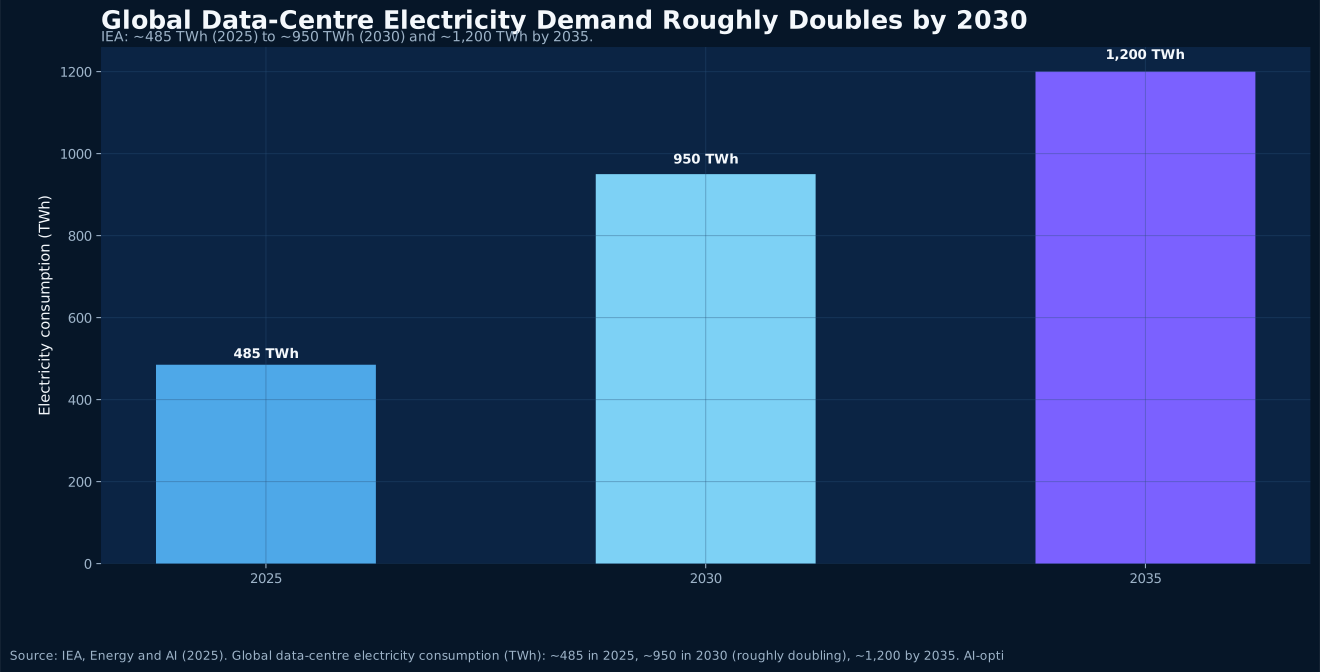
The flip side of vast compute is equally vast power consumption. Per the IEA's Energy and AI report, global data-center electricity use is projected to roughly double from ~485 TWh in 2025 to ~950 TWh by 2030, rising further to ~1,200 TWh by 2035. AI-optimized data centers grow fastest, with their electricity demand set to more than quadruple by 2030. AI's share of total data-center power could jump from 5-15% in recent years to 35-50% by 2030.
Power is thus shifting from a hidden cost to a hard constraint on how fast AI can scale. US data-center demand in 2026 is seen at ~260 TWh and Europe at ~150 TWh, with China in between. Grid capacity, transformers, distribution gear, backup power and even nearby generation are becoming a shared focus for tech firms and governments alike. For supply chains, the spillover into power equipment and energy infrastructure is amplifying in lockstep with compute itself.
Supply-Chain Spillover: From GPUs to Cooling and Power Gear
The real force of trillion-dollar capex is how it propagates layer by layer through the supply chain. At the top are AI chips and high-bandwidth memory (HBM), followed by servers, switches and optical modules, then racks, liquid-cooling systems, plus uninterruptible power, transformers and distribution units. Each link sees a demand jump from dense AI data-center construction. Liquid cooling and high-power-density delivery in particular have shifted from optional to essential for high-compute clusters, sharply improving order visibility.
For China and Asian manufacturing, this is a clear window of opportunity. China holds mature capacity and cost advantages in power equipment, copper interconnects, racks, cooling modules, optical components and passive parts—well placed to absorb sourcing demand spilling out of global data-center build-outs. For a trade and sourcing partner like MO-TEK, the key is identifying which sub-categories sit in the acceleration zone and helping overseas buyers lock in reliable supply before capacity tightens.
The Road Ahead and Its Risks: Can Heavy Spending Pay Off?
Spending on this scale is not without controversy. Skeptics worry whether AI monetization can keep pace with investment; if demand disappoints, heavy depreciation could weigh on profits and even create infrastructure overcapacity. Power availability, chip capacity, rising memory costs and build timelines are all real execution constraints. In Q1 2026, memory-cost inflation already pushed up per-unit data-center costs—a reminder that this track is not frictionless.
Over the medium term, however, the direction of AI compute demand is fairly clear, and major players show resolve to keep investing. For supply-chain participants, the rational move is not to bet on a single scenario but to position along higher-certainty links—power, cooling, interconnect and basic components—the underlying support needed however AI applications evolve. Pacing well, securing reliable capacity, and watching cost and lead-time shifts is the pragmatic way through this investment cycle. By Minghao, Shanghai MO-TEK International Trade (MO-TEK).