Year One of Commercialization: From Lab to Factory Floor
After years of technical groundwork, 2026 is widely seen as year one of humanoid commercialization. At CES 2026 early this year, humanoids stole the show, with multiple vendors demonstrating prototypes capable of real tasks. Goldman Sachs expects global humanoid shipments of 50,000-100,000 units in 2026. Modest next to cars or phones, the figure nonetheless marks a pivotal turn: the industry is moving from research demos and small pilots into genuine scaled production.
Driving the leap is the simultaneous maturing of several technologies: large models give robots stronger environmental understanding and task planning (so-called embodied or Physical AI), motor and actuator costs fall, and battery and sensor performance improves. As general-purpose humanoids gain the ability to perform repetitive labor in factories, warehouses and service settings, their potential market moves from imagination to reality—drawing in a flood of capital and supply-chain players.
Market Size: From Tens of Billions to a Trillion-Dollar Imagination
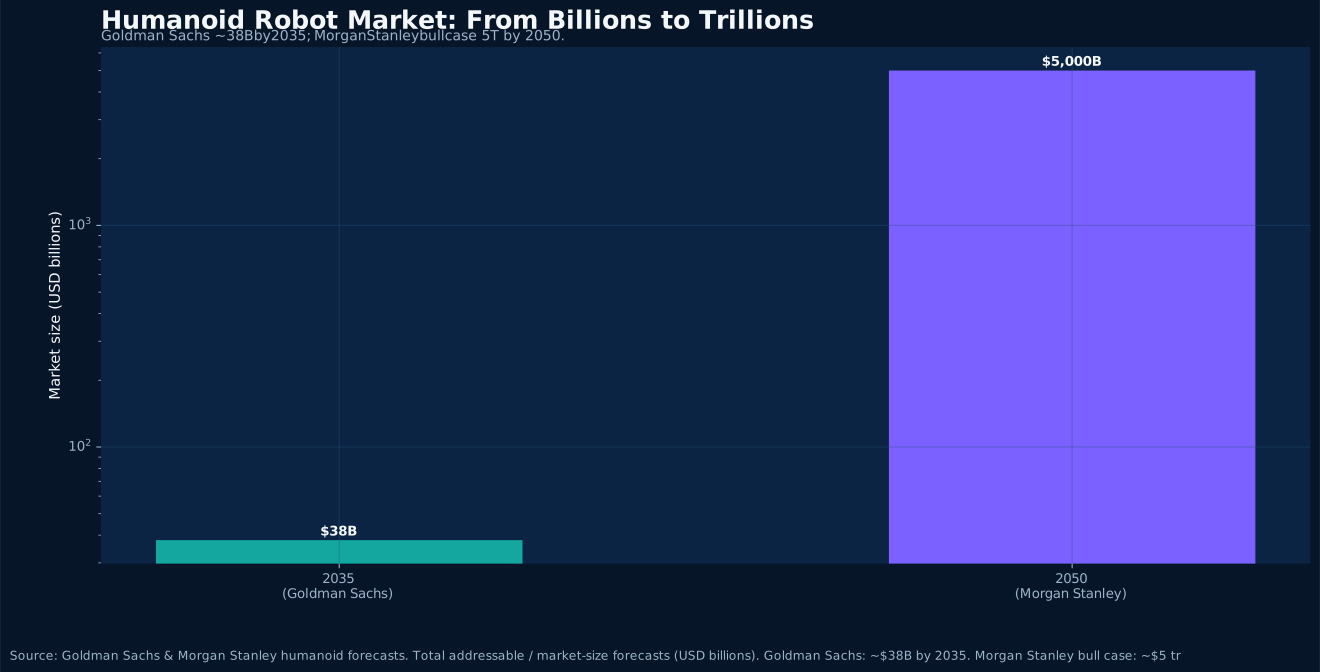
On market size, institutions offer wildly different but directionally aligned forecasts. Goldman Sachs sees the global humanoid market reaching ~$38 billion by 2035—a relatively cautious, higher-visibility medium-term call. Morgan Stanley paints a longer, bolder picture: by 2050, the global humanoid market could reach ~$5 trillion in a bull case. The order-of-magnitude gap reflects different assumptions about adoption speed and application depth.
It bears stressing that these long-range forecasts are scenario analyses, not precise point estimates; realization depends heavily on the pace of technology maturation, cost decline and deployment. Yet even on conservative readings, humanoids are already enough to become—after EVs and smartphones—another hardware platform that could reshape manufacturing and services. For the supply chain, the point is not to argue over endgame numbers but to spot the inflection where demand scales and which links benefit first.
Deployment Trajectory: From 100,000 to a Billion
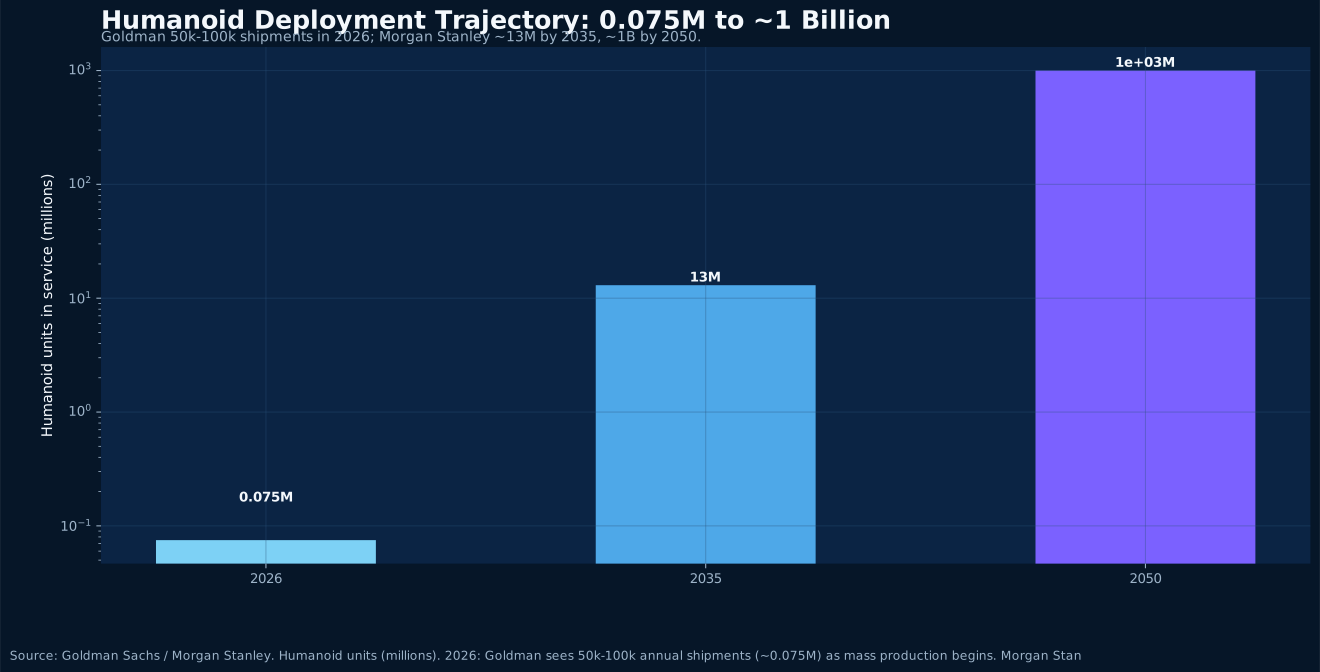
If market size depicts value, deployment maps the physical path of adoption. Combining Goldman and Morgan Stanley, 2026 global annual shipments are ~50,000-100,000 units—an early stage; Goldman sees annual shipments potentially topping one million by the early-to-mid 2030s. Morgan Stanley offers a longer deployment curve: ~13 million humanoids in service by 2035, climbing to over one billion by 2050.
A key variable behind this explosive growth is cost. Morgan Stanley expects unit prices to fall from ~$200,000 today to ~$50,000 in wealthy markets. Rapid cost decline opens the demand gates across industry, logistics and even the home—much like the cost curves EVs and solar once rode. Once a single robot's payback period shrinks into a range businesses accept, deployment growth tends to be nonlinear.
Supply-Chain Opportunity: Actuators, Reducers and Sensors
The humanoid supply chain is complex and precise, creating vast incremental room for upstream components. A humanoid typically has dozens of degrees of freedom, each joint needing a motor, a reducer (harmonic or planetary), a torque sensor and a controller—plus dexterous hands, vision and tactile sensors, batteries, and the AI chips that carry embodied intelligence. Many of these links are exactly where Chinese manufacturing holds scale capability and cost competitiveness.
For buyers and trade partners, humanoids mean a new supply chain still early but with high growth certainty. Harmonic reducers, coreless motors, force-control sensors, lightweight structural parts and precision-machined components could all see demand scale over the coming years. The value of a partner like MO-TEK is connecting overseas OEMs and component makers with mature Chinese suppliers, building stable, traceable supply relationships before capacity gets crowded.
Risks and Reality: The Twin Tests of Use Case and Cost
Amid the hype, level-headedness matters too. For humanoids to truly scale, two real thresholds remain: reliable use cases and an acceptable total cost of ownership. Many demos still occur in controlled settings; robustness, safety and battery life in complex, unstructured environments are unproven. If lofty expectations arrive too early and go unmet, a phase of market correction and cooling investment could follow.
Over a longer cycle, however, aging labor forces, manufacturing worker shortages and rising service costs give humanoids a real and durable demand base. For supply-chain participants, the pragmatic stance is neither to chase the concept blindly nor to ignore a track whose certainty is rising. Positioning along components, sensing and precision manufacturing—while watching the mass-production cadence and cost inflection—is how to benefit steadily from this emerging hardware wave. By Minghao, Shanghai MO-TEK International Trade (MO-TEK).