From Lab to the Eve of Mass Production: Why Solid-State Carries Such Hopes
Solid-state batteries replace the liquid electrolyte of conventional lithium-ion cells with a solid electrolyte, and are widely seen as the core direction for next-generation energy storage. Their appeal rests on three pillars: higher energy density means longer range in the same volume; a non-flammable solid electrolyte sharply reduces thermal-runaway and fire risk, lifting safety; and a wider operating-temperature window improves stability in harsh environments. For EVs, grid storage and consumer electronics, these traits hit the industry's pain points squarely.
Accordingly, major cell makers and automakers have invested intensively over the past few years. From patent counts to pilot lines, from electrolyte chemistry choices to process validation, solid-state has moved from concept to an engineering grind. The key question in 2026 is no longer whether it can be made, but when it can be scaled at an acceptable cost. That leap from zero to one, and then from one to a hundred, is the narrative the industry is watching most closely.
Market Size: Aligned on Direction, Split on Magnitude
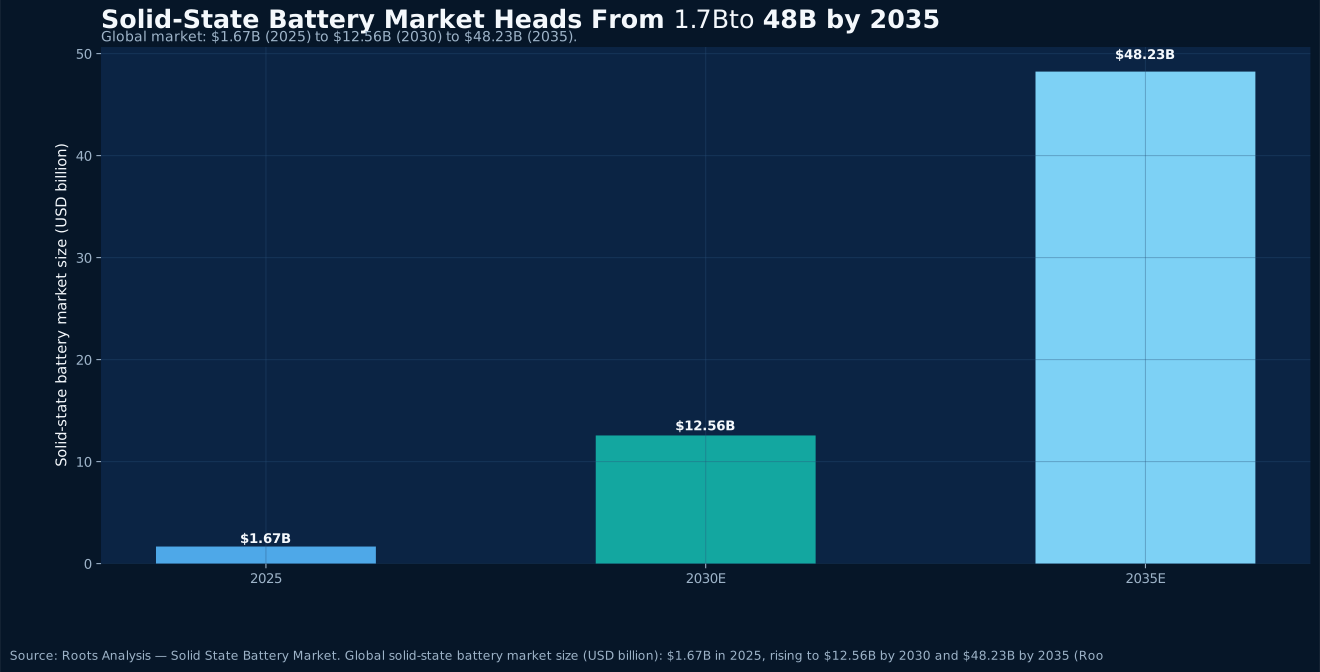
On the forecasts, the growth direction is highly consistent. Roots Analysis expects the global market to rise from ~$1.67B in 2025 to $12.56B by 2030 and $48.23B by 2035, a CAGR in the tens of percent. Grand View Research sees ~$1.6B in 2025 reaching $15.65B by 2033 at about 31.8% CAGR; most firms' mid-term reads point to a steeply rising curve.
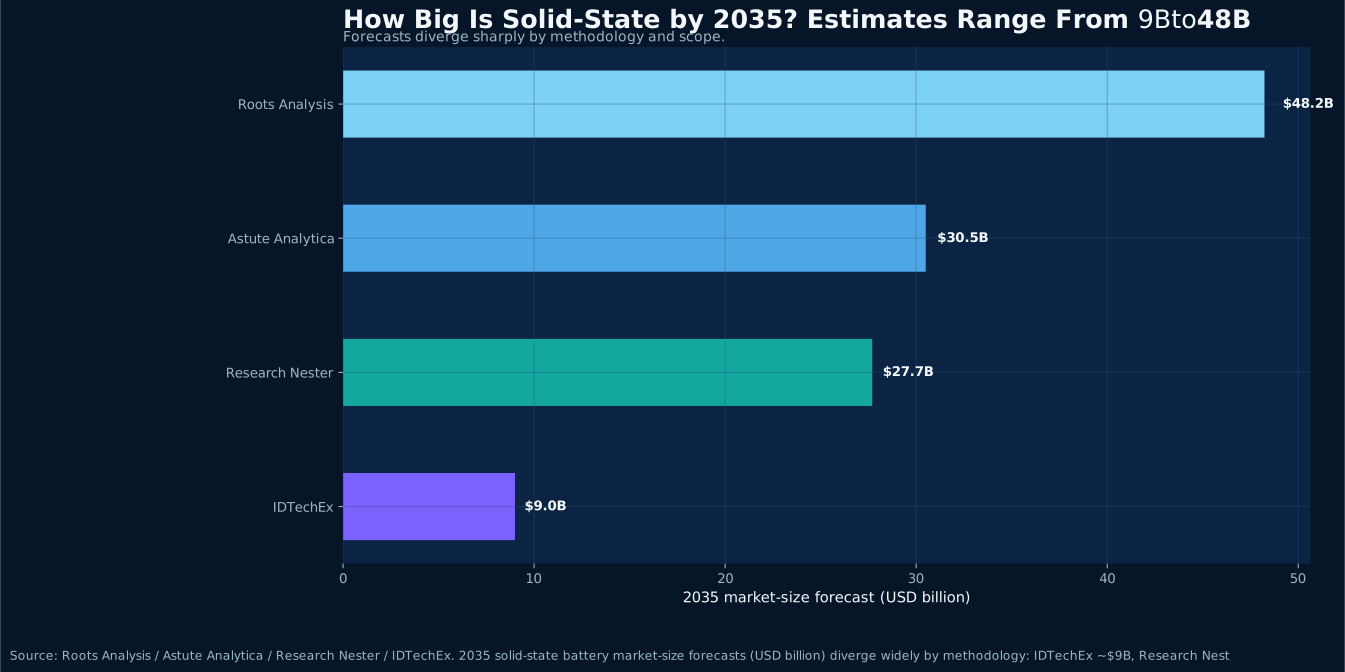
For the longer-dated 2035 view, however, the spread is wide. IDTechEx is conservative at ~$9B; Research Nester ~$27.7B; Astute Analytica ~$30.5B; and Roots Analysis the most bullish at ~$48.2B. That $9B-to-$48B band—a more-than-fivefold range—essentially encodes different assumptions about the timing of mass production, the pace of yield ramp, and the cost-down curve. The commercialization tempo remains the single biggest variable setting the market ceiling.
A Three-Nation Contest: Toyota, Samsung SDI and China's Battery Bloc
In the technology and production race, Japan, Korea and China form the front rank. Toyota holds over 1,300 solid-state patents and is building sulfide-electrolyte pilot facilities with Idemitsu Kosan, targeting 2027-2028 for production. Samsung SDI is betting on both oxide and sulfide routes, with a $3.4B Suwon facility slated to begin solid-state pilot production in 2026-2027, aimed at premium EVs. Japanese and Korean players generally enter via an energy-density-plus-premium positioning.
China's bloc leans on scale and supply-chain integration. CATL and BYD have each announced solid-state R&D milestones, while GAC, FAW and Geely advance pilots and small-scale production; Beijing has earmarked over $4.5B for next-generation battery technology under the 14th Five-Year Plan. Broadly, China emphasizes cost and capacity ramp, Japan and Korea emphasize the technology high ground, and the three paths converge on the same 2027-2028 mass-production window.
Production Hurdles: Cost, Yield and the Interface Problem
Despite the allure, the road to mass production is bumpy. One core engineering challenge is the solid-solid interface: contact between electrode and solid electrolyte is less complete than with a liquid, prone to interfacial resistance, lithium dendrites and volume expansion that hurt cycle life and fast-charging. The sulfide route offers high energy density but is moisture-sensitive with demanding production environments; the oxide route is stable but brittle and hard to process. Each path has process gates to clear one by one.
Cost and yield are the other threshold. Material and manufacturing costs for solid-state remain well above mature liquid lithium cells, with economies of scale yet to kick in; the yield ramp from pilot to volume is typically measured in years. That helps explain why 2035 market forecasts diverge so widely—if yield and cost fall faster than expected, the bullish case holds; if process bottlenecks persist, the conservative case is likelier. Industrialization is an endurance race, not a sprint.
Implications for Supply Chains and China-Korea Trade
For firms on the front line of China-Korea trade, solid-state industrialization is both an opportunity and a warning. The opportunity: solid-state chemistries will reshape upstream material demand, creating entirely new shopping lists for sulfide electrolytes, solid cathodes and anodes, specialty separators and packaging, and dry-electrode equipment. Connecting early with capable Chinese material and equipment suppliers can lock in capacity and pricing before volumes ramp—precisely where a trade partner can add value.
The warning: routes have not converged—oxide, sulfide and polymer paths coexist, and betting wrong can strand inventory and certification costs. The pragmatic stance is a flexible, multi-route, multi-supplier posture, watching the production milestones of Toyota, Samsung SDI and CATL as weathervanes, and seizing sample and pilot cooperation across China, Japan and Korea ahead of the 2027-2028 window. MO-TEK will keep tracking this race and support clients with sourcing, matchmaking and compliance.