From Research to Commerce: The Inflection Nears
Quantum computing has long been labeled a technology of the future, but the signs in 2026 suggest it is nearing the inflection from research to commerce. Unlike classical computers that use bits (0 or 1), quantum machines exploit the superposition and entanglement of qubits for exponential parallelism on certain problems. That makes them promising for molecular simulation, combinatorial optimization, cryptography and machine learning—precisely the hard problems classical compute struggles to solve efficiently.
What is bringing the inflection closer is not only rising qubit counts but the maturing of Quantum-Computing-as-a-Service (QCaaS). IBM, AWS, Microsoft and Google now open quantum compute to enterprises via the cloud, letting finance, pharma and materials firms experiment without building costly hardware. The parallel evolution of business model and technical capability is pushing quantum from the lab into real industrial use cases.
Market Size: A $20.2B Rendezvous in 2030
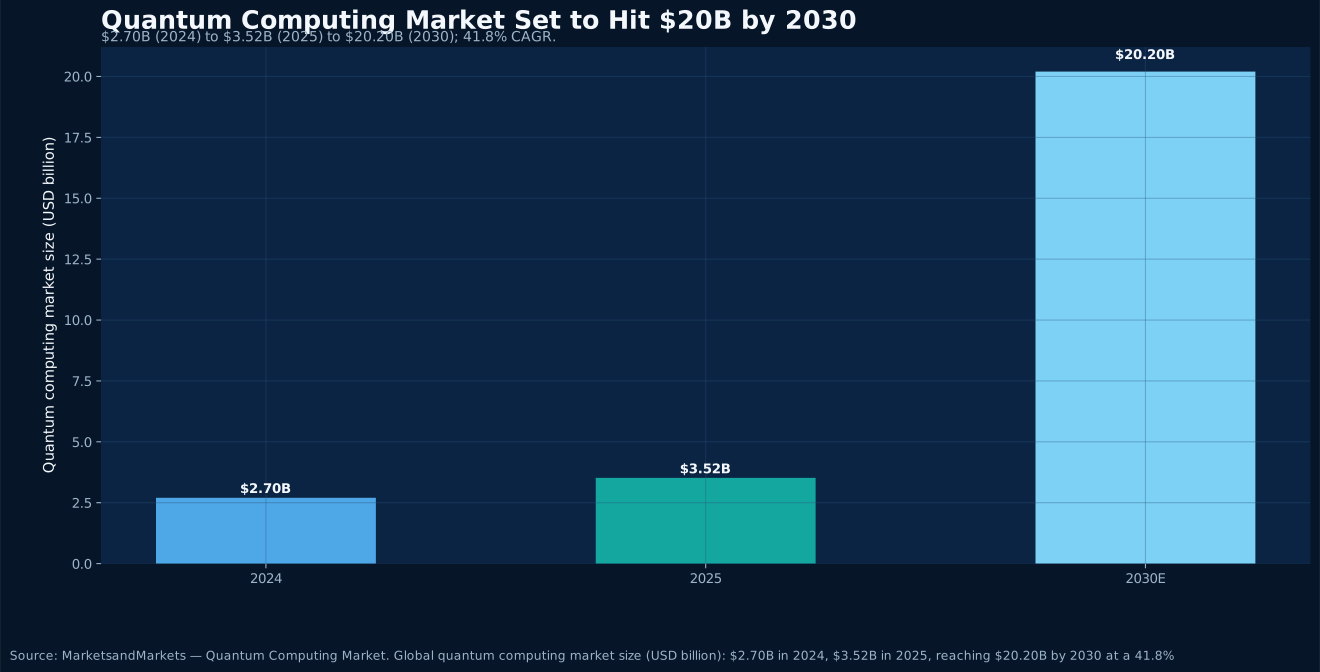
Forecasts trace a steep growth curve. MarketsandMarkets estimates the global quantum-computing market rising from $2.70B in 2024 and $3.52B in 2025 to roughly $20.20B by 2030, a 41.8% CAGR. Services—including QCaaS—hold the largest share, and cloud deployment is seen as the dominant future form, reflecting how on-demand access is becoming the main way enterprises tap quantum compute.
To be clear, firms differ widely on scope and size: Grand View Research offers a more conservative mid-term figure of about $8.0B by 2033 at a ~22.3% CAGR. The divergence stems from differing expectations of when practical quantum advantage arrives. But on any definition, sustained high growth over the next five-to-ten years is near-consensus, and BFSI demand for portfolio optimization, fraud detection and next-generation cryptography is viewed as the most certain early landing zone.
The Qubit Race: From 105 to 4,000+
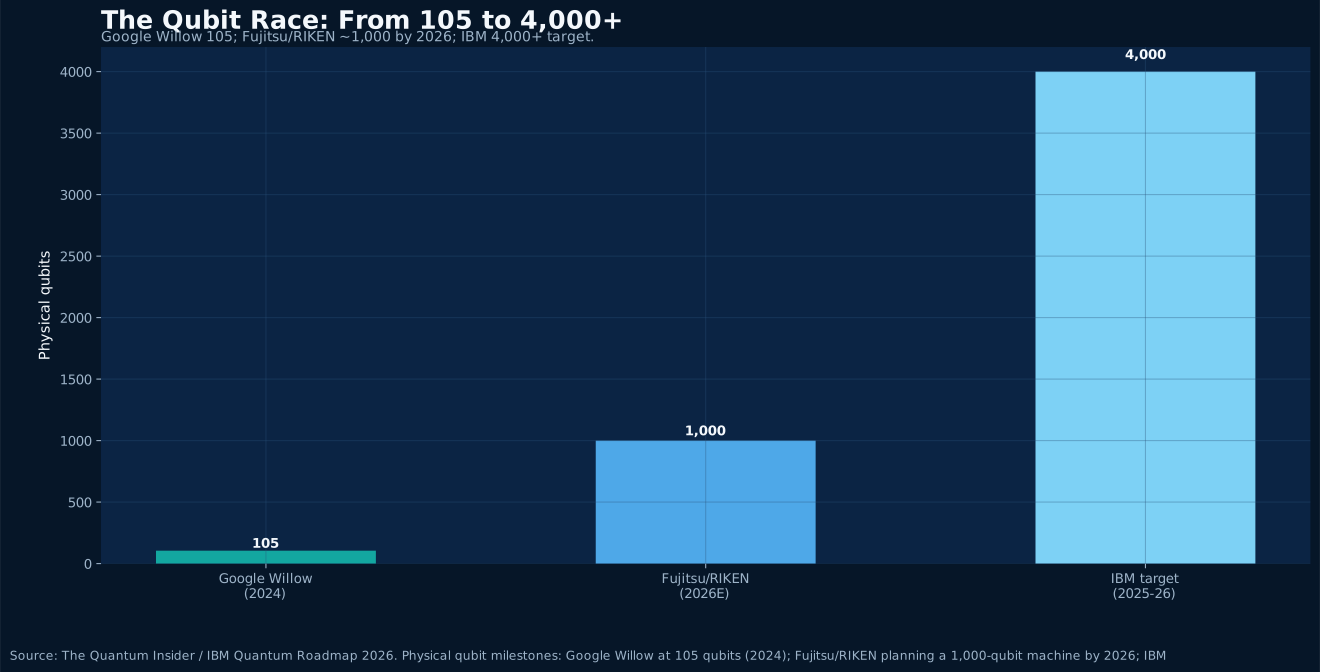
Hardware progress is the foundation of commercialization. Google's Willow carries 105 superconducting qubits and achieved a landmark in error correction—as qubit count rises, the logical error rate falls rather than climbs, a key step toward a practical, error-corrected machine, which Google targets for 2029. Fujitsu and RIKEN plan a 1,000-qubit machine in 2026, while IBM sets a system target above 4,000 qubits and maps a quantum supercomputer able to run billion-gate circuits by 2033.
A caveat: physical qubit count is not the only metric. Coherence time, gate fidelity, connectivity and error-correction overhead together determine a machine's truly usable power. The field is shifting from racing on physical qubits to racing on logical qubits—high-quality, stably usable qubits after correction. That shift moves the competitive focus from sheer scale to engineering quality: whoever first pushes error rates below the practical threshold gets to define the real starting line of quantum commerce.
Applications and the Crypto Risk That Demands Action Now
Quantum's early commercial value concentrates where classical compute struggles. In pharma and materials, quantum simulation could accelerate molecular design and new-material discovery; in finance, quantum algorithms aid portfolio optimization, risk analysis and fraud detection; in logistics and manufacturing, complex combinatorial problems (routing, scheduling) are natural fits. What unites these is that even a few percentage points of efficiency gain translate into substantial economic value.
Alongside the opportunity sits a risk that cannot be ignored—harvest now, decrypt later. Adversaries may intercept encrypted data today and decrypt it once a sufficiently powerful quantum machine arrives. That means data with long-lived secrecy needs to migrate to post-quantum cryptography (PQC) now. For enterprises, quantum is not merely an optional upgrade but a security line that must be laid down in advance.
Implications for China-Korea Tech and Trade
For the tech and industrial ecosystems of China and Korea, quantum computing is a strategic race to track over the long run. China invests heavily in quantum communication and parts of quantum hardware, while Korea accelerates in quantum algorithms, sensing and industrial applications. The two have both competition and complementarity across talent, standards and supply chains. For trade and service firms, near-term direct hardware deals are limited, but addressable niche demand is already emerging around cryogenics, control electronics, specialty materials and software tools for quantum.
The more practical value is cognitive readiness. Firms should understand early how quantum may disrupt and benefit their industry—especially finance, pharma and logistics—assess the timeline for post-quantum cryptography migration, and watch for quantum-related emerging needs in partnerships with Chinese and Korean tech players. MO-TEK will keep monitoring quantum commercialization, helping clients build knowledge and supply-chain links before the technology matures.