AI Reshapes Both Attack and Defense
Cybersecurity has always been an arms race, and generative AI has pushed that race to new speed. On offense, AI makes phishing more convincing, social engineering more personalized, and malware generation and vulnerability discovery more automated, sharply lowering the barrier to attack. On defense, AI can analyze massive logs in real time, detect anomalous behavior, and automate response and remediation, freeing security teams from a sea of alerts. The same technology is arming both spear and shield.
This double-edged nature elevates cybersecurity from a cost center to the core of enterprise digital strategy. As AI applications spread everywhere — from internal knowledge bases to customer-facing agents — the corporate attack surface is expanding fast; every AI interface, every training dataset, every automated workflow can become a new entry point. Security is no longer an IT afterthought but the precondition for whether AI can be trusted and deployed at scale.
Market Size: $93.8 Billion of High-Certainty Growth
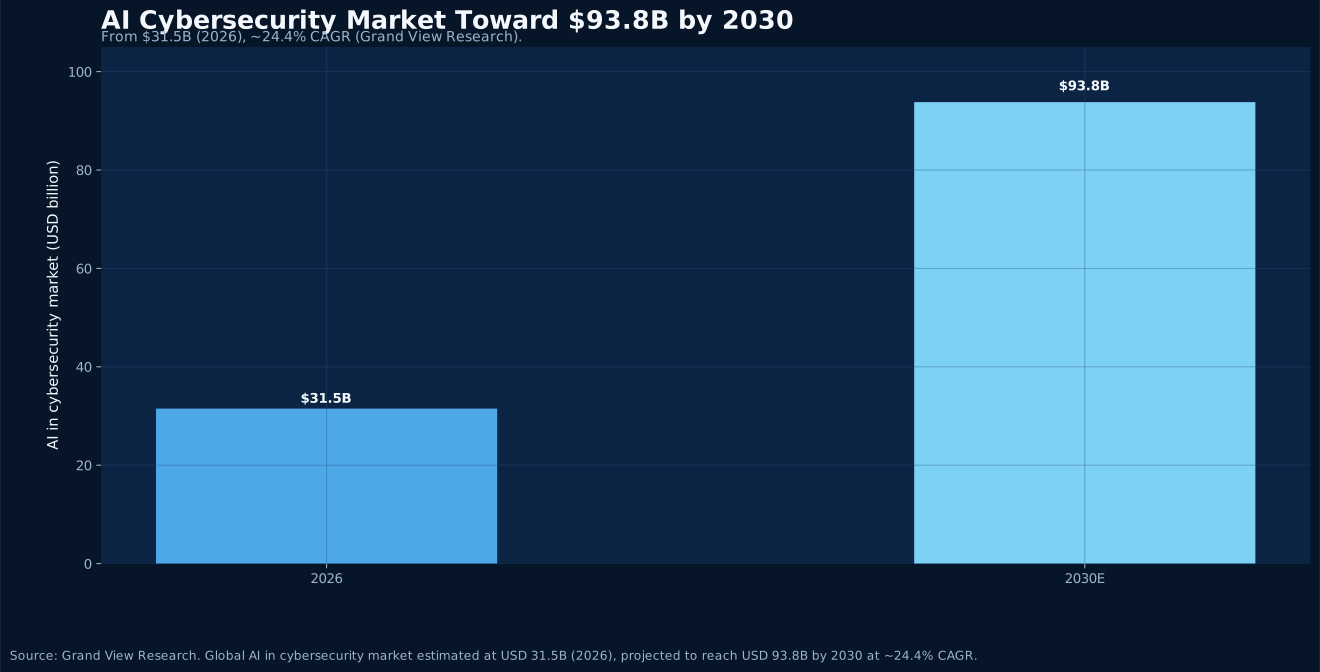
Market data confirms this strategic status. Per Grand View Research, the global AI-in-cybersecurity market was about $31.5B in 2026 and is projected to reach $93.8B by 2030 — nearly tripling in four years at a ~24.4% CAGR. While firms' specific figures differ, growth rates generally fall in the high 18%-to-28% range, reflecting a broadly favored track with very high growth certainty.
The underlying drivers are rigid: threat volume and complexity keep rising, compliance grows stricter, and the AI application boom keeps creating new risk exposure. Enterprises have no choice but to keep increasing security spend. For the industry, that means nearly every segment — from threat detection, identity and data protection to security-operations (SOC) automation — is being reshaped by AI, and each harbors new growth opportunities.
The Defense Dividend: IBM's $1.9 Million Finding
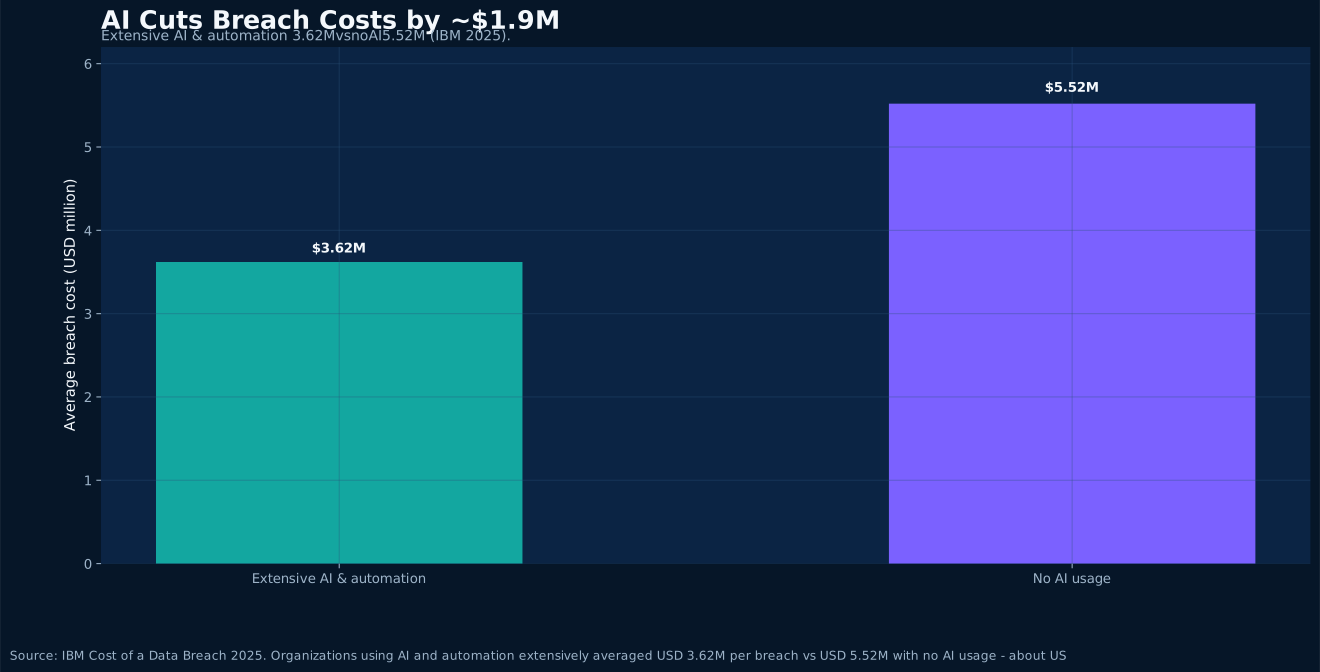
The value of AI defense is no longer theoretical. Per IBM's 2025 Cost of a Data Breach report, firms extensively deploying AI and automation averaged $3.62M per breach, while those using no AI reached $5.52M — a gap of about $1.9M. This difference stems mainly from faster detection and containment: AI-driven security cut the mean time to identify and contain a breach to 241 days, the lowest in nine years.
More broadly, the 2025 global average breach cost fell to $4.44M, down about 9% year over year — the first decline in five years. IBM attributes this turn mainly to the spread of security AI and automation. These numbers send a clear signal to decision-makers: deploying AI in cybersecurity is not just a defensive posture but a quantifiable cost saving and risk hedge — the return on investment is plainly visible.
Shadow AI and New Types of Risk
Yet AI does not bring only dividends. IBM's report specifically warns of shadow AI — employees using unapproved external AI tools to handle company data. A high level of shadow AI adds about $670K to the average breach cost. Such ungoverned AI usage bypasses a firm's existing data governance and security boundaries, becoming the most easily overlooked yet fast-growing source of risk in 2026.
This reminds us that AI security is not simply buying an AI defense product, but requires systemic support in governance, process and culture: clear AI-use policies, controlled data flows, and security assessments of AI systems themselves. The real winners will be organizations that both harness AI to raise defensive efficiency and effectively contain the new risks AI brings. Which way the attack-defense balance tips depends on governance capability, not procurement alone.
The Path for Chinese and Korean Enterprises
For enterprises in both China and Korea, AI cybersecurity is both a defensive challenge and an industrial opportunity. Both economies are large, manufacturing-heavy and export-oriented, with huge security needs across cross-border data flows, supply-chain coordination and the industrial internet. Both have accumulated strengths in AI algorithms, security products and compliance services, leaving broad room for cooperation and complementarity. As cross-border data compliance tightens, security and compliance capability is becoming a passport for firms going global.
For MO-TEK, cybersecurity matters on two levels. On one hand, as a cross-border trade-service provider, we must hold the security baseline for clients' data and transaction information. On the other, security and compliance capability is an important dimension in evaluating suppliers and serving customers. In an era where AI reshapes attack and defense, understanding and harnessing these tools is both self-protection and a key part of creating trust value for clients.