From Demonstration to Operations: The 2026 Watershed
The autonomous-truck story has been told for nearly a decade, but 2026 finally brings a qualitative leap. In the past, the industry lingered in closed-course testing and supervised operations with safety drivers. Now, leaders run fully driver-out commercial freight on real highways. This step matters because it turns the question from whether the technology can drive into whether the business can earn — milestones shift from demo videos to paid freight contracts.
Driving this watershed is the economics of long-haul freight itself. U.S. long-distance drivers are scarce and costly, and bound by legal Hours-of-Service limits; a driverless truck can run almost around the clock. On a ~1,000-mile corridor a human driver must rest mid-route, while the machine runs it non-stop. Once technical maturity and safety records reach a tipping point, shippers and carriers start treating driverless trucks as a real capacity option rather than a distant future.
Market Size: A $29 Billion Long, Thick Slope
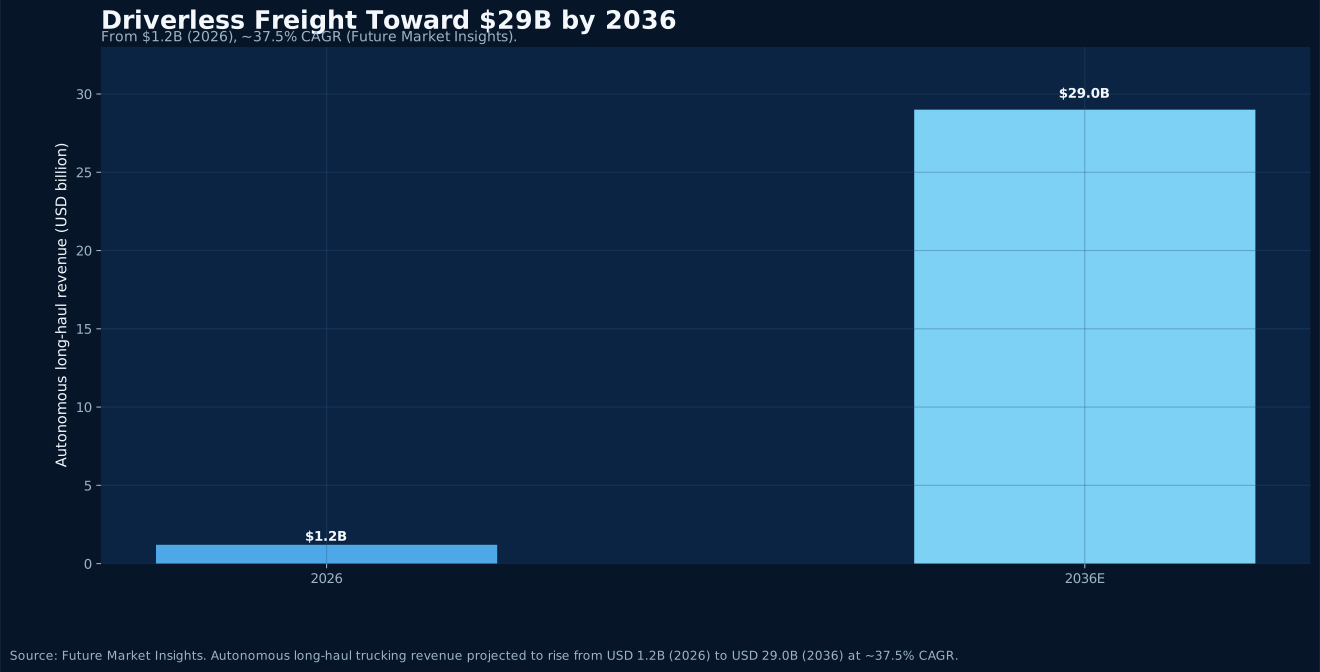
Research firms assign this track an exceptionally high growth outlook. Per Future Market Insights, global autonomous long-haul freight revenue will leap from about $1.2B in 2026 to roughly $29.0B in 2036 — more than 20x in a decade at a ~37.5% CAGR. Such a slope is rare among mature industries, reflecting strong market expectations for the inflection from zero to scaled operations.
A caveat: definitions of the autonomous-truck market vary enormously. Some count only fully driver-out long-haul revenue; others fold in whole-vehicle sales equipped with advanced driver assistance (ADAS), which can reach tens of billions of dollars. Understanding these definitional gaps avoids being misled by a single number. Either way, the direction is the same — a high-growth track moving from technical validation to commercial payoff.
Leaders: Aurora and Kodiak Push on Two Fronts
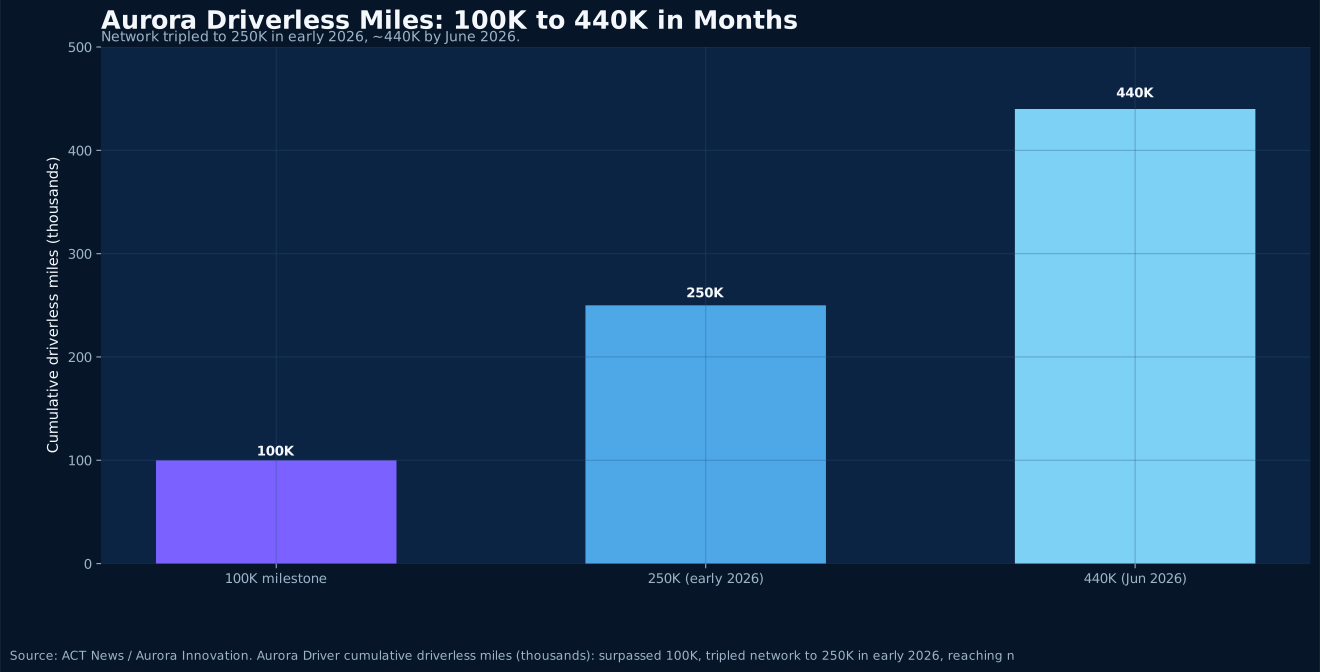
Mileage tells the story best. Per ACT News and Aurora disclosures, the Aurora Driver's cumulative driverless miles climbed fast in H1 2026: it first surpassed 100,000, then reached 250,000 as commercial routes expanded to ten and the network tripled, and neared 440,000 by end of June — with zero Aurora-attributed collisions. One ~1,000-mile Fort Worth-to-Phoenix corridor became the first autonomous freight lane exceeding human legal driving-hour limits.
Aurora's CEO told investors the company targets 200 driverless trucks and an ~$80M revenue run rate by year-end, with roughly 20 trucks rolling off the line per week in H2. Meanwhile, Kodiak expanded its driverless fleet to 20 and pioneered triple-trailer capability — theoretically tripling per-tractor capacity — while partnering with Bosch on production-grade hardware to pave the way for longer-haul driverless launches by year-end. The two leaders advancing together mark the industry's shift into a capacity-and-operations race.
Why Long-Haul Freight Lands First
Among all autonomous applications, highway long-haul freight is the first to prove a business model, for three reasons. First, highway environments are relatively structured and predictable — far simpler than city streets. Second, long-distance transport has a high labor-cost share and severe driver shortages, so the replacement value is greatest. Third, freight customers prize cost and on-time delivery, and accept driverless operation more readily than passenger mobility does. Together these make long-haul freight the most pragmatic commercialization entry for autonomy.
Notably, China's path differs from the U.S. China is advancing rapidly in autonomous commercial vehicles at ports, mines and trunk highways, leveraging a vast commercial-vehicle manufacturing and electrification base to explore an autonomy-plus-new-energy-commercial-vehicle combination. Differences in regulation, road conditions and business models across markets mean there will be no single winning template globally, but many blossoming points, each with its own character.
China-Korea View: Supply Chain and Commercial-Vehicle Opportunities
The autonomous-freight value chain is far more than software and algorithms. Lidar, cameras, domain controllers, by-wire chassis, HD maps, automotive-grade chips — even whole-vehicle manufacturing and aftermarket service — each is a sizable market. China holds cost and scale advantages in sensors, by-wire actuation, electrified chassis and vehicle manufacturing, while Korea has strengths in automotive semiconductors, precision components and system integration. This gives a solid basis for Chinese-Korean division of labor across the autonomous commercial-vehicle supply chain.
For MO-TEK, the opportunity lies in identifying the components on this chain with strong certainty and fast-rising localization, helping Chinese suppliers connect with Korean and global commercial-vehicle and logistics customers. The commercialization of autonomous freight has only just begun; the sooner one understands customers' stringent demands for automotive-grade quality, certification and long-term supply, the more one can build irreplaceable intermediary value on this high-growth track.