1. Why APEC 2026 matters so much for the China-Korea trade landscape
China hosts APEC in 2026, the first time since the 2014 Beijing APEC that China has led the highest-level Asia-Pacific economic cooperation agenda. The core themes of this APEC include supply chain resilience and connectivity, new digital economy rules, and green and sustainable trade. These are not abstract macro-policy discussions but directly relate to specific rule changes that affect the daily operations of China-Korea trade businesses. For example, the Supply Chain Connectivity Framework Action Plan (SCFAP III) is entering its final phase, with the end-of-2026 evaluation expected to conclude and initiate the next cycle’s action plan. As one of the most important bilateral trade axes within the APEC framework, China and Korea will be directly impacted by any new rule-setting in trade flows, customs clearance efficiency, and compliance requirements.
Korea’s APEC hosting in 2025 already laid important foundations for China-Korea cooperation. At the Gyeongju summit, Korea pushed for the integration of trade and technology agendas, particularly in critical minerals supply chain coordination and digital trade rules. After China takes over in 2026, deeper practical cooperation in supply chain investment, digital economy, and environmental and climate change areas is expected. The trend of China and Korea moving from competitive agenda-setting to complementary topic advancement within the APEC framework is becoming increasingly evident, creating a positive environment for bilateral trade businesses to participate in regional rule-making.
2. Structural shifts and resilience tests in China-Korea bilateral trade
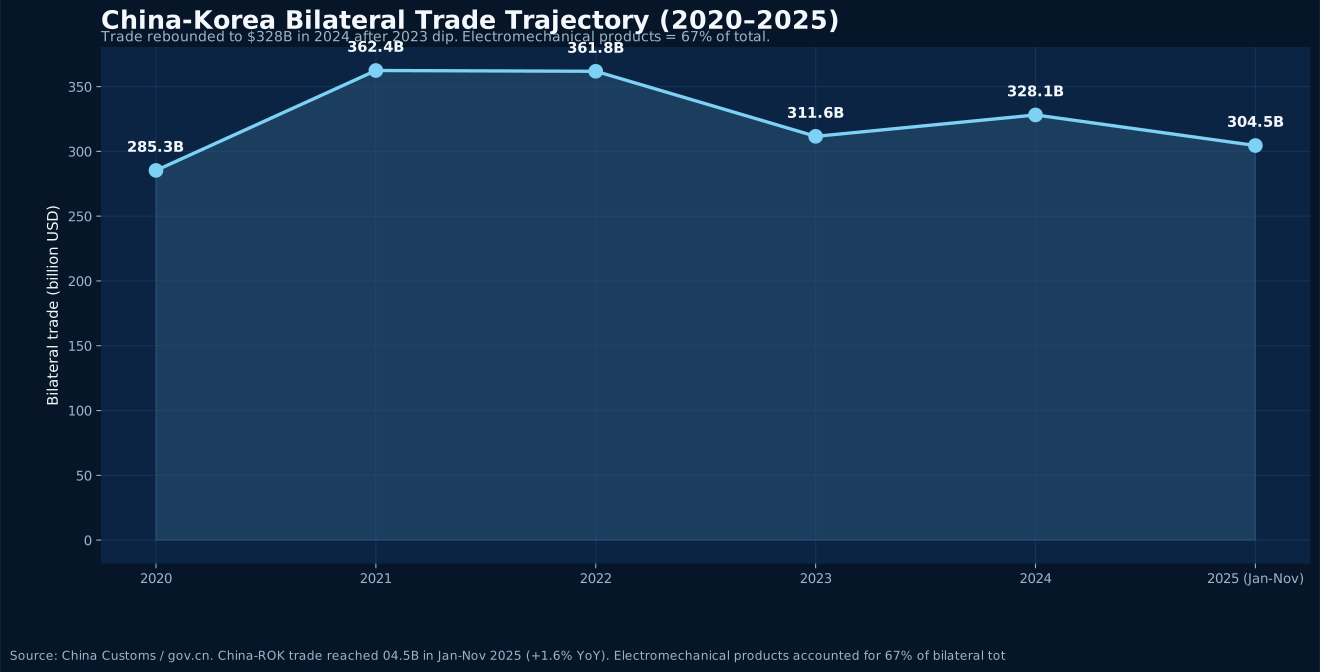
Trade data shows that China-Korea bilateral trade has stabilized after the 2023 correction. Bilateral goods trade reached $328.08 billion in 2024, up 5.6 percent year-on-year. Trade for January to November 2025 was $304.46 billion (approximately RMB 2.14 trillion), up 1.6 percent. The structural shift is notable: electromechanical products accounted for 67 percent of bilateral trade, up 5.9 percent; China’s imports of electronic components from Korea grew 9.9 percent, and computer parts and accessories increased 7.4 percent. This indicates that the core of China-Korea trade is shifting from commodities to high-tech intermediates.
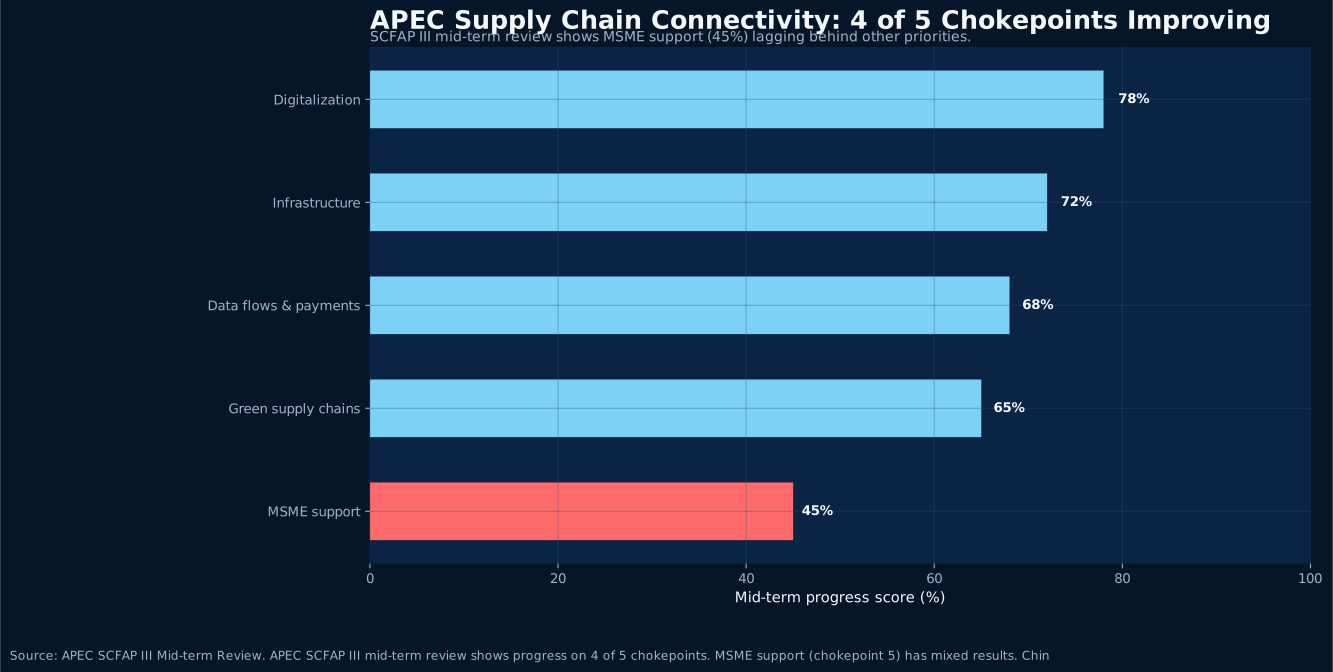
This structural transformation means that China-Korea trade resilience depends more on the continuity of technology supply chains than on simple price competition. Under APEC’s supply chain resilience theme, challenges that China and Korea need to address jointly include geopolitical disruptions to semiconductor supply chains, upstream material uncertainty from critical mineral export controls, and new requirements for cross-border data flow rules driven by digital transformation. The SCFAP III mid-term review shows that among five chokepoints, digitalization (78%) and infrastructure (72%) have progressed well, data flows and cross-border payments (68%) and green supply chains (65%) are improving, but MSME support (45%) lags significantly.
3. Digital economy rules: the new frontier of China-Korea cooperation within APEC
In the APEC 2026 agenda, digital economy rule-making has been elevated to an unprecedented priority. This carries particular significance for China-Korea trade. Electromechanical products, which account for 67 percent of bilateral trade, are increasingly dependent on digital systems for production, quality inspection, customs clearance, and after-sales service. Cross-border data flow rules will determine whether companies can efficiently transfer product specifications, quality data, customer information, and logistics tracking data between the two countries. If APEC can establish a more unified framework in this area, the digital efficiency of China-Korea trade will improve substantially.
At the same time, competition and cooperation in the cross-border e-commerce space between China and Korea will also be shaped by APEC digital economy rules. Chinese platforms like AliExpress and Temu have reached 8.88 million and 8.3 million monthly active users in Korea respectively, while Korea is also actively pushing the internationalization of domestic platforms. E-commerce rules discussions under the APEC framework will cover core topics including consumer protection, product liability, data localization, and tax compliance. For China-Korea cross-border e-commerce practitioners, understanding these emerging regional rules has more strategic value than tracking individual platform policy changes.
4. Green supply chains and carbon compliance: the next compliance frontier for China-Korea trade
The APEC SCFAP III mid-term review gave green supply chains a progress score of 65 percent, showing improvement but significant room to grow. For China-Korea trade businesses, green supply chains are no longer a nice-to-have but are becoming a hard market access requirement. The EU Carbon Border Adjustment Mechanism (CBAM) is already affecting the cost structure of steel, aluminum, and chemical products that both China and Korea export to Europe. Korea is also expanding and strengthening its own Korea Emissions Trading System (K-ETS). If APEC 2026 can reach regional consensus on green supply chain standards, carbon footprint mutual recognition, and green finance cooperation, it will provide China-Korea trade businesses with a clearer compliance pathway.
In specific China-Korea trade scenarios, green compliance impacts have already penetrated multiple industries. Korean construction demand for ZEB-certified glass continues to rise, Korean beauty industry requirements for packaging recyclability and carbon footprint are becoming stricter, and Korean battery industry ESG screening of upstream minerals is becoming a prerequisite for supplier selection. For Chinese exporters, suppliers who can provide carbon footprint data, ESG compliance certificates, and green product certifications will gain clear competitive advantages. APEC 2026’s rule advancement in this area will accelerate the institutionalization of this trend.
5. How China-Korea trade businesses can seize the APEC policy window
APEC 2026 provides China-Korea trade businesses with a rare window to participate in Asia-Pacific supply chain restructuring at the rules level. Specific recommendations include: first, monitor the APEC Business Advisory Council (ABAC) policy recommendation reports, which are typically released months before the leaders’ summit and represent the core demands of Asia-Pacific business communities regarding trade rules. The China Council for the Promotion of International Trade’s participation in the APEC Trade and Investment Committee meeting and Sustainable Supply Chain Forum in Korea in May 2026 is an important policy signal. Second, actively participate in APEC-related industry seminars organized by trade associations, especially on topics like digital trade rules, carbon compliance standards, and MSME support.
Third, leverage MSME support mechanisms within the APEC framework. The SCFAP III evaluation gave MSME support just a 45 percent progress score, indicating this area is still in early development. APEC 2026 is expected to launch new MSME cross-border trade support measures, including digital tools, cross-border payment facilitation, and trade financing channel expansion. For small and medium-sized trade companies operating between China and Korea, these measures may be more directly practical than the macro outcomes of FTA negotiations. Fourth, incorporate APEC policy trends into corporate medium and long-term strategic planning. Whether it is green supply chain compliance, cross-border data flow rules, or critical mineral supply security, the direction of these issues is already fairly clear. Companies that position themselves early will gain first-mover advantages when new rules take effect.