1. Why FTA Phase 2 matters far more than Phase 1 for China-Korea trade
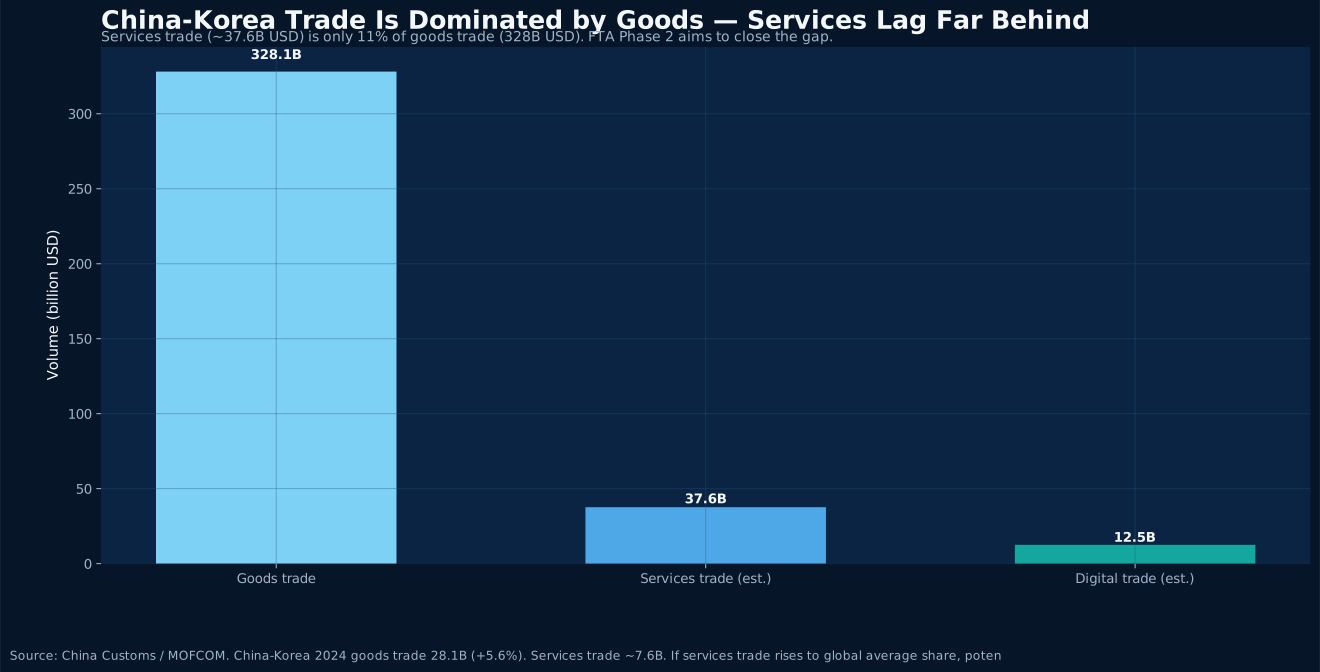
The first phase of the China-Korea FTA, which took effect in 2015, mainly covered tariff reductions on goods trade and delivered significant results. China-Korea goods trade reached $328.08 billion in 2024, up 5.6 percent year-on-year, with China remaining Korea’s top trading partner for the 21st consecutive year. But goods trade growth is increasingly constrained by both industrial structure and geopolitical factors. The real growth potential lies in services trade and investment. Current China-Korea services trade is estimated at around $37.6 billion, equivalent to just 11 percent of goods trade. If services trade were to reach the global average share of total trade, the China-Japan-Korea services market could exceed $130 billion.
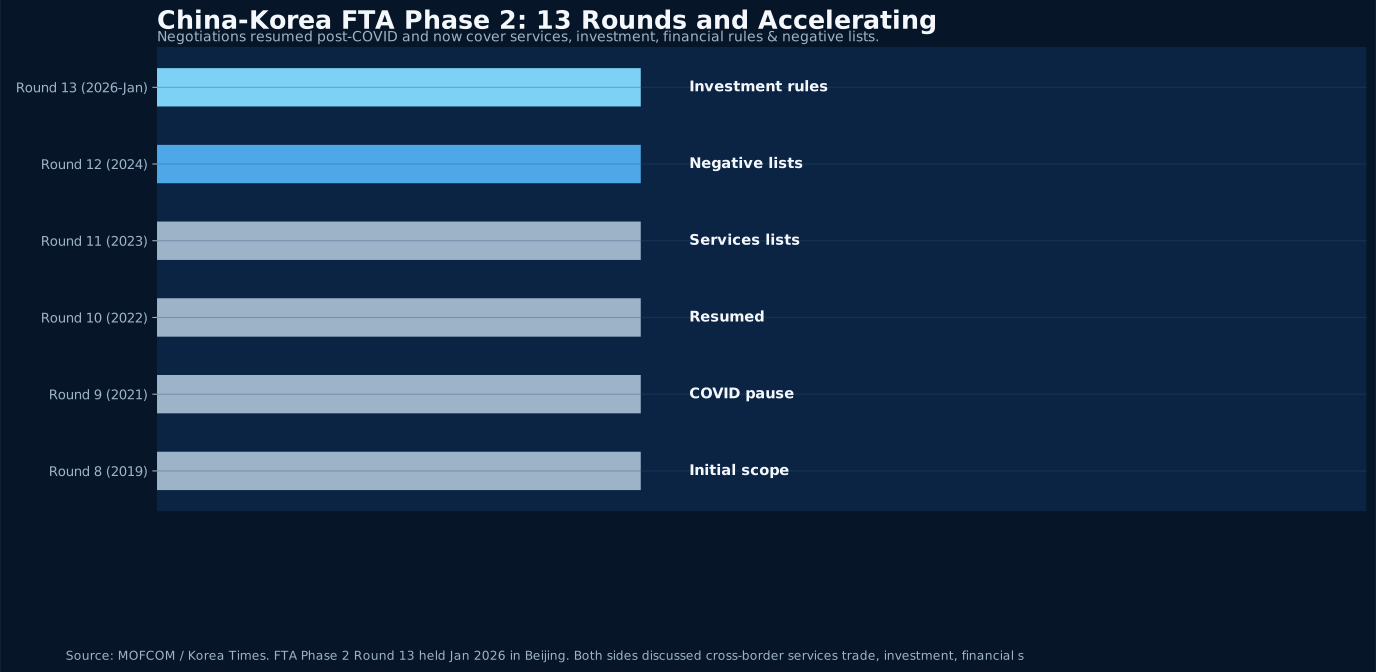
Phase 2 negotiations aim to fill precisely this structural gap. Compared to Phase 1, the core topics include cross-border services trade liberalization, bilateral investment protection, financial services rules, and negative list negotiations. Once these issues are resolved, they will directly affect the entry barriers for Korean companies to conduct consulting, IT outsourcing, cultural content licensing, and legal services in China, while also opening new channels for Chinese companies to enter Korea’s digital economy, tourism services, and professional services markets. For trade service providers operating between China and Korea, services trade liberalization means entirely new business categories and revenue streams.
2. What substantive progress was made in Round 13
The 13th round of Phase 2 negotiations was held in Beijing from January 19 to 23, 2026. According to MOFCOM, both sides held in-depth and constructive discussions on cross-border services trade, investment, financial services rules, and negative lists, following the consensus of both countries’ leaders, and achieved positive progress. A key signal from this round was the agreement to hold regular in-person meetings involving all relevant government agencies starting in 2026 to narrow remaining differences. Additionally, both sides plan to convene an additional ministerial-level trade meeting in the first half of the year to allow their top trade officials to directly review progress.
Korea has explicitly stated its goal of completing Phase 2 negotiations within 2026. In January 2026, President Lee Jae-myung visited China accompanied by the heads of Korea’s four major conglomerates, and both governments signed 15 core documents covering trade facilitation, investment protection, industrial and technology cooperation, and customs and quality inspection coordination. These high-level moves provide political momentum for the FTA negotiations. In terms of actual negotiation progress, the specific provisions of the negative lists remain the biggest challenge, particularly regarding the degree of opening in sensitive sectors such as financial services, telecommunications, and professional services. However, consensus is gradually expanding in softer areas like culture, tourism, and education.
3. What specific opportunities will services trade opening create
If FTA Phase 2 achieves a breakthrough in services trade, the most directly affected industries will include the following. First is the cultural and content industry. Korea has built formidable global competitiveness in film, music, and gaming content exports but has long been constrained by market access restrictions in China. If the services trade agreement can provide clearer rules for content licensing, co-production, and copyright management, it would significantly reduce compliance costs and uncertainty for Korean content companies entering China. Similarly, China’s emerging content and service formats such as short dramas, livestream e-commerce, and digital payments could enter the Korean market in a more structured way.
Second is the professional services and digital economy space. Korea’s IT consulting, software development, and design services enjoy strong global reputations, while China’s cloud computing, AI, and platform economy are rapidly expanding overseas. The complementarity between the two countries in these fields far exceeds competition. If Phase 2 can establish operational frameworks for cross-border data flows, e-commerce rules, and intellectual property protection, it would greatly promote bilateral digital services trade. Additionally, further opening of tourism services deserves attention. During the 2025 APEC summit hosted by Korea, positive progress was made on tourist visa facilitation between China and Korea, and China as the 2026 APEC host may push further in this direction.
4. How upgraded investment rules will affect China-Korea businesses in practice
The upgrade of investment rules in FTA Phase 2 is equally significant. Among the 15 core documents signed between China and Korea in January 2026, investment protection agreements hold a prominent position. For Korean companies, this means investments in China will receive clearer legal protections and dispute resolution mechanisms. For Chinese companies, Korea’s attractiveness as an investment destination will increase thanks to more transparent access conditions and national treatment commitments. Particularly noteworthy is the strong willingness from both sides to cooperate on investment in frontier areas including new energy, artificial intelligence, and biopharmaceuticals.
From a more practical perspective, clearer investment rules will benefit China-Korea trade companies in several ways: reducing uncertainty in cross-border investment compliance reviews, simplifying project approval processes, and providing more predictable legal pathways for dispute resolution. For trade service providers like MO-TEK, the investment rules upgrade also means that client companies’ business needs will become more diversified, extending from pure import-export trade to investment advisory, compliance support, and comprehensive project services.
5. The policy overlay effect of APEC 2026 and FTA negotiations
One policy overlay effect that cannot be ignored in 2026 is that China’s APEC hosting and the acceleration of China-Korea FTA Phase 2 negotiations are proceeding in parallel. The APEC 2026 agenda covers supply chain connectivity, digital economy rules, and sustainable trade, topics that substantially overlap with the core concerns of FTA Phase 2. As the host, China has an incentive to demonstrate its constructive role within multilateral frameworks, and an FTA breakthrough could serve as a China-Korea showcase within the APEC agenda. Korea has similar policy interests: having pushed trade technology and critical minerals coordination during APEC 2025, it can use FTA outcomes in 2026 to consolidate its bridge position in Asia-Pacific supply chains.
For China-Korea trade practitioners, 2026 is a policy window that deserves close attention. If FTA Phase 2 reaches a framework agreement within the year, implementation could unfold gradually in 2027–2028. Understanding the liberalization areas, the specific provisions of negative lists, and the scope of investment protection in advance will help businesses gain first-mover advantage before competitors react. This is particularly important for small and medium-sized trade companies, as services trade liberalization will reduce cross-border service costs that previously only large enterprises could afford, creating more equitable participation opportunities.