1. China’s mineral export controls have moved from licensing to outright bans, exceeding expectations
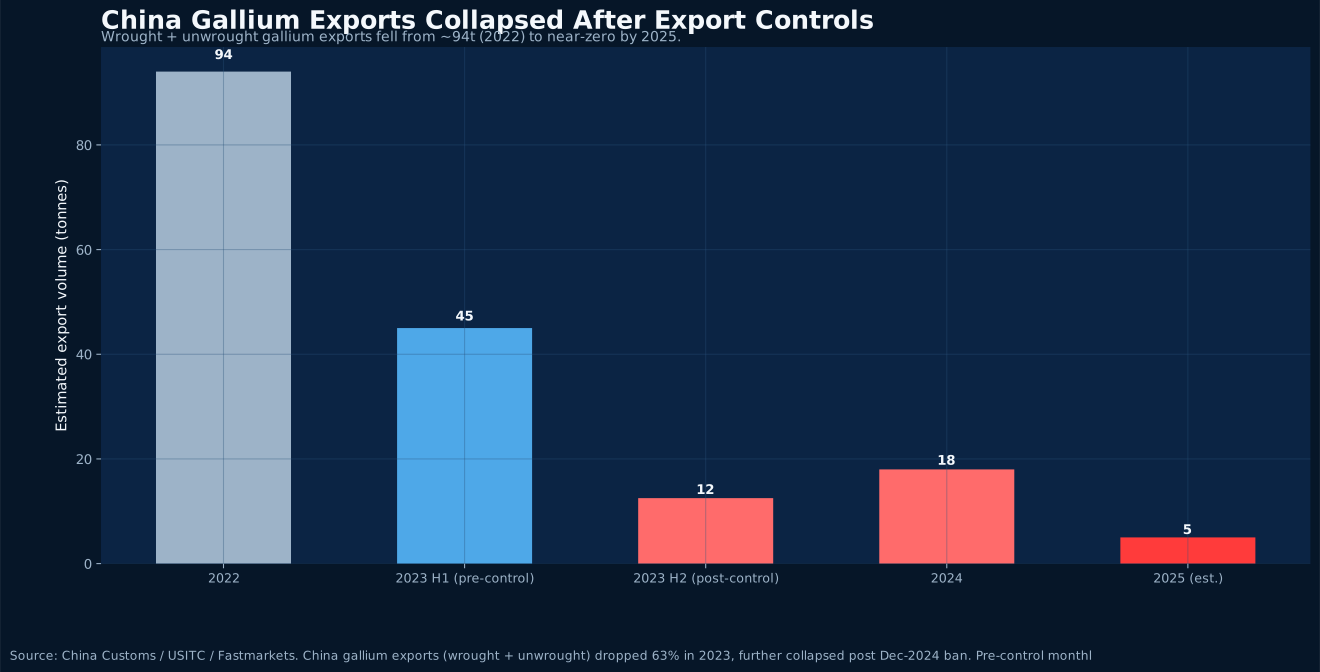
In July 2023, China’s Ministry of Commerce announced export licensing requirements for gallium and germanium. Many analysts initially viewed this as a symbolic gesture. The reality proved far more disruptive. Chinese gallium exports fell from roughly 45 tonnes in the first half of 2023 to about 12.5 tonnes in the second half. The full year of 2024 saw only around 18 tonnes shipped. In December 2024, China escalated further by banning gallium, germanium, and antimony exports to the United States and tightening scrutiny on shipments to other countries. By 2025, estimated global gallium exports from China had fallen below 5 tonnes, a decline of over 94 percent from the approximately 94 tonnes exported in 2022.
This is not a gradual adjustment but a structural break in global critical mineral supply. China accounts for over 90 percent of global gallium refining and around 60 percent of germanium refining. When the dominant supplier effectively closes its export channels, downstream industries including semiconductors, fiber optics, infrared optics, and solar cells face unprecedented procurement uncertainty. Germanium spot prices in Europe surged by 400 percent, and gallium prices rose by over 365 percent. For Korean manufacturers that depend on these materials, the impact has been immediate and direct.
2. Korea’s three-pronged response: reserve expansion, dedicated funding, and international alliances
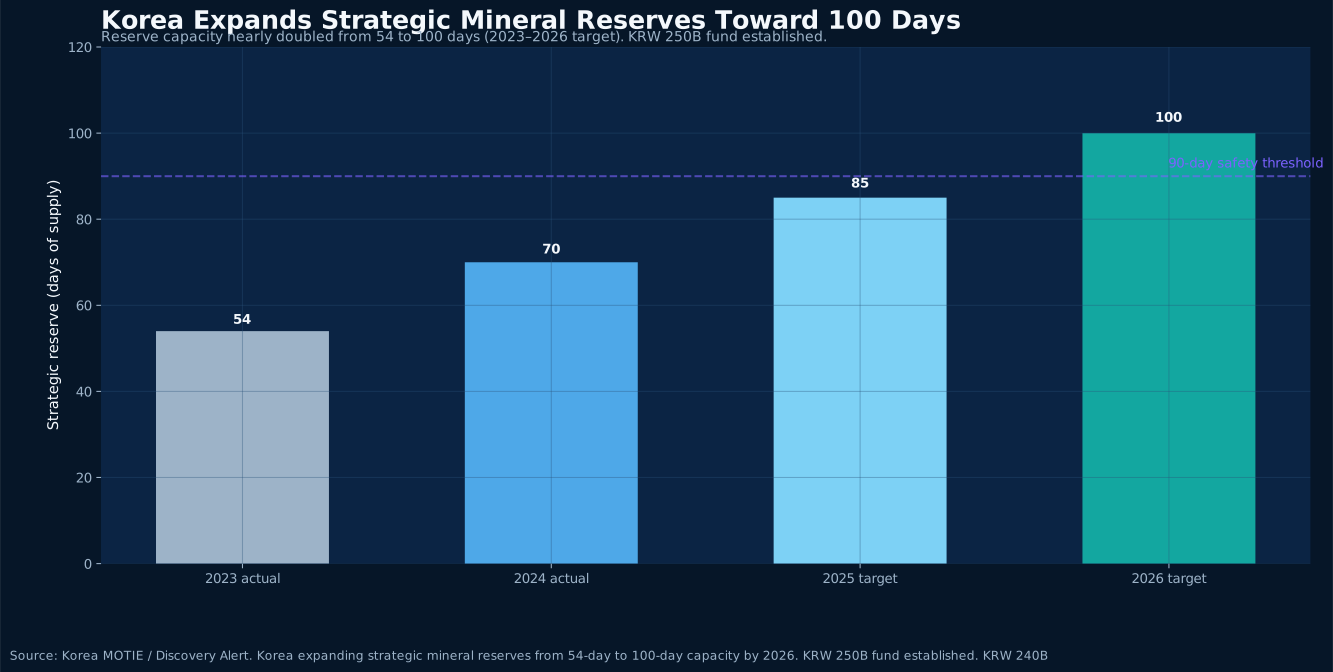
Facing the supply shock from China’s mineral controls, Korea’s government has not sat idle. In 2023, Korea’s strategic mineral reserve stood at just 54 days, offering almost no buffer against supply disruptions that typically last eight to twelve weeks or longer. The Ministry of Trade, Industry and Energy launched a rapid expansion plan, targeting 85 days by 2025 and 100 days by 2026. A KRW 240 billion critical minerals storage facility is being built in the Saemangeum industrial complex in North Jeolla Province, expected to be operational by 2026. Additionally, the government established a KRW 250 billion Critical Minerals and Energy Supply Chain Stabilization Fund to support direct and indirect investments in supply diversification.
On the international front, Korea has adopted a pragmatic dual-track strategy. On one hand, Korea has not abandoned procurement from China. Instead, it established a hotline and joint committee with Chinese authorities specifically designed to help Korean companies import Chinese minerals more quickly and reliably. On the other hand, Korea actively joined the U.S.-led Minerals Security Partnership and took the chair of the FORGE initiative, while signing bilateral critical minerals agreements with Australia, Canada, and Japan. This approach of not decoupling but diversifying risk stands in contrast to the full decoupling stance of some Western countries and better reflects the real dependency of Korean manufacturing on Chinese intermediates.
3. The deeper impact of mineral controls on China-Korea intermediate goods trade
The impact of critical mineral controls extends well beyond raw materials. For companies engaged in China-Korea trade, the more important factor is the ripple effect through intermediate goods supply chains. Korea’s semiconductor industry uses gallium to produce compound semiconductors like GaN and GaAs, materials widely used in 5G base stations, LED lighting, and military radar. Germanium is essential for fiber optics and infrared optical systems. When the supply of these upstream materials becomes unstable, downstream processing, packaging, and end-product exports are all affected. Korean companies face a difficult choice between maintaining access to Chinese materials and serving U.S. defense contracts, while supply chain diversification could increase manufacturing costs by 20 to 35 percent.
For Chinese exporters, the controls also mean that the existing export structure is being reshuffled. Companies that previously exported large volumes of raw materials now face uncertainty in license approvals, while suppliers capable of offering processed products or compliance solutions may gain new competitive advantages. From this perspective, although mineral controls limit trade flows in the short term, they are also forcing supply chain upgrades and trade model transformation. Mineral trade between China and Korea will not disappear, but its form is evolving from bulk raw material direct supply toward compliance-channeled, deep-processing collaboration.
4. The unique position of China and Korea in the global mineral geopolitics game
From a broader perspective, China’s mineral controls are not merely an extension of the U.S.-China rivalry but also fundamentally affect the underlying logic of China-Korea economic relations. China supplies 91 percent of the world’s refined rare earths and 92 percent of rare earth magnets. For 19 out of 20 important strategic minerals, China is the leading refiner, with an average market share of 70 percent. This means any plan to completely bypass China for mineral supply faces enormous cost and time challenges. The Korean government clearly recognizes this, which is why it has chosen a realistic path of maintaining partial Chinese procurement while diversifying new sources, rather than the full substitution approach advocated by some Western camps.
Over the next five years (2024–2028), Korea plans to invest more than KRW 38 trillion across the secondary battery supply chain, covering minerals, materials, and finished products. In June-July 2026, Korea will host the Mining and Critical Minerals Korea Conference in Seoul. These moves signal that Korea has elevated critical mineral security to a national strategic priority. For trade service providers and intermediate goods suppliers operating between China and Korea, this is not a distant issue but a structural change requiring immediate attention. Understanding these changes and finding compliant, sustainable ways to participate will become a new source of competitiveness in China-Korea trade.
5. Practical implications for China-Korea trade practitioners
First, closely monitor export licensing developments from China’s Ministry of Commerce. Mineral control policies remain in flux, and approval requirements may change at any time across different minerals and destinations. An approved export channel today does not guarantee permanent access, and companies need to establish dynamic tracking mechanisms. Second, Korean companies’ procurement strategies are shifting from lowest-price orientation to supply-security priority. This means Chinese suppliers that can offer stable supply, complete compliance documentation, and deep-processing capabilities will gain more favor in the new competitive landscape.
Third, the mineral hotline and joint committee mechanisms established between China and Korea offer trade companies a new policy communication window. Understanding and utilizing these official channels can help companies gain clearer guidance in license applications and customs clearance. Fourth, from a long-term perspective, mineral controls are pushing China-Korea trade from low-end bulk toward high-end specialization. Suppliers who understand end-use application requirements and can provide technical support and ancillary services will have stronger survival prospects than pure raw material wholesalers. This is consistent with trends we observe across other China-Korea trade sectors: the core of competition is shifting from price to value.