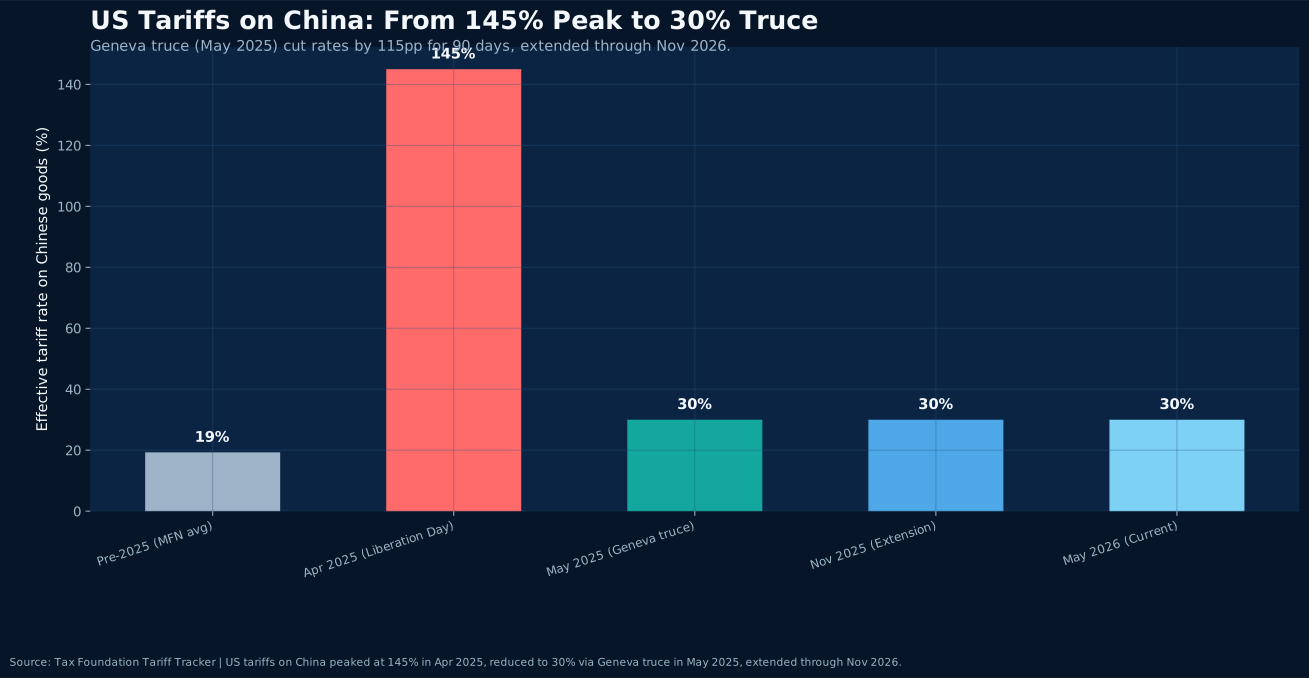
I. The Geneva Truce: How Tariffs Dropped from 145% to 30%
In April 2025, US tariffs on China surged to 145% under the “reciprocal tariff” policy—a rate virtually unprecedented in modern trade history. Import costs for American businesses spiked and global supply chains faced fracture risks. To defuse the crisis, the US and China reached a “90-day truce” in Geneva in May 2025, slashing tariffs by 115 percentage points to 30%, comprising a 10% baseline levy plus a 20% fentanyl-specific surcharge. The dramatic reduction immediately calmed global market panic.
In November 2025, both countries extended the truce for one year at the Busan APEC summit, through November 2026. This means US tariffs on China remain at 30% throughout 2026—still above the pre-trade-war average of 19.3% but far below the peak. Uncertainty persists: both sides committed to no new tariffs during the truce, but rates could rebound if negotiations collapse. For Korean firms dependent on both Chinese and American markets, this window is both an opportunity and a test.
II. Korea’s “Dual-Track” Dilemma: Pressure on Both China and US Exports
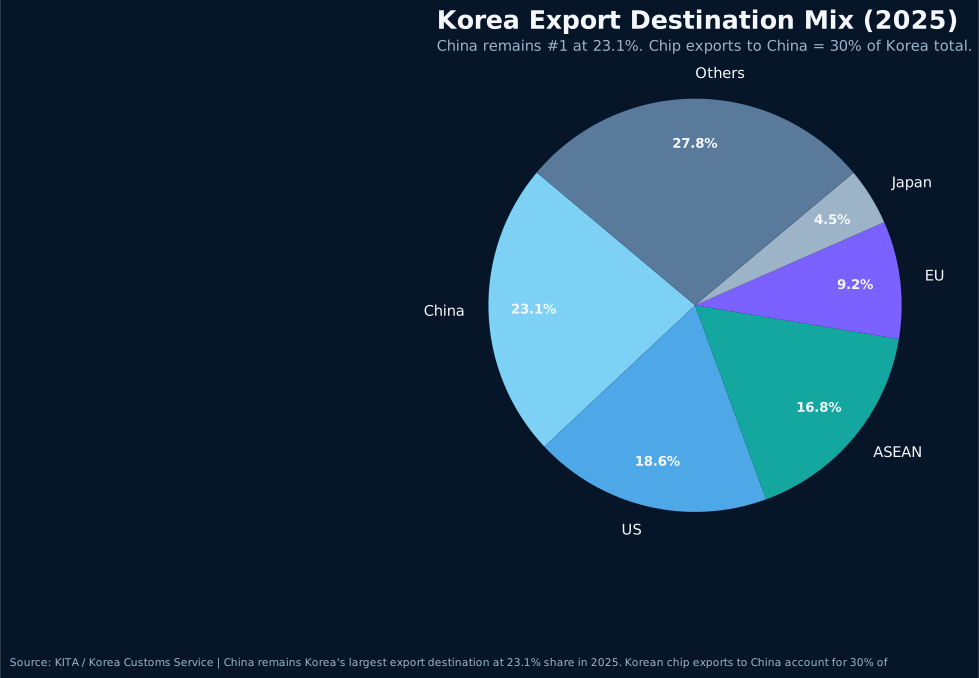
Korea’s trade structure defines its unique position in the US-China tariff standoff. China is Korea’s top export destination at 23.1%, with the US close behind at 18.6%. More critically, Korean semiconductor exports to China account for 30% of Korea’s total chip exports, versus just 7% to the US. This means any tariff shift from either side directly hits Korea’s most vital export sector. In semiconductors especially, Korea must navigate both US export control escalation and maintaining stable supply to China.
US tariffs on Korea have also fluctuated sharply. The “Liberation Day” reciprocal tariff was set at 25%, later reduced to 15% in November 2025. Auto tariffs hit Korean carmakers’ profits particularly hard, though the KORUS FTA provides a buffer for qualifying goods. In this complex landscape, the core challenge for Korean firms is maintaining balance between the two markets—avoiding US transshipment scrutiny while preserving Chinese market share.
III. Supply Chain Diversion and Korea’s “China+1” Strategy in Practice
The US-China tariff standoff has accelerated the global “China+1” supply chain shift. ECB research shows that while US tariffs on China have not caused massive trade diversion, Chinese intermediate goods exports to ASEAN have surged significantly, mirrored by rising US imports from ASEAN. This “ASEAN transit” pattern is reshaping Asia-Pacific supply chain geography, with Vietnam, India, and Mexico as primary beneficiaries. For Korean firms, this is both threat and opportunity—threat because Chinese suppliers may bypass Korea to supply ASEAN directly; opportunity because Korean companies can position themselves as “dual-track hubs.”
Major Korean firms are already acting. Samsung and SK Hynix are maintaining Chinese factory operations while actively expanding capacity in the US and Southeast Asia. The Korean government secured more favorable tariff treatment through a $35 billion US investment framework. For small and mid-sized China-Korea trade businesses, the priority is building “rules of origin” and “China content” compliance systems to ensure products pass US customs without triggering additional duties for “China association.”
IV. Semiconductors and Autos: Tariff Strategies for Korea’s Two Pillar Industries
Semiconductors are Korea’s dominant export pillar, and their position in the US-China standoff is most complex. The Chip 4 alliance (US, Japan, Korea, Taiwan) is reducing Korea’s reliance on Chinese chip supply chains, but China remains Korea’s largest chip buyer in the short term. US export controls primarily target advanced-node chips, while mature-process products can still trade normally. Korean chipmakers’ strategy is “layered response”: concentrating advanced-node capacity in the US and Korea while retaining mature-process operations in China.
The auto industry faces parallel tariff pressures. US tariffs on Korean cars dropped from 25% to 15% but remain above historical levels. Hyundai and Kia are offsetting tariff impacts by increasing US domestic manufacturing investment. Meanwhile, Chinese EV brands continue gaining market share in Korea, fundamentally shifting the competitive dynamics of China-Korea automotive trade. The implication for trade businesses: whether in parts supply or finished goods export, tariff cost structures and market positioning strategies need reassessment.
V. Practical Recommendations for China-Korea Trade Businesses During the Truce
For China-Korea trade businesses, the core strategy during the truce is “stockpile window-period advantages, position for the post-tariff era.” First, leverage the stable 30% rate window in 2026 to optimize inventory and procurement cycles. Second, build multi-pathway rules-of-origin systems ensuring products receive optimal tariff treatment under KORUS FTA, RCEP, and other frameworks. Third, closely monitor US customs scrutiny of “China content” and prepare compliance documentation in advance.
More importantly, businesses should view this truce as a strategic opportunity for supply chain diversification, not the new normal. Even the reduced 30% tariff rate may lead to consumer price hikes, and long-term US-China trade uncertainty will persist. China-Korea trade firms should use this window to accelerate building alternative supply chains in Vietnam, Indonesia, and other ASEAN nations while deepening technical collaboration with Korean domestic partners—constructing flexible supply networks that can adapt to multiple tariff scenarios. This is not just risk mitigation; it is a critical window for gaining first-mover advantage as global trade rules are reshaped.