I. China’s Food Exports to Asia: Macro Trends and Korea’s Market Position
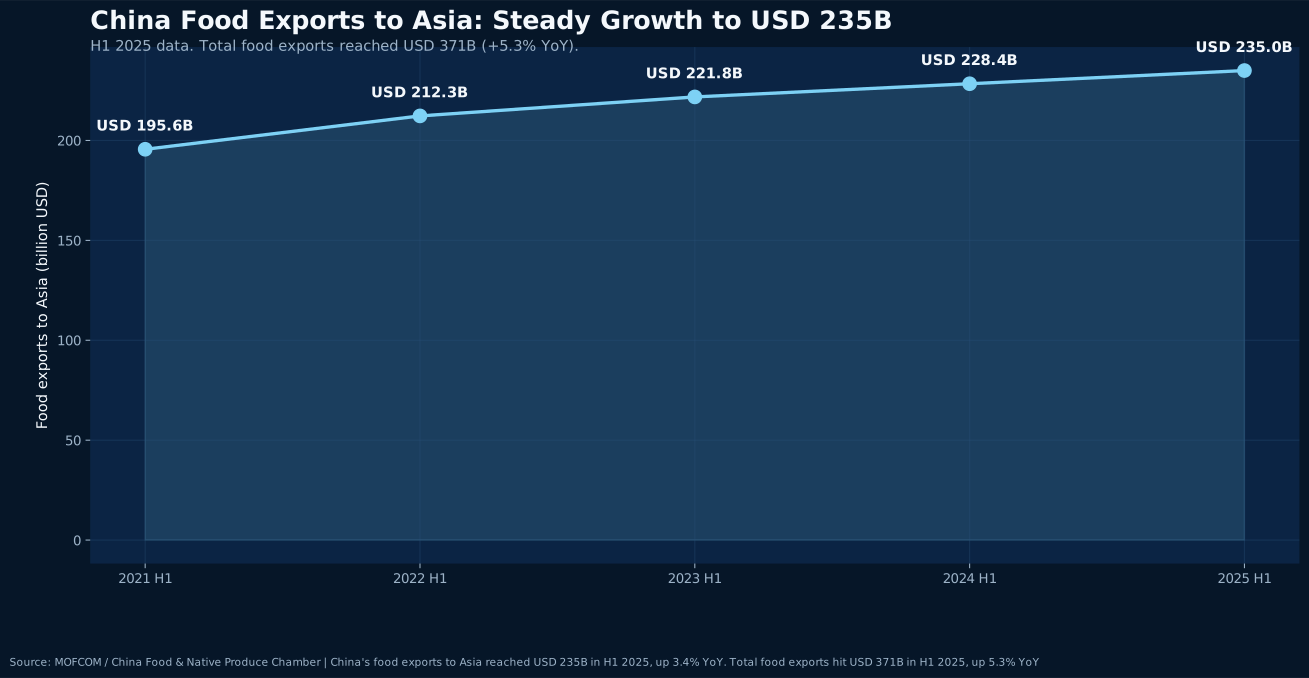
China’s food exports maintain robust growth. In H1 2025, total food exports reached $371 billion, up 5.3% year-on-year. Exports to Asia accounted for $235 billion, growing 3.4% YoY and representing 63% of the total. Asia remains the core destination for Chinese food exports, and Korea—as Asia’s fourth-largest economy with high per-capita food consumption—plays an outsized role. The geographic proximity between China and Korea keeps fresh and cold-chain food trade costs relatively manageable, an advantage that Southeast Asian and Western markets cannot match.
Behind the growth numbers, however, are ever-higher compliance thresholds. MFDS’s three-stage imported food safety management system—pre-import registration, customs inspection, and post-market surveillance—imposes full-chain compliance requirements on exporters. In processed and functional foods, Korea’s standards rank among the strictest in major Asian markets. For Chinese food companies seeking to expand Korean market share, understanding and meeting MFDS requirements has shifted from a ‘bonus’ to a ‘survival imperative.’
II. Decoding MFDS Violation Data: Where the Problems Lie
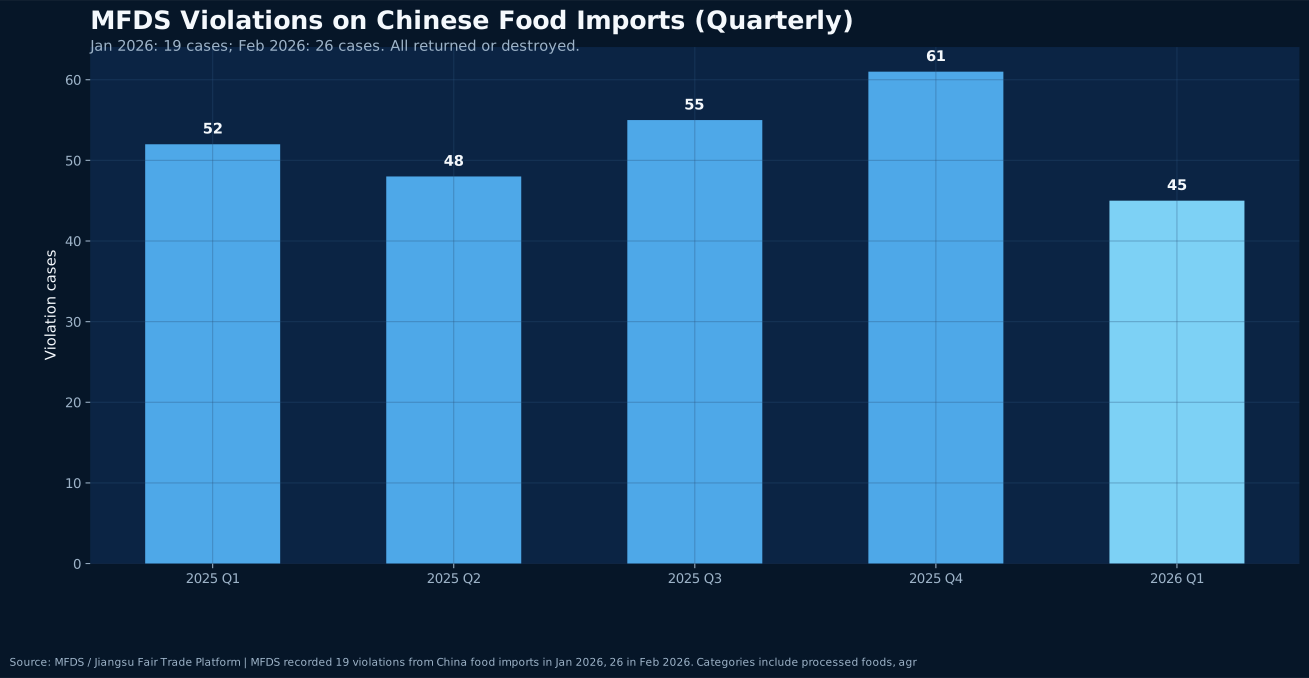
MFDS violation data provides the most direct compliance improvement signal for Chinese food exporters. In January 2026, MFDS recorded 19 Chinese food import violations; February saw 26 cases. Violations span processed foods, agricultural products, and livestock products, with all non-compliant products returned to origin or destroyed on-site. Quarterly trends show violations fluctuating between 48 and 61 cases throughout 2025, with 45 cases in Q1 2026—a slight decline but still elevated.
Analysis of violation causes reveals the most common issues: pesticide residue exceedances, heavy metal content above limits, microbial contamination, food additive usage not meeting Korean standards, and incomplete labeling. Pesticide and heavy metal issues concentrate in agricultural products, while additive compliance problems appear primarily in processed foods. Notably, Korea and China have significant differences in permitted food additive types and quantity limits—a major driver of processed food violations. Chinese companies must cross-reference Korea’s Food Additives Code item-by-item before export.
III. Latest Revisions to Korea’s Food Safety Regulations
Korea’s 2026 food safety regulations show a dual-track pattern of loosening and tightening. On the loosening side: on April 9, 2026, Korea’s Ministry of Agriculture, Food and Rural Affairs published a partial amendment to poultry-origin processed animal protein feed import hygiene requirements, optimizing quarantine rules. The new rule clarifies that products processed using inactivation methods approved by the exporting country’s government can be imported through standard declaration procedures, without additional Korean unilateral process certification. This revision aims to align with international standards, simplify customs clearance, and facilitate cross-border trade.
On the tightening side: on April 24, 2026, Korea published a draft amendment to the Special Act on Imported Food Safety Management enforcement rules, further strengthening processed food scrutiny. Revisions cover import food registration procedures, inspection frequency, and post-market surveillance mechanisms. Functional food ingredients and novel foods face more detailed approval processes requiring more comprehensive safety assessment data. Additionally, February 2026 saw Korea updating GMO labeling standards. These cumulative changes mean China’s food export compliance threshold for Korea is rising systematically.
IV. Balancing Compliance Costs with Market Returns
For China-Korea food trade businesses, the core compliance question is ROI. Korea’s high consumer purchasing power and strict quality requirements mean compliance investments generate positive long-term returns. A typical compliance pathway includes: pre-export formula review and additive cross-referencing (2–4 weeks), MFDS registration and documentation (4–8 weeks), first-shipment inspection and customs clearance (2 weeks), and ongoing post-market surveillance cooperation. The total timeline runs 3–6 months, with financial costs varying by product category.
Three key strategies reduce compliance costs: First, establish long-term partnerships with Korean-accredited testing labs to lower per-test costs through volume. Second, incorporate Korean standards during product development—a ‘compliance by design’ approach—avoiding major formula adjustments before export. Third, leverage China-Korea FTA and RCEP rules of origin to optimize tariff cost structures. SMEs can also consider partnering with specialized cross-border trade service providers, outsourcing compliance management to professional teams and replacing uncertain compliance risks with fixed fees.
V. Future Opportunities and Strategic Recommendations for China-Korea Food Trade
Despite increasing compliance challenges, the long-term outlook for China-Korea food trade remains positive. Korea’s aging population and growing single-person households drive expanding demand for convenience foods, functional foods, and health snacks. China’s food industry holds cost and supply chain advantages in these categories. In functional food ingredients particularly, China has abundant natural plant extract resources, while Korean market demand for functional ingredients beyond ginseng is growing rapidly. This provides Chinese food exporters a strategic upgrade path from ‘bulk agricultural products’ to ‘high-value functional foods.’
Strategic recommendations for China-Korea food trade firms can be summarized as three principles: compliance first, category upgrade, channel diversification. Compliance first means treating MFDS compliance as the minimum market access threshold, not an extra cost. Category upgrade means shifting from price-sensitive bulk commodities to high-value functional and organic foods. Channel diversification means not relying solely on traditional B2B importer channels but actively developing Korean online retail and social commerce channels. Korea’s 2026 regulatory dual-track signals the direction: simplify procedures, tighten standards. For companies with established compliance systems, this actually reduces operational complexity; for those still outside the compliance threshold, the window is narrowing.