Chinese E-Commerce Platforms' Korean Offensive
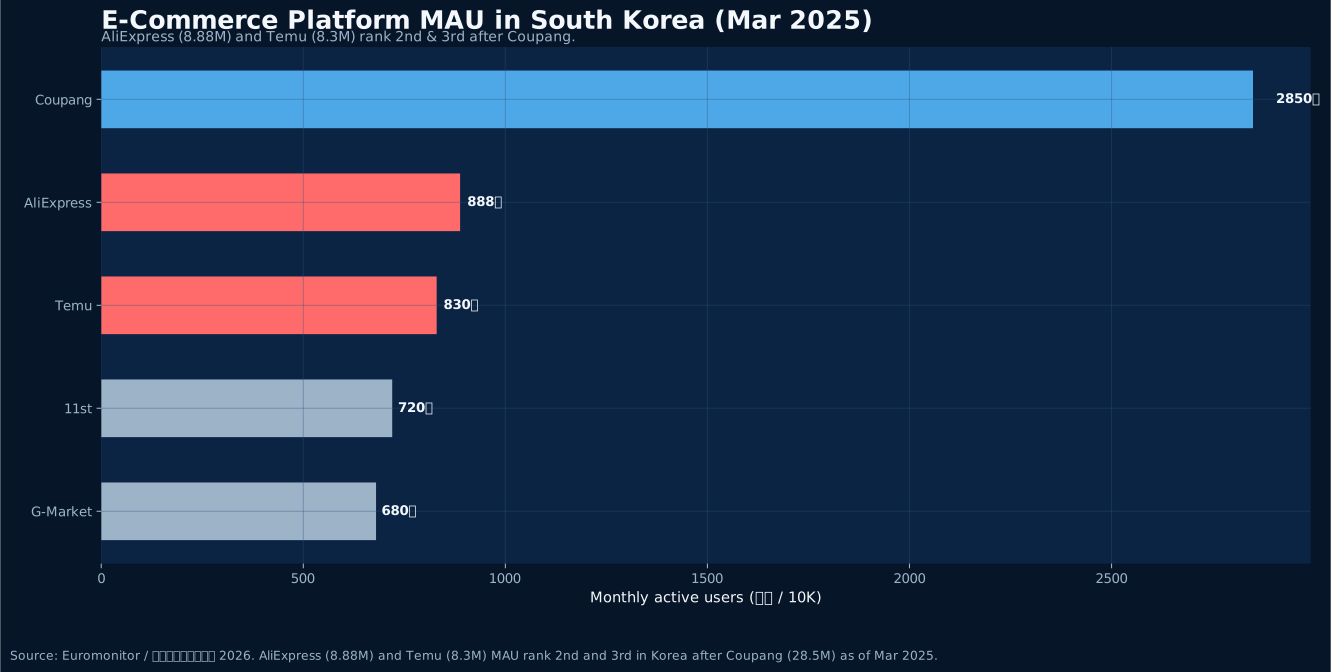
Since 2025, Chinese cross-border e-commerce platforms have achieved unprecedented depth of penetration in the Korean market. As of March 2025, AliExpress reached 8.88 million monthly active users and Temu 8.3 million, ranking second and third among Korean e-commerce platforms behind domestic giant Coupang at 28.5 million. Chinese CBEC platforms now account for nearly 50% of total cross-border e-commerce sales into Korea, a share that more than doubled from 2022 to 2023.
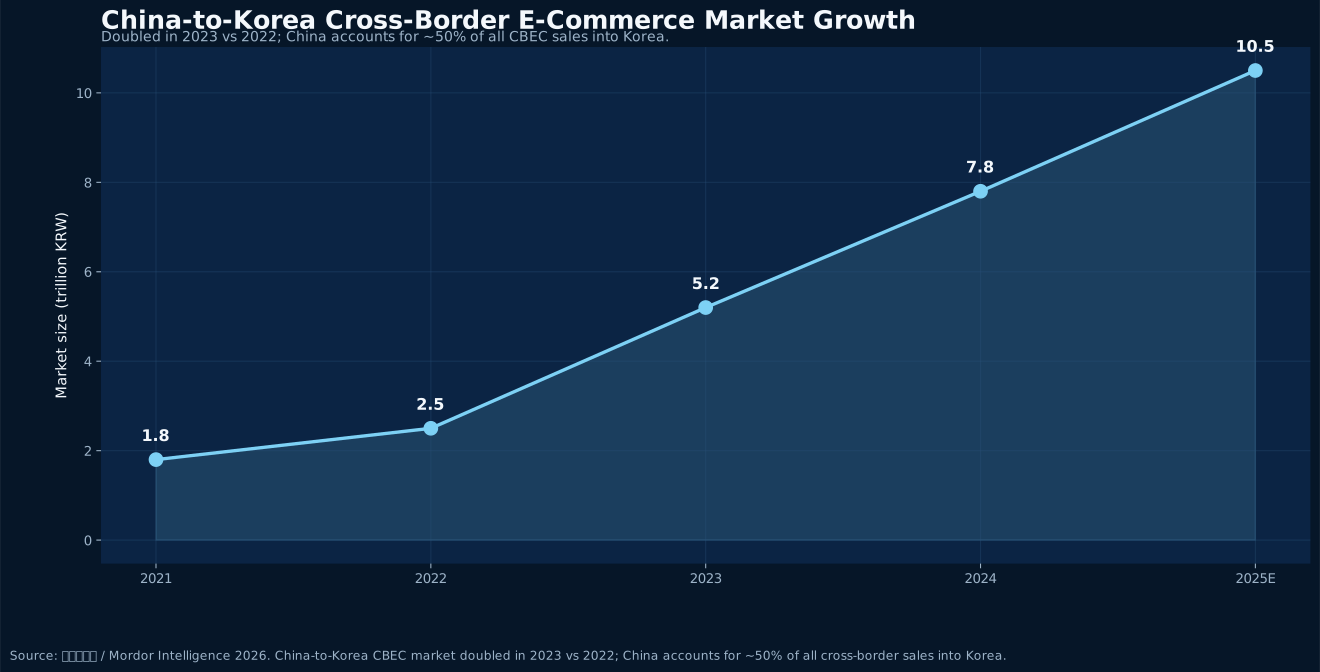
In market size terms, China-to-Korea CBEC grew from 1.8 trillion KRW in 2021 to an estimated 10.5 trillion KRW in 2025, nearly a fivefold increase in four years. The core driver of this explosive growth was the 'extreme low price plus full-consignment model'—Temu and AliExpress directly connect with Chinese manufacturers, compress intermediary links, and subsidize logistics costs to offer Korean consumers irresistibly low-priced goods.
Consumer Safety Complaints and Regulatory Pressure
The rapid expansion of Chinese CBEC platforms in Korea has also brought increasingly serious consumer safety concerns. The Korea Fair Trade Commission (KFTC) has conducted on-site inspections of AliExpress, triggered by a surge in consumer complaints. Key complaint categories include delivery breaches such as delayed shipments, incorrect items, and missing packages; refund difficulties; and product quality issues including defective goods, counterfeits, and damaged products.
Deeper concerns center on product safety. Korean consumer rights organizations note that some products sold through cross-border platforms may bypass Korea's KC safety certification system, potentially including items recalled abroad. In May 2024, the Korean government announced a ban on cross-border sales of 80 product categories. Although the policy was withdrawn after three days due to strong pushback, it sent a clear signal that Korean regulators are seriously considering stricter product safety standards for CBEC.
2026: The Global Year of CBEC Compliance
2026 is emerging as the 'Year of Compliance' for global cross-border e-commerce. Major markets including the EU, Japan, Thailand, and Mexico have simultaneously abolished duty-free small parcel policies, marking the end of the 'low-price duty-free' dividend era. China's revised Foreign Trade Law, effective March 1, 2026, introduced an intellectual property chapter imposing trade sanctions on platform IP infringement.
Domestically, China's State Taxation Administration has strengthened tax oversight of online e-commerce transactions, requiring internet platforms to assume broader tax reporting, data collection, and withholding obligations. These global regulatory tightening measures are reshaping the rules of cross-border e-commerce—business models relying on duty-free loopholes and low-price dumping will become unsustainable.
Platform Model Transformation: From Full Consignment to Brand Co-Building
Facing tighter regulation and market maturation, China's three major CBEC platforms—Temu, SHEIN, and AliExpress—have simultaneously completed strategic transitions: from early 'full-consignment traffic harvesting' to 'semi-managed plus overseas warehousing plus brand co-building' refined operations. Semi-managed means the platform handles traffic acquisition and order management while sellers manage warehousing and logistics, improving delivery speed and product quality control.
Overseas warehouse deployment is key to this transformation. In the Korean market, Chinese platforms are accelerating construction or leasing of local warehousing facilities to achieve 'next-day delivery' while enabling KC certification testing at the inbound stage. Brand co-building means platforms are cultivating sellers with brand strength. In H1 2025, AliExpress saw 72% YoY growth in newly onboarded brands, with over 500 brands doubling their sales.
The Compliance Roadmap for Chinese Sellers in Korea
For Chinese cross-border sellers targeting Korea, compliance has shifted from optional to mandatory. First, KC certification is the basic threshold for entering the Korean market—electronics, children's products, cosmetics, and other categories must obtain certification from the Korean Agency for Technology and Standards (KATS). Second, Korea's E-Commerce Act requires cross-border platforms and sellers to provide clear return and refund policies, accurate product descriptions, and after-sales service meeting Korean consumer protection standards.
From a broader perspective, the compliance evolution of China-Korea CBEC is essentially a 'survival of the fittest' process. Chinese sellers who can quickly adapt to compliance requirements, establish overseas warehousing capabilities, and elevate product quality and brand value will gain more sustainable competitive advantages. For China-Korea trade service providers and logistics companies, demand for compliance consulting, KC certification agency, and overseas warehouse operations will continue to grow.
Outlook: New Opportunities in Regulated Competition
China-Korea CBEC is transitioning from 'wild growth' to a new phase of 'regulated competition.' In the short term, rising compliance costs may squeeze some sellers' profit margins, but in the long run, a regulated market environment will benefit truly competitive brands and products. Korean consumers' acceptance of Chinese goods has already increased significantly; the key is converting that acceptance into lasting brand loyalty through compliant operations and quality assurance.
For Chinese companies considering Korean market entry, MO-TEK recommends focusing on three priorities: first, initiate KC certification processes early to clear compliance channels for core product lines; second, evaluate Korean overseas warehouse partnerships to improve delivery experience while reducing return rates; third, leverage Korean localization marketing teams to build brand awareness within Korea's mainstream internet ecosystems like Naver and Kakao. Compliance is not a burden but an entry ticket to high-quality competition in the Korean market.