1. Annual Licensing: From Waiver to Yearly Approval
On December 31, 2025, the “validated end-user” (VEU) waiver that Samsung Electronics and SK Hynix had relied upon officially expired. This waiver had allowed the two Korean memory giants to ship US-origin semiconductor manufacturing equipment to their China fabs without seeking individual export licenses for each shipment. In its place, the US Department of Commerce approved annual export licenses on December 30 — one day before the deadline — covering Samsung's Xi'an NAND flash facility and SK Hynix's Wuxi DRAM and Dalian NAND plants for the full calendar year of 2026.
The most significant change under the annual license regime is its “leverage effect”: a yearly approval window means Washington can adjust conditions, add restrictions, or withhold renewal at any time based on the broader trade and national security climate. Compared to the relatively permissive VEU system, the new mechanism subjects Korean companies' China operations to greater policy uncertainty. However, the speed of the 2026 approval also signals that, amid the Trump administration's push for trade talks with Beijing, completely cutting off Korean memory giants' China fabs does not serve US interests.
2. Doubling Down: Korean Firms Surge China Fab Investment
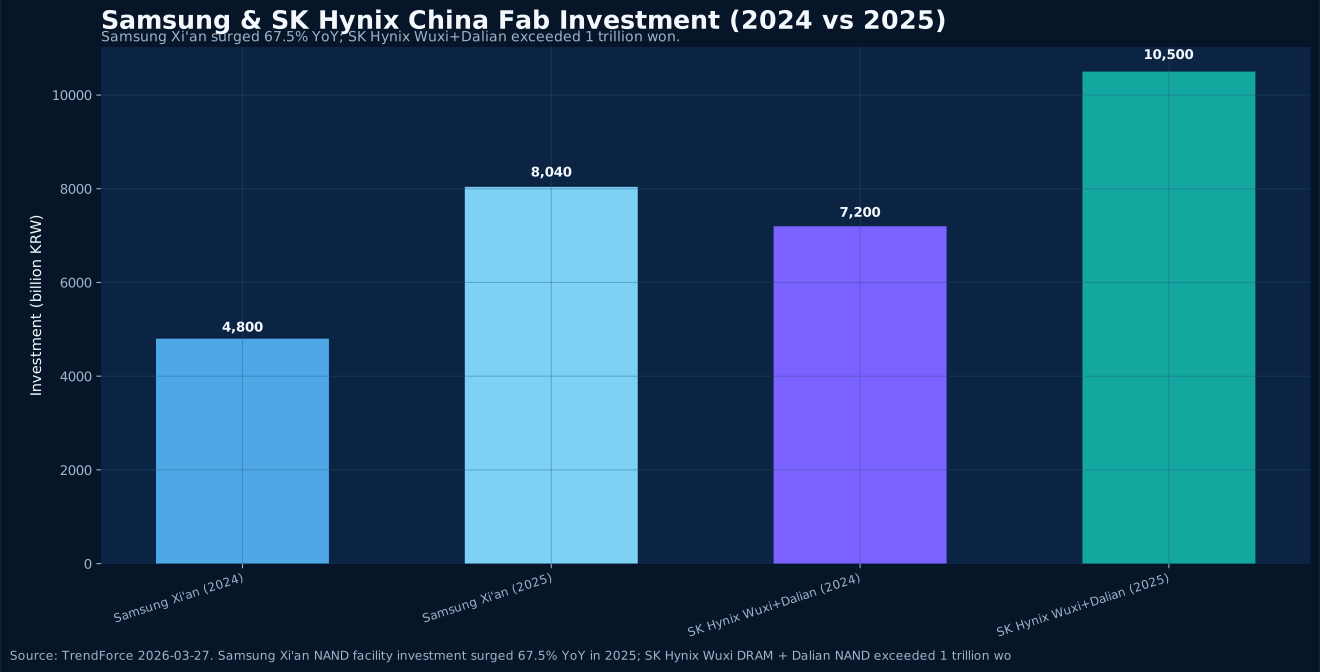
According to TrendForce's March 2026 data, Samsung's investment in its Xi'an NAND flash facility surged from approximately 480 billion won in 2024 to about 804 billion won in 2025, a 67.5% year-on-year increase. This growth is driven by AI data center demand for conventional memory chips — while high-end HBM (High Bandwidth Memory) dominates headlines, AI servers also require massive amounts of NAND flash for data storage, and Samsung's Xi'an plant is one of its primary legacy NAND production bases.
SK Hynix's China investment was equally impressive. In 2025, combined investment in its Wuxi DRAM plant and Dalian NAND flash subsidiary exceeded the 1 trillion won mark. The Wuxi facility is a vital component of SK Hynix's global DRAM capacity, contributing 35-40% of its total DRAM output; the Dalian plant (formerly Intel's NAND operations, acquired by SK Hynix in 2021) likewise carries critical production capacity. The seemingly contradictory behavior of “facing tighter export controls while significantly increasing investment” reflects the irreplaceable strategic value of China as both a market and a manufacturing base for Korean semiconductor companies.
3. DRAM Market Upheaval: SK Hynix Overtakes Samsung
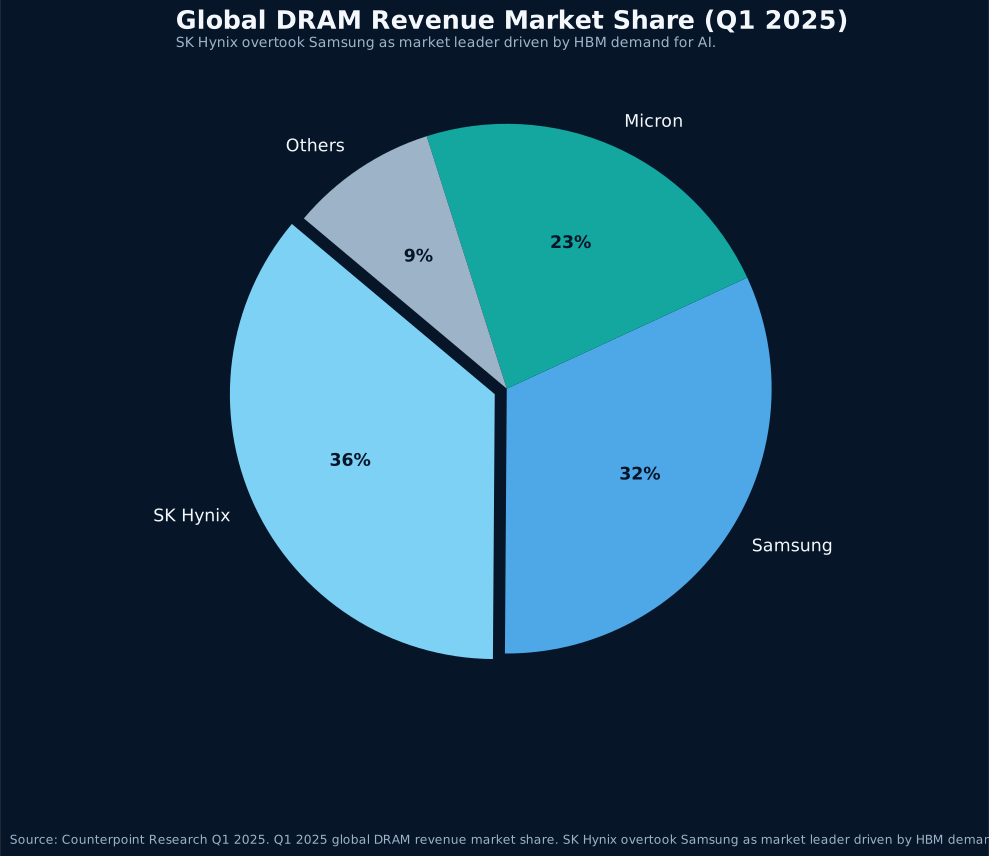
In Q1 2025, the global DRAM market witnessed a historic shift — SK Hynix overtook Samsung Electronics with a 36% revenue market share versus Samsung's 32%, claiming the top spot for the first time. The core driver of this reversal was the explosive growth of the HBM (High Bandwidth Memory) market. Massive demand from AI chip giants like NVIDIA gave SK Hynix — a pioneer in HBM technology — an overwhelming order advantage, with its HBM capacity reportedly booked by NVIDIA through the end of 2026.
Micron ranked third with 23% share. Notably, in the DRAM market competition, China fabs serve as a “rear base” — both Korean companies primarily use their Chinese facilities for mature-process legacy DRAM and NAND production, freeing up advanced production lines in Korea to focus on cutting-edge products like HBM. This “legacy chips from China, advanced chips from Korea” division of labor makes China fabs paradoxically more important under export controls — any disruption to Chinese facilities would create a capacity gap in conventional memory products that directly impacts global supply chains.
4. Korean Chipmakers in the Geopolitical Chess Game
Korean semiconductor companies find themselves caught in the “crossfire” of US-China tech competition. On one hand, the US is Korea's most important technology partner and market — NVIDIA is SK Hynix's largest HBM customer, and Samsung is actively pursuing HBM orders; on the other hand, China is an indispensable manufacturing base contributing a significant share of both companies' global memory capacity. The “chip diffusion rule” effective January 2026 further categorized the world into three tiers, with Korea as a US ally placed in the top “Tier 1” priority level, giving Korean companies a relatively favorable position.
However, “Tier 1” status does not guarantee security. The annual license system itself is a form of “revocable goodwill” — the US retains the power to adjust terms at any time. For Korea-China trade, semiconductor supply chain stability is directly tied to tens of billions of dollars in bilateral trade and tens of thousands of jobs. The Korean government is actively communicating with Washington to secure longer-term licensing arrangements while also promoting diversification of domestic semiconductor manufacturing to reduce over-reliance on any single production base.
5. Future Pathways for Korea-China Semiconductor Cooperation
Looking ahead, Korea-China semiconductor cooperation is transitioning from “pure manufacturing” to “differentiated division of labor.” Korean companies' China presence will increasingly focus on mature-process products (legacy DRAM, NAND flash, CIS image sensors, etc.), while concentrating advanced processes (sub-3nm logic chips, next-gen HBM4 memory) in Korea and the US. This division is not a voluntary choice but a new reality shaped by export controls. For China's semiconductor industry, the stable operation of Korean fabs on Chinese soil is equally vital — they provide not just jobs and tax revenue but serve as critical nodes connecting China to the global semiconductor supply chain.
For companies like MO-TEK that specialize in Korea-China trade services, semiconductor supply chain changes signal new business opportunities. From cross-border logistics for semiconductor equipment components to trade compliance for specialty chemicals, to raw material supply for mature-process capacity expansion, the Korea-China semiconductor trade ecosystem is generating new growth points under the reshaping of export controls. Understanding policy trends and grasping compliance requirements will be key to seizing these opportunities.