1. The Explosive Growth of China's Digital Yuan
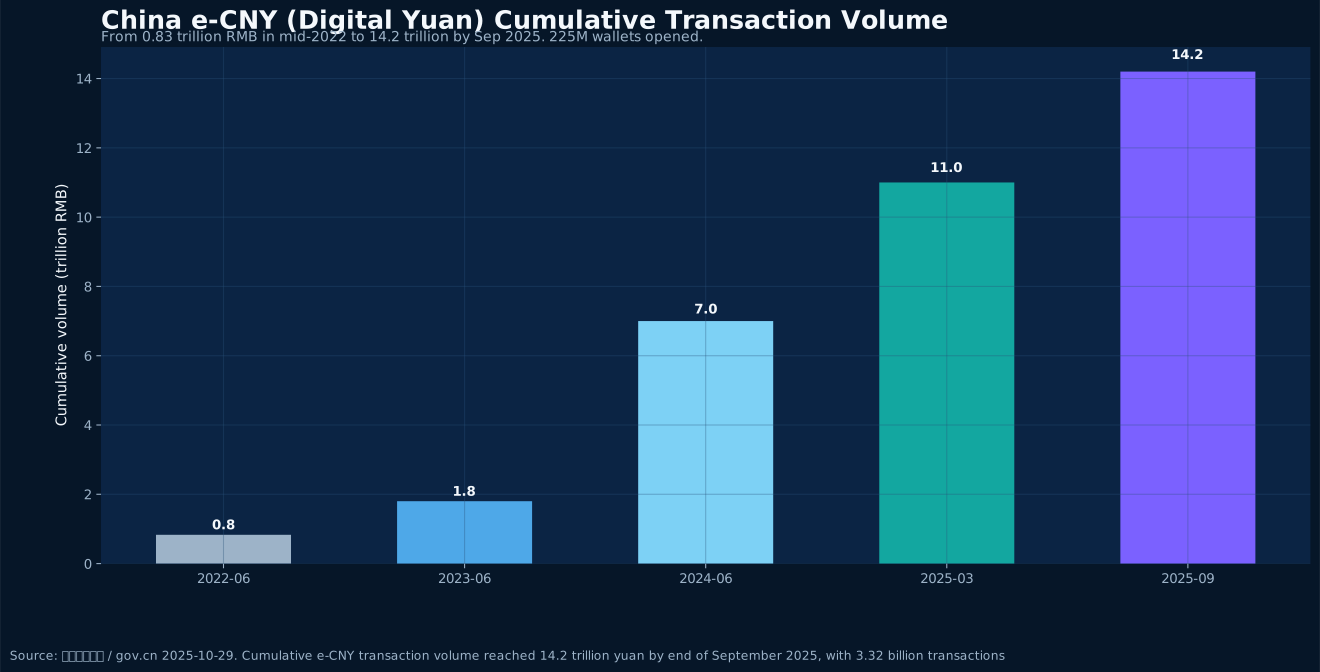
China's digital yuan (e-CNY) is transitioning from pilot to mainstream at a staggering pace. By the end of September 2025, cumulative e-CNY transaction volume had reached 14.2 trillion RMB (approximately $2 trillion), with 3.32 billion transactions processed and over 225 million personal wallets opened. From 0.83 trillion RMB in mid-2022 to nearly 16.7 trillion by late 2025, the roughly 20-fold increase in just over three years puts the e-CNY far ahead of any other central bank digital currency (CBDC) globally.
The e-CNY pilot coverage has also been steadily expanding, now spanning 26 cities and regions across 17 provincial-level jurisdictions — from initial trials in Shenzhen, Suzhou, and Chengdu to major economic centers like Beijing, Shanghai, and Guangzhou. Use cases have evolved from early small-value consumption subsidies to public transit, government procurement, and cross-border tourism payments. Starting January 1, 2026, the People's Bank of China allows commercial banks to pay interest on e-CNY wallet balances — marking a pivotal shift from pure “digital cash” (M0 replacement) to “digital deposit currency,” significantly boosting its appeal for corporate and trade settlement scenarios.
2. mBridge: The Super Highway for Cross-Border CBDC Payments
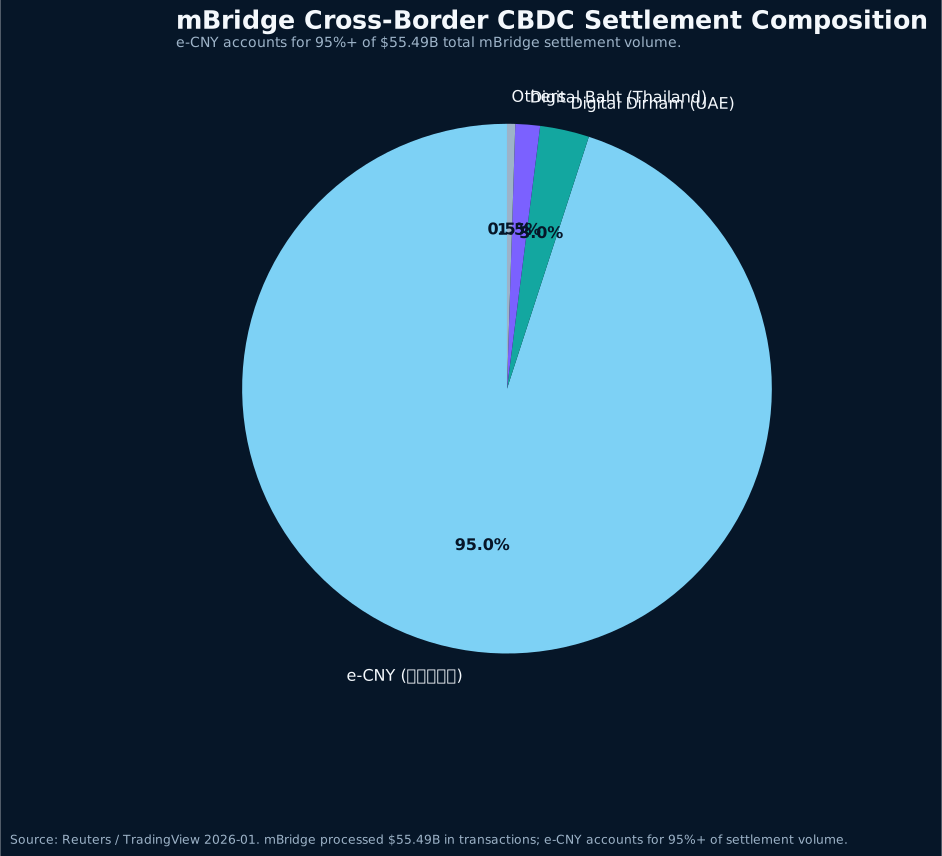
mBridge is a cross-border CBDC payment platform jointly developed by the People's Bank of China, the Hong Kong Monetary Authority, the Bank of Thailand, the Central Bank of the UAE, and the Saudi Central Bank. As of November 2025, the platform had processed 4,047 transactions with a total volume of $55.49 billion — a roughly 2,500-fold increase from its initial pilot phase in 2022. This explosive growth has made mBridge the world's largest cross-border CBDC experiment.
Particularly noteworthy is that the digital yuan dominates mBridge settlement with an overwhelming share — over 95% of settlement volume is conducted in e-CNY. This reflects China's first-mover advantage and dominant position in cross-border digital currency. In October 2024, the Bank for International Settlements (BIS) stepped away from the project, transferring governance to participating central banks — further underscoring mBridge's strategic positioning as a “non-dollar-dominated” cross-border payment infrastructure. The platform is currently used primarily for energy and commodity trade settlement, with the UAE Ministry of Finance and Dubai Department of Finance having already executed government financial transactions on the platform.
3. Potential Impact on Korea-China Trade Settlement
Korea-China bilateral trade exceeded $300 billion in 2024, reflecting deep economic ties. Currently, the vast majority of Korea-China trade is denominated and settled in US dollars; RMB settlement share has been rising annually but remains limited. The maturation of the digital yuan and the development of the mBridge platform provide the technical possibility for Korea-China trade to bypass the dollar clearing system for direct local-currency settlement. For Korean exporters, receiving and making payments directly in digital yuan could significantly reduce exchange costs and time delays — traditional cross-border dollar remittances typically take 2-5 business days with high fees, while CBDC peer-to-peer settlement can theoretically be completed in seconds.
The Bank of Korea has also been advancing CBDC research and testing since 2021, and while a digital won has not yet been officially issued, Korean interest in CBDC technology and cross-border applications continues to grow. If a future digital won were to interconnect with the digital yuan through a mechanism similar to mBridge, Korea-China trade settlement could enter a new “disintermediation” paradigm — bypassing correspondent banks in New York or London for direct central bank digital currency clearing. This holds particular cost-reduction and efficiency-boosting potential for the large volume of intermediate goods traded between the two countries (semiconductors components, chemical raw materials, electronic components, etc.).
4. Challenges and Risks: The Dollar System and Geopolitics
However, promoting cross-border digital yuan applications is far from straightforward. First, the dollar's dominance in global trade settlement is difficult to challenge in the short term — according to SWIFT data, the dollar still accounts for over 40% of international payments, while the RMB stands at roughly 4-5%. Second, mBridge's “de-BIS-ification” has raised Western concerns about potential use for sanctions evasion, and the US remains highly vigilant toward any alternative that could undermine the dollar clearing system's dominance. As an important US ally, Korea must carefully balance its relationship with Washington when engaging in RMB cross-border settlement networks.
Furthermore, the practical application of the digital yuan in cross-border scenarios faces technical and regulatory challenges. Interoperability standards between national CBDCs remain unharmonized, and cross-border coordination mechanisms for anti-money laundering (AML) and know-your-customer (KYC) requirements are still evolving. For Korea-China trade enterprises, the digital yuan may find more immediate application in small-value cross-border consumption (tourism shopping, e-commerce refunds, etc.) in the near term, while the full digital transformation of bulk trade settlement will require more time for institutional and technical development.
5. Corporate Strategy and Outlook
Facing the rapid development of the digital yuan and cross-border CBDC payments, Korea-China trade enterprises should prepare in advance. First, pay attention to e-CNY wallet setup and usage — Korean companies operating in China should familiarize themselves with e-CNY corporate wallet functions and their applications in supply chain payments and payroll processing. Second, closely track mBridge platform expansion — if the Bank of Korea joins or establishes an interoperable mechanism with mBridge, early-mover companies will gain a competitive advantage. Third, partner with trade service providers experienced in cross-border payment compliance to ensure regulatory adherence in new payment channels.
From a longer-term perspective, cross-border CBDC payments represent not just an advance in payment technology but a microcosm of the evolving international monetary system. The internationalization of the digital yuan is closely aligned with China's broader RMB internationalization strategy, and South Korea — as the world's ninth-largest economy and a major trading nation — faces both challenges and opportunities in this transformation. MO-TEK will continue monitoring the latest applications of digital currency in Korea-China trade, providing clients with cutting-edge trade settlement solution references.