1. China's Micro-Dramas: From Grassroots to a Multi-Billion Industry
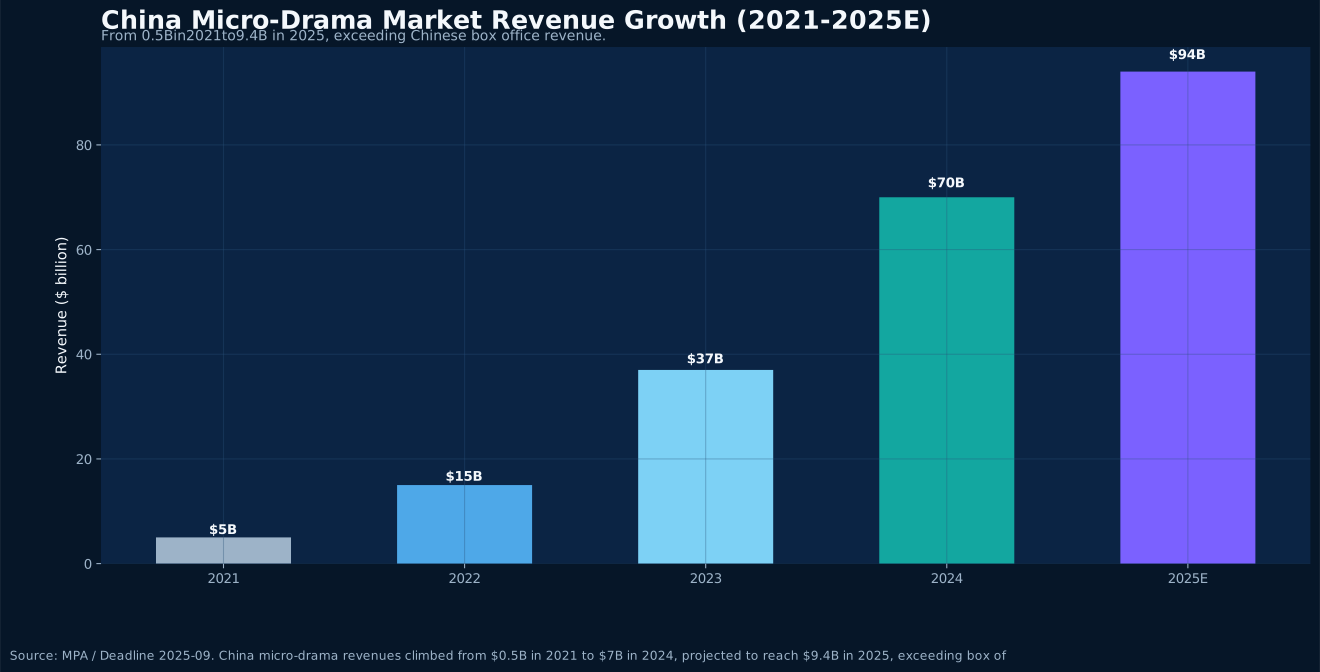
China's micro-drama market has experienced remarkable explosive growth over the past five years. In 2021, this emerging content format's market size was merely about $500 million; by 2024 it had surged to $7 billion; and 2025 projections reach $9.4 billion — meaning micro-dramas are on the verge of surpassing Chinese box office revenue to become the new “cash cow” of China's content industry. Industry forecasts suggest the Chinese micro-drama market will climb further to over $16.2 billion by 2030, maintaining double-digit compound annual growth rates.
Micro-dramas' core characteristics are “short, fast, and satisfying” — 1-3 minutes per episode, 60-100 total episodes, vertical filming optimized for smartphone viewing, with extremely fast-paced plots and dense plot twists. This format perfectly matches the fragmented consumption habits of the mobile internet era. The business model primarily relies on IAP (in-app purchases to unlock episodes), supplemented by advertising revenue. Leading platform ReelShort (under COL Digital Publishing Group) generated approximately $400 million in 2024 revenue, while DramaBox achieved $323 million with $10 million in net profit. However, high customer acquisition costs (primarily spent on TikTok, Facebook, and other social media platforms) keep most platforms in the red.
2. The Rise of Korea's Short-Drama Ecosystem
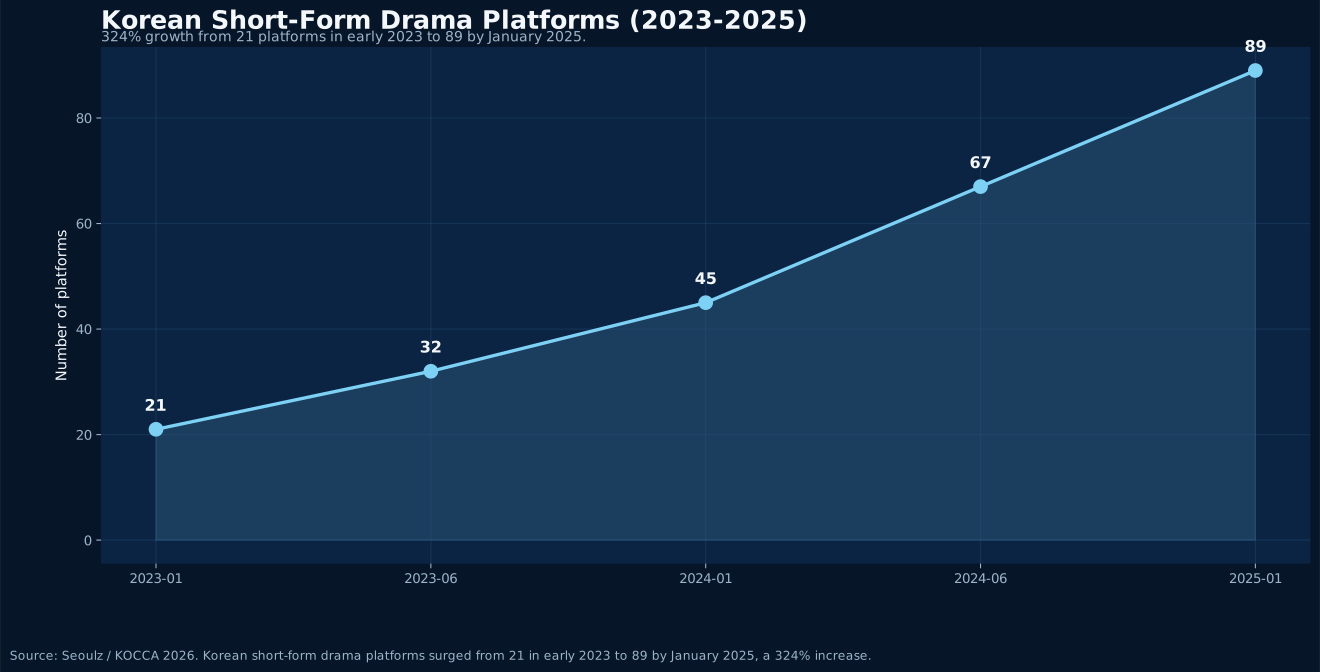
Korea's rapid emergence in the short-drama space is equally remarkable. Since early 2023, the number of Korean short-form drama platforms has surged from 21 to 89 by January 2025 — a 324% increase. Behind this growth lies the Korean content industry's distinctive competitive advantages: polished cinematographic aesthetics, attractive casts, nuanced emotional soundtracks, and sophisticated narrative techniques. Reportedly, Korean-produced short dramas by KT Studio Genie immediately hit No. 1 on both DramaBox and ReelShort upon launch, outperforming the platforms' existing Chinese content libraries.
Another crucial advantage of Korea's short-drama industry comes from its powerful webtoon ecosystem. South Korea accounts for approximately 70% of global paid webtoon revenue, and webtoon IPs are naturally suited for short-drama adaptation — stories are pre-tested with millions of readers, character designs are ready-made, and vertical panel storyboards naturally align with vertical filming requirements. The conversion efficiency from webtoon IP to short drama far exceeds original screenplay development, giving Korean production teams a unique “arsenal” advantage in content supply. According to the Korea Creative Content Agency (KOCCA), the global Korean webtoon market has reached $6 billion, providing an inexhaustible IP reservoir for the short-drama industry.
3. China-Korea Collaboration: The Content Quality “Chemistry”
A distinctive “coopetition” landscape is forming between China and Korea in the micro-drama space. Chinese platforms (ReelShort, DramaBox, ShortTV, etc.) possess powerful distribution channels, mature monetization models, and massive marketing budgets, but face challenges of content homogeneity and rough production quality. Korean production teams offer premium content capabilities and the globally recognized “Hallyu” brand appeal, but lack large-scale platform distribution experience and overseas marketing resources. The complementarity between the two has spawned numerous cross-border collaboration projects.
Specific collaboration models include: “commissioned production” where Chinese platforms fund and Korean teams produce; “joint production” with shared investment and global distribution rights; and “IP licensing” where Korean webtoon IPs are licensed for Chinese platform adaptation. Experience shows that short dramas produced by Korean teams achieve significantly higher completion rates and paid conversion rates than purely Chinese content on global platforms, especially in North American, Southeast Asian, and European markets. Recommendation algorithms tend to push high-engagement Korean content to broader audiences, creating a virtuous cycle.
4. Global Market Competition and Localization Challenges
The global expansion of micro-dramas faces significant content localization challenges. Chinese micro-dramas initially centered on formulaic genres like “overbearing CEO romance” and “reincarnation revenge,” which had some audience base in East and Southeast Asian markets but limited cultural acceptance in North America and Europe. The entry of Korean production teams is changing this dynamic — Korean-style narrative emotional depth and visual quality resonate more easily with Western audiences. 2025 data shows Korean-produced short dramas achieve 35-50% higher average engagement rates than Chinese-produced content in English-language markets.
In Korea's domestic market, Chinese short-drama platforms are also actively penetrating. Reports indicate that Chinese micro-dramas have surged in popularity in Japan and Korea, though leading platforms like ReelShort have not yet completed their full expansion in these markets. Korean domestic platforms leverage deep understanding of local user preferences and partnerships with Korean telecom operators (such as KT Studio Genie) to maintain home-field advantage. The future competitive landscape may feature a triple structure: “Chinese platforms leading global distribution, Korean teams leading content production, and direct competition between both countries' companies in the East Asian market.”
5. Trade Services Perspective: Cross-Border Opportunities in Content Industries
The China-Korea collaboration boom in micro-dramas is creating entirely new business opportunities for trade service companies. First, IP transactions and copyright licensing — licensing of Korean webtoon IPs to Chinese platforms is increasingly frequent, involving complex cross-border copyright negotiations, contract reviews, and payment settlement services. Second, production service outsourcing — Chinese platforms commissioning Korean teams for content production involves cross-border project management, visa coordination, equipment customs clearance, and cross-border fund transfers. Additionally, cross-border e-commerce sales of short-drama derivatives (character IP merchandise, co-branded cosmetics, etc.) are becoming a new trade growth point.
The global micro-drama market is projected to exceed $16.2 billion by 2030, and the depth and breadth of China-Korea cooperation in this field will continue to expand. For companies like MO-TEK that specialize in Korea-China trade services, understanding content industry cross-border collaboration needs and providing one-stop services spanning IP copyright transactions, production service matching, and derivative goods trade represents a new direction for developing high-value-added business. The “China-Korea chemistry” in the micro-drama industry is not only creating compelling content on screen but also generating rich commercial possibilities in the trade space.