1. A dramatic shift in global battery market: China claims nearly 70%
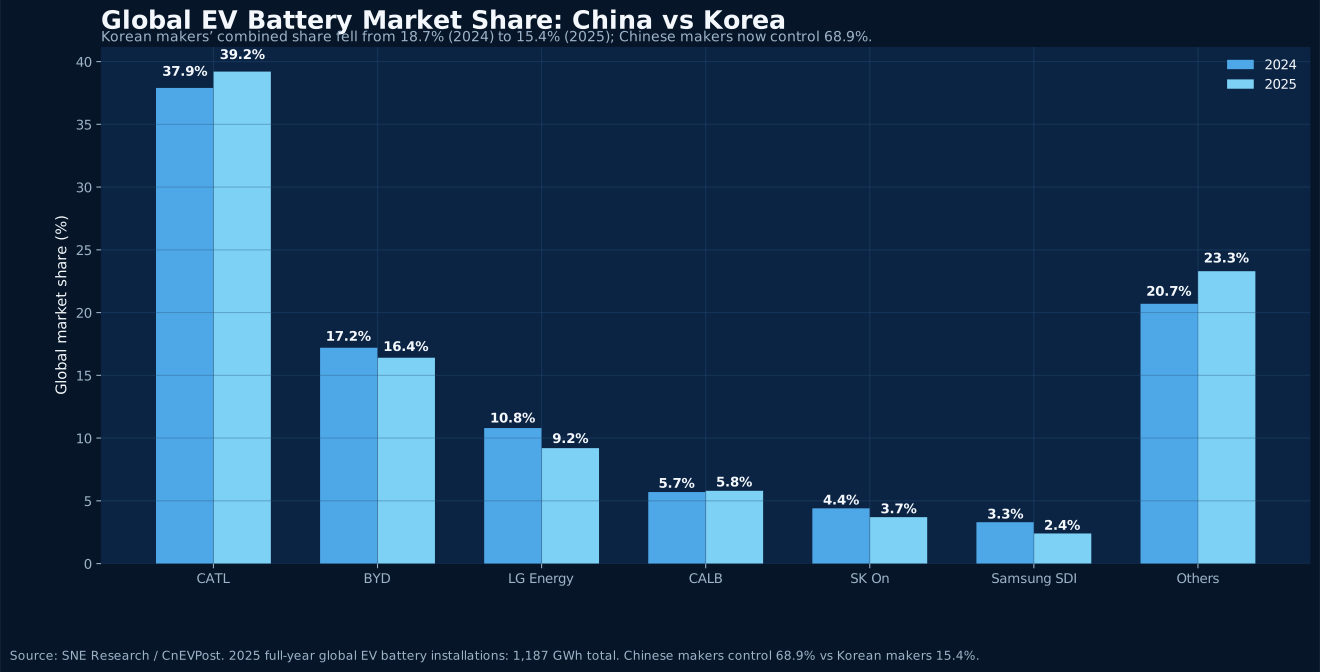
Global EV battery installations hit a record 1,187 GWh in 2025. Chinese battery makers captured 68.9% of the market, with CATL leading at 39.2% and BYD at 16.4%. This represents a dramatic shift from 2020, when Korean firms still held roughly 35% of the global market.
This shift is driven by Chinese firms’ comprehensive advantages in technology, scale, and cost. Through vertical integration from lithium mining to cell manufacturing, Chinese companies control the full value chain, while Korean firms remain heavily dependent on imports for raw materials. The rise of LFP battery technology has further strengthened China’s cost advantage.
2. The declining trajectory of Korea’s Big Three battery makers
LG Energy Solution’s global share fell from 10.8% (2024) to 9.2% (2025), SK On from 4.4% to 3.7%, and Samsung SDI from 3.3% to 2.4%. Their combined share dropped from 18.7% to 15.4%—a 3.3 percentage point decline in one year. This marks the fifth consecutive year of market share erosion, shrinking from 35% in 2020 to just 15.4% today.
SK On’s decline is particularly notable—despite heavy investment in US factory construction, uncertainty around IRA provisions has clouded its return on investment. Samsung SDI faces competitive pressure from CATL in the premium segment, with key customer BMW diversifying its procurement toward Chinese suppliers.
3. Raw material dependency: the Achilles’ heel of Korea’s battery industry
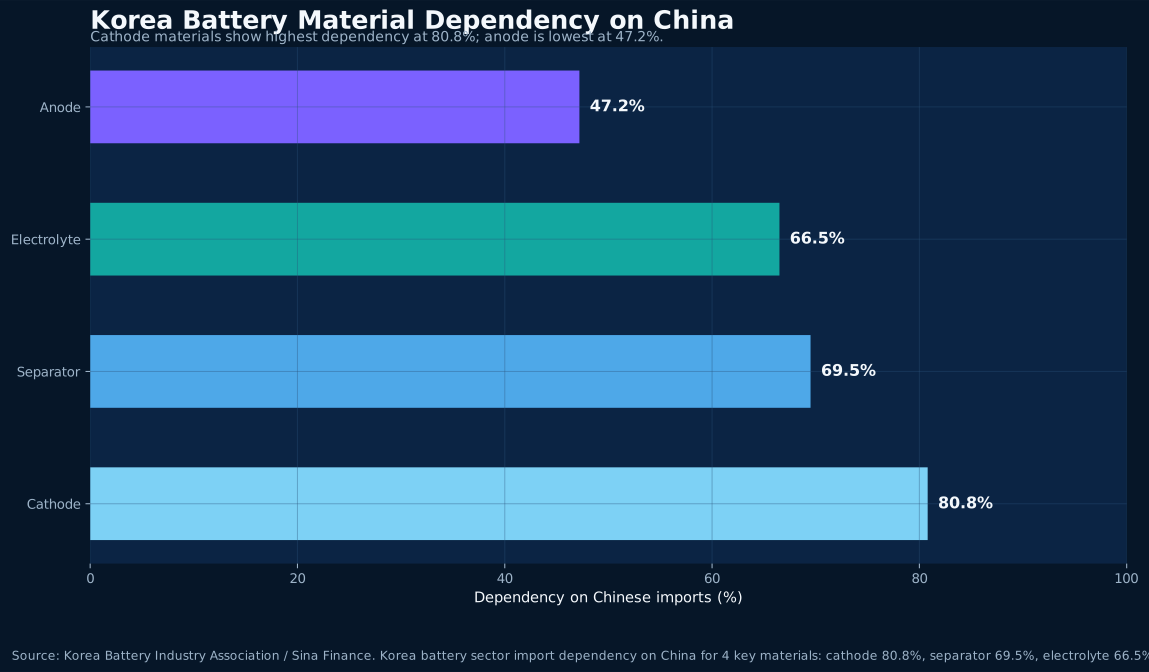
Korea’s four core battery materials show alarming dependency on Chinese imports: cathode at 80.8%, separator at 69.5%, electrolyte at 66.5%, and anode at 47.2%. This means every step of Korean battery production relies on the Chinese supply chain—especially cathode materials, the most expensive component, with over 80% sourced from China.
Adding to concerns, China has begun implementing export controls on lithium batteries, cathode materials, and graphite anode materials, effective November 2025. This means Korean firms may face even greater difficulty sourcing Chinese raw materials in the future—a risk amplified by current geopolitical tensions.
4. Korea’s policy response: massive funds and technology bets
Facing this challenge, the Korean government has taken multiple measures. In January 2025, it established a KRW 10 trillion (approx. USD 7.5B) supply chain security fund for overseas mineral resource development. Additionally, KRW 430 billion was allocated for R&D in EV core materials and components, focusing on next-generation solid-state and lithium-sulfur batteries.
However, experts widely agree these measures cannot change the situation in the short term. Commercialization of solid-state batteries is still 3–5 years away, and Chinese companies are also accelerating in this field. Overseas mineral development has long cycles and high risks. Until these efforts bear fruit, Korean firms will remain dependent on Chinese supply chains.
5. Challenges and adjustments in China-Korea joint ventures
China-Korea battery joint ventures are also facing adjustments. LG Chem and Huayou Cobalt’s LFP cathode plant in Morocco has been delayed from 2026 to 2027. SK On, ECOPRO Materials, and GEM’s precursor factory plan was scrapped due to weakening demand and IRA uncertainty. These cases reflect a deep restructuring of China-Korea battery cooperation.
Meanwhile, SK On’s battery factory in Yancheng, Jiangsu has become its largest single plant globally—revealing the tension between “de-China-ification” and “deepening China cooperation” among Korean firms. This dilemma will persist, and China-Korea battery cooperation will continue seeking new equilibrium amid complex geopolitics.
6. Implications for China-Korea trade enterprises
For enterprises engaged in China-Korea trade, the battery supply chain restructuring presents both challenges and opportunities. Korea’s strong demand for Chinese raw materials provides a stable export market for Chinese suppliers, while evolving export control policies may impact trade processes and compliance requirements.
We recommend China-Korea trade enterprises closely monitor changes in China’s export control lists and build compliance frameworks proactively. Meanwhile, Korean firms’ “China+1” supply chain strategies in Southeast Asia present new cooperation opportunities. Battery material trade will continue growing as a share of bilateral trade—a field worth focused attention from trade service companies.