China Leads Global Humanoid Robot Shipments
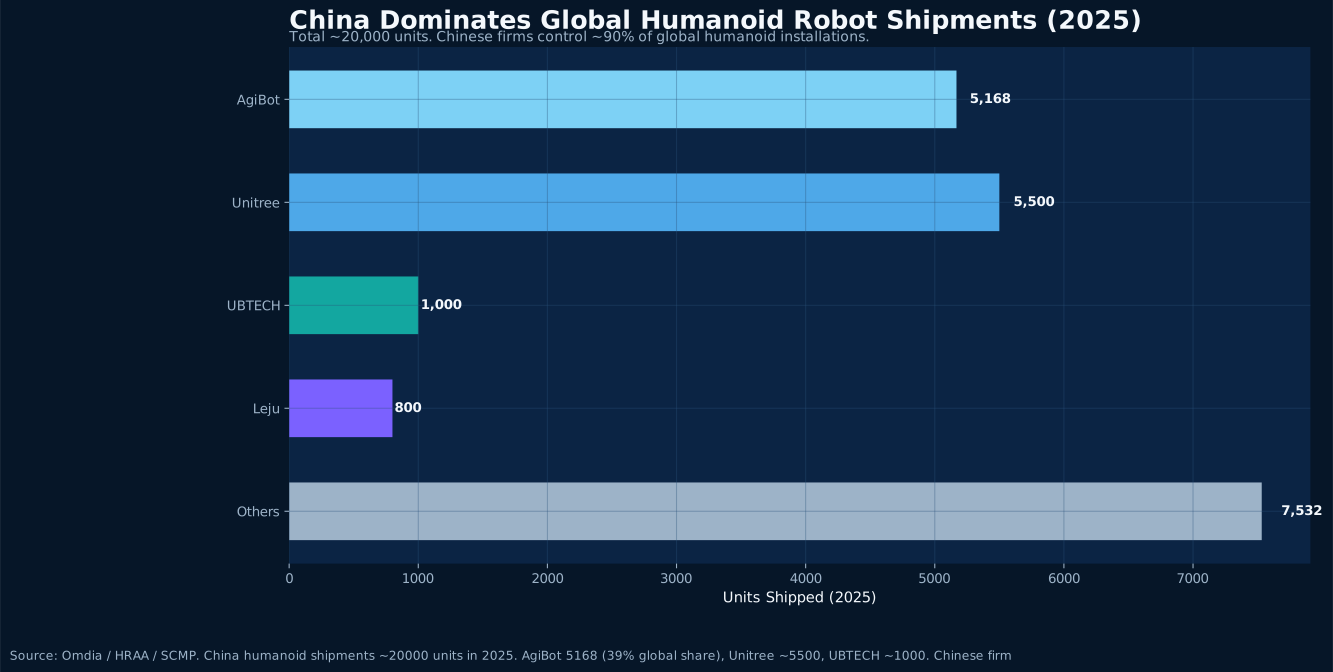
2025 marked a milestone year for China’s humanoid robot industry. According to the China Humanoid Robot Scene Application Alliance (HRAA), Chinese humanoid firms shipped approximately 20,000 units in 2025. Shanghai’s AgiBot led the world with 5,168 units shipped, capturing 39% of global market share. Hangzhou’s Unitree came in second with approximately 5,500 units. UBTECH shipped around 1,000 units, and Leju approximately 800 units.
Combining these figures, Chinese companies account for nearly 90% of global humanoid robot installations. Meanwhile, American humanoid firms such as Figure AI and Apptronik remain in small-batch pilot production. Chinese companies’ advantages lie in faster iteration cycles, lower production costs, and more abundant manufacturing application scenarios. This gap in scaled production capability may widen further in the coming years.
2026 Production Explosion: The 94% Growth Forecast
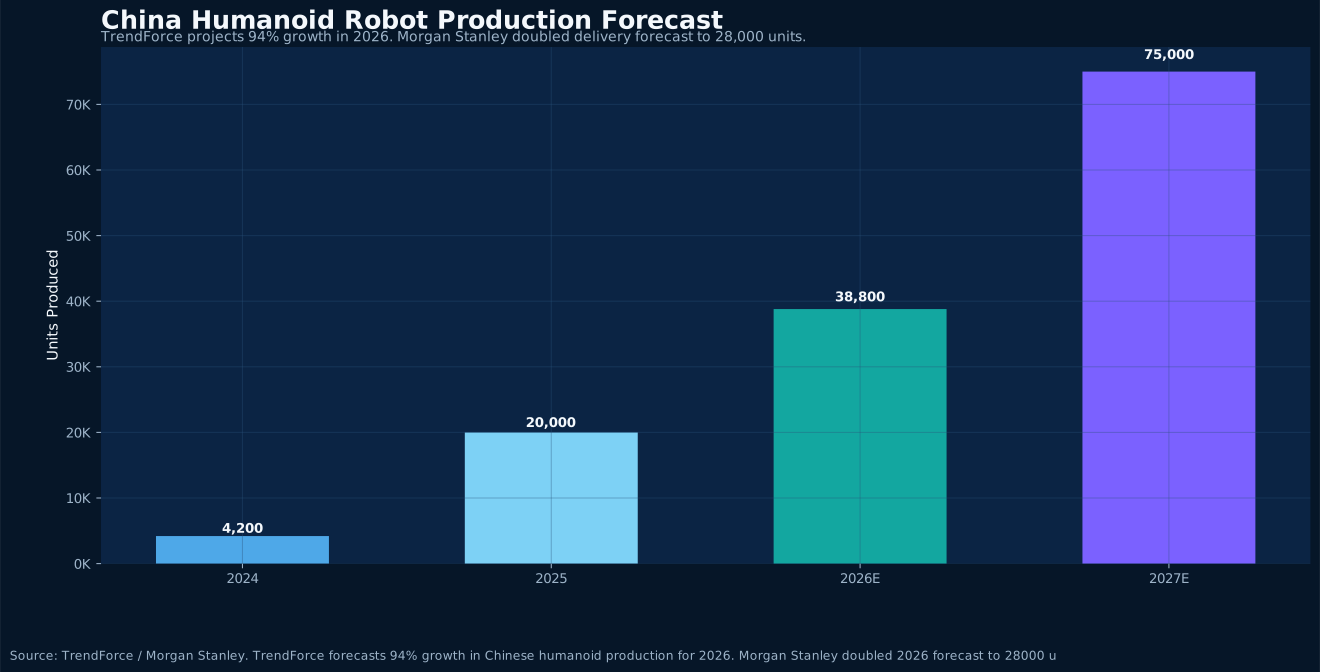
TrendForce forecasts that Chinese humanoid robot production will grow by as much as 94% in 2026, with commercialization accelerating notably in the second half. Morgan Stanley doubled its 2026 delivery forecast for the Chinese market to 28,000 units, a 133% increase over 2025. Unitree CEO Wang Xingxing stated his company’s 2026 delivery target is 10,000 to 20,000 units, while UBTECH set its industrial humanoid annual production target at 10,000 units.
Investment enthusiasm is equally staggering. In 2025, Chinese humanoid robot-related investment reached 39.8 billion yuan (approximately $5.5 billion) across 325 deals, a 326% year-over-year increase. Unitree closed its Series C at a $3 billion valuation, targeting a $7 billion IPO valuation. Galbot raised over $300 million. This capital-intensive influx is accelerating industrialization.
Commercialization: From Lab to Factory Floor
Commercialization of Chinese humanoid robots is progressing simultaneously across automotive manufacturing, logistics, and consumer applications. In automotive manufacturing, multiple OEMs have begun deploying humanoid robots on production lines for quality inspection, material handling, and assembly assistance. In logistics, humanoids are used for warehouse sorting and shelf management. On the consumer end, Unitree’s G1 and H1 models have entered the education and entertainment markets.
However, the commercialization process also faces real challenges. Reports indicate that over 150 companies in China are now involved in the humanoid robot space, but only 23% of buyers are satisfied with current products. This means the industry is still in its early stages, with significant room for improvement in technology maturity and application scenario matching. For cross-border trade companies, this is both a risk indicator and a market opportunity signal.
Korea Smart Factory Expo: New Window for China-Korea Robot Cooperation
In March 2026, Smart Factory & Automation World 2026 took place at COEX in Seoul, bringing together 500 smart manufacturing innovation companies from 24 countries across 2,300 booths. Notably, five Chinese humanoid robot companies—AGIBOT, Fourier, Huawei, Leju, and Unitree—exhibited collectively at a Korean expo for the first time, marking an important milestone in China-Korea robotics industry cooperation.
South Korea has long ranked first globally in industrial robot density, with 1,012 robots per 10,000 manufacturing workers. This deep automation DNA provides fertile ground for Chinese humanoid robots entering the Korean market. Korean companies’ high receptivity to automation technology and mature application scenarios offer an ideal test market for Chinese humanoid robots’ overseas expansion.
Future Outlook and Trade Opportunities
The humanoid robot industry stands on the eve of explosive growth. Morgan Stanley projects the global humanoid robot market will reach $5 trillion by 2050. For China-Korea trade, there are broad cooperation opportunities in robot components, sensors, servo motors, and software systems. South Korea’s advantages in precision manufacturing, sensor technology, and AI algorithms complement China’s scaled production capabilities and vast market demand. MO-TEK International Trade (Shanghai) will continue monitoring this rapidly evolving industry.
By Minghao, MO-TEK International Trade (Shanghai)