NVIDIA ‘Largely Concedes’ China Market: A Historic Turning Point
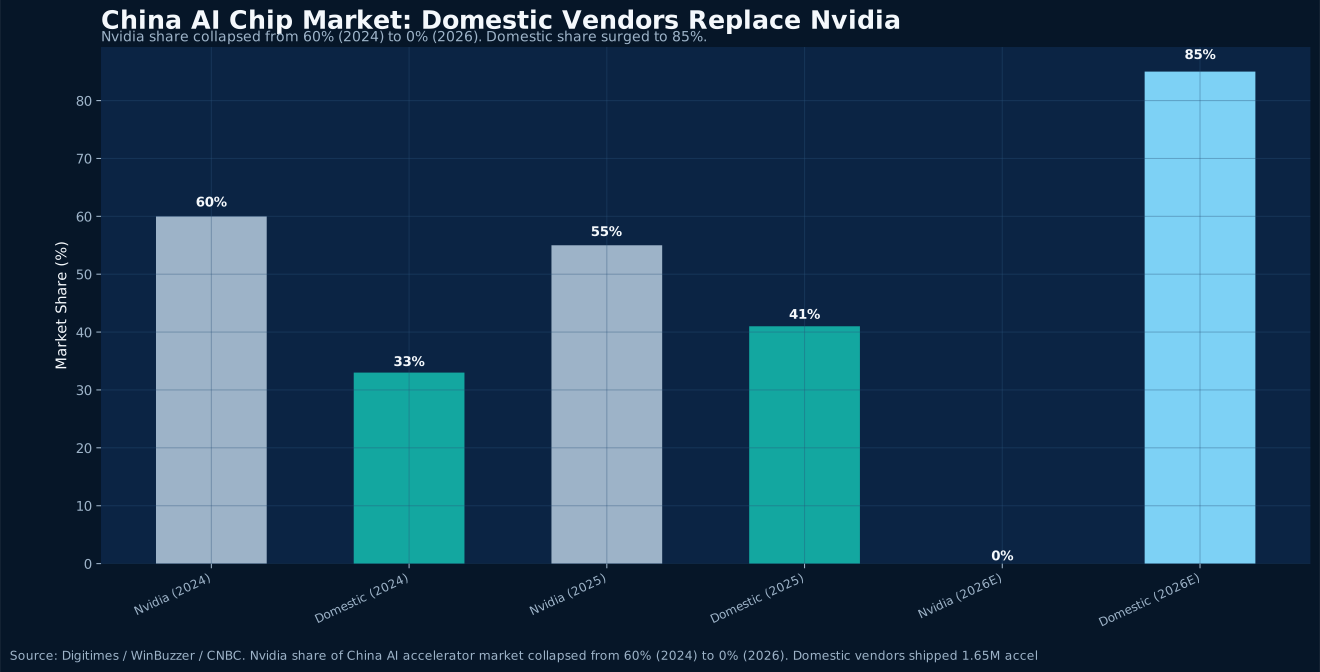
In May 2026, NVIDIA CEO Jensen Huang publicly acknowledged that the company has ‘largely conceded’ China’s artificial intelligence chip market. This statement marks a fundamental restructuring of the global AI hardware landscape. As U.S. export control policies continued to tighten—from restricting A100/H100 exports to China to blocking H200 shipments—NVIDIA’s share of China’s AI accelerator market collapsed from 60% in 2024 to zero. This is not merely one company’s market loss, but the latest manifestation of U.S.-China tech decoupling in the semiconductor domain.
From a trade perspective, this transformation has profound implications for the semiconductor supply chains of both China and South Korea. South Korea, as a global memory chip manufacturing center, sees Samsung and SK Hynix operating large-scale manufacturing bases in China, similarly constrained by U.S. export controls. As China accelerates domestic substitution, Korean semiconductor companies face the dual pressure of maintaining Chinese market share while complying with U.S. regulations.
Huawei’s Rise: From Follower to Market Leader
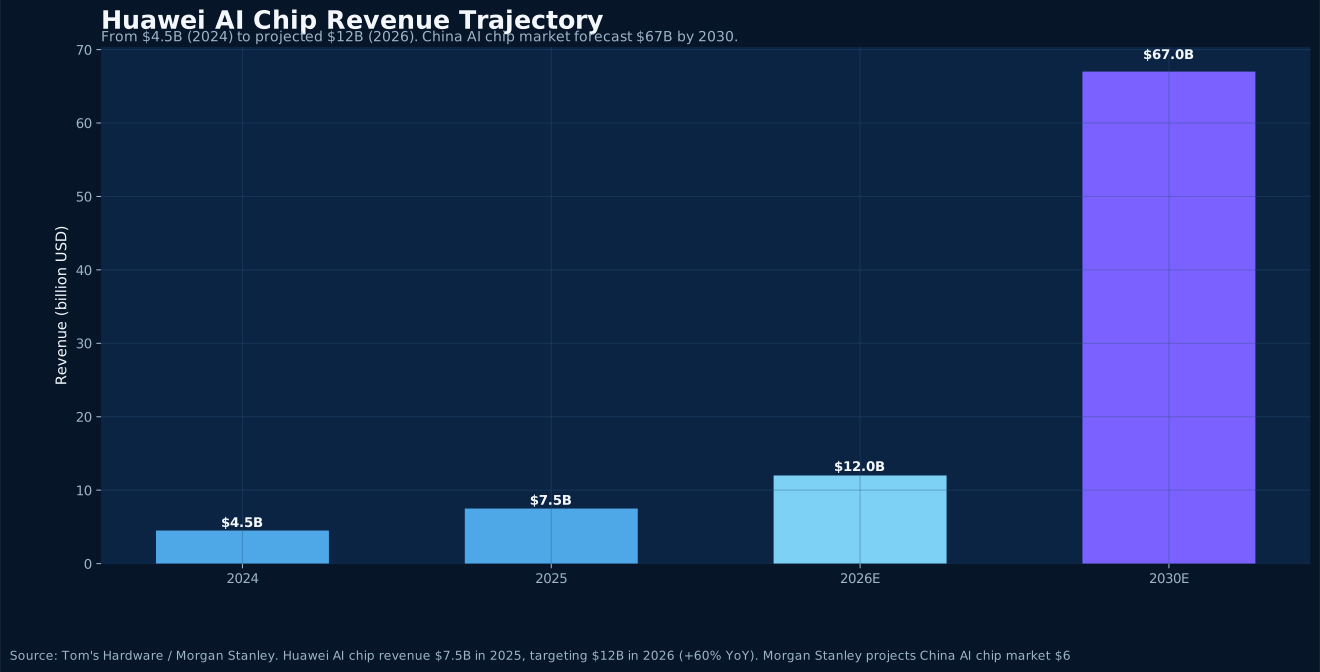
Huawei’s rise should be understood against the backdrop of AI chip market bifurcation. Its Ascend AI processor series—particularly the Ascend 910B and 920 chips—have become the backbone of China’s AI infrastructure. Huawei’s AI chip revenue reached $7.5 billion in 2025, with the 2026 target elevated to $12 billion, representing 60% year-over-year growth. This pace reflects not only robust market demand but also China’s firm resolve on the path to AI hardware self-sufficiency.
However, Huawei’s supply chain also faces challenges. Chinese foundries struggle to keep pace with demand growth, and advanced-node chip production remains dependent on limited domestic manufacturing capabilities. Nevertheless, through software optimization and architectural innovation, Huawei has demonstrated performance comparable to NVIDIA products across multiple benchmarks. The release of the DeepSeek V4 model further proves that the AI ecosystem built on Huawei hardware has achieved commercial competitiveness.
The Comprehensive Rise of the Domestic Supplier Ecosystem
The rise of domestic Chinese AI chips is not solely a Huawei story. According to WinBuzzer, Chinese domestic chipmakers captured 41% of the AI chip market in 2025, shipping 1.65 million accelerator cards. Beyond Huawei, companies like Hygon, Cambricon, Biren, and Enflame have achieved significant breakthroughs in their respective niches, forming a multi-layered domestic AI chip supply system.
From a broader perspective, the global share of Chinese open-source AI models has surged from 1.2% in late 2024 to nearly 30%. Alibaba Cloud’s Qwen model has exceeded 700 million downloads on Hugging Face. DeepSeek V4’s output pricing is just $3.48 per million tokens, compared to $30 and $25 from OpenAI and Anthropic respectively. This price advantage is reshaping the competitive landscape of global AI applications, while also creating new possibilities for China-Korea cooperation at the AI application layer.
The New Reality of China-Korea Semiconductor Trade
For the China-Korea trade relationship, AI chip market bifurcation brings both opportunities and challenges. On one hand, China’s massive demand for high-performance AI computing infrastructure creates market space for key Korean components like HBM (High Bandwidth Memory). SK Hynix dominates globally in HBM, and its products are critical for enhancing the performance of China’s domestic AI chips.
On the other hand, the acceleration of China’s AI chip self-sufficiency also means South Korea’s long-term position in the Chinese semiconductor market may face erosion. As China intensifies domestic substitution across memory chips, logic chips, and packaging and testing, Korean companies need to reassess their China strategy, seeking sustainable cooperation models within compliance frameworks. Morgan Stanley projects that by 2030, China’s AI chip market will reach $67 billion, with 86% supplied by domestic vendors.
Future Outlook and Strategic Recommendations
AI chip market bifurcation is an irreversible trend. For businesses engaged in trade between China and Korea, understanding this structural change is critical. China’s burgeoning AI computing ecosystem will generate substantial demand for software tools, data services, and derivative hardware, creating new spaces for cooperation between the two countries in non-restricted domains. MO-TEK International Trade (Shanghai) will continue tracking developments in this crucial sector.
By Minghao, MO-TEK International Trade (Shanghai)