Gap and Ambition: Starlink Leads, China Races to Catch Up
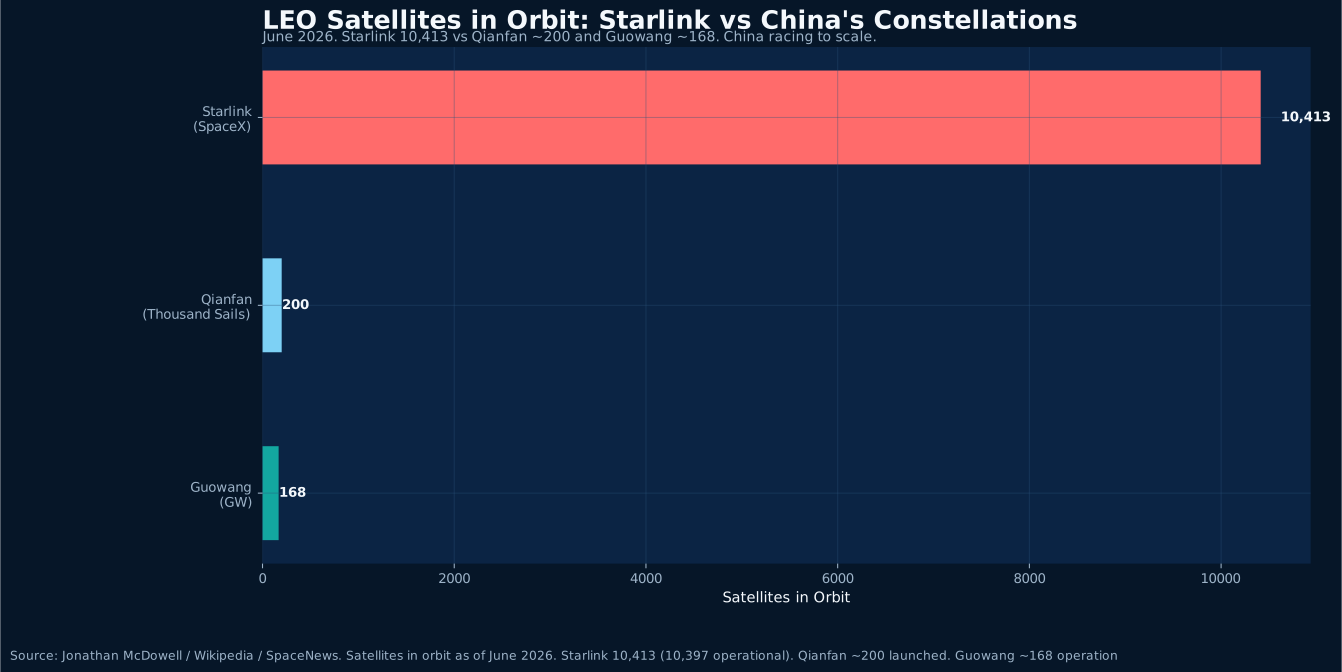
Low-Earth-orbit (LEO) satellite internet has become a new frontier in the global competition over digital infrastructure. As of June 2026, SpaceX's Starlink had over 10,400 satellites in orbit, of which about 10,397 were operational—a commanding lead. By contrast, China's two major constellations remain in early deployment: Qianfan (Thousand Sails) at about 200 satellites, and Guowang (GW) at about 168. This gap reflects China's later start in LEO satellites but also signals vast room to catch up.
The gap has not dampened China's ambition. The Qianfan constellation plans over 15,000 satellites and Guowang over 13,000—more than 28,000 combined—aiming to build a globe-spanning Chinese version of satellite internet. Unlike Starlink, China's constellations will enjoy a protected domestic market, while the state vigorously develops new launch vehicles and mass satellite-manufacturing capacity. This dual assurance—driven by national strategy and underpinned by market demand—gives China's mega-constellation plans strong execution certainty.
Qianfan Constellation: The Shanghai-Led Commercial Pioneer
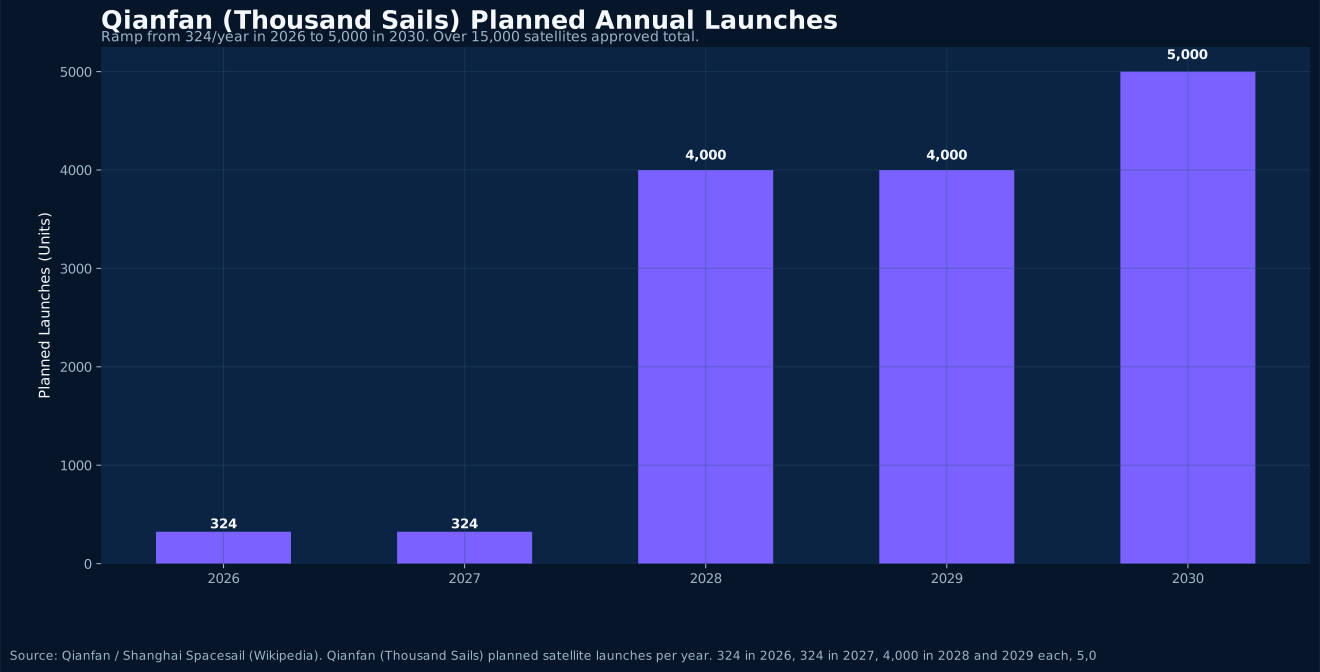
The Qianfan constellation is operated by Shanghai Spacesail Technologies Co., Ltd.; the name means Thousand Sails. Launched in 2024 as a rival to SpaceX's Starlink, Qianfan's public plan calls for 324 launches in 2026, another 324 in 2027, 4,000 each in 2028 and 2029, and 5,000 in 2030, with the total approved to operate exceeding 15,000 satellites. As of June 2026, about 200 had been launched—on the eve of dense network build-out.
Qianfan carries a stronger commercial flavor, actively expanding overseas and negotiating satellite-internet service cooperation with multiple countries—seen as a pioneer in China's satellite-internet going global. From a value-chain view, Qianfan's dense launch schedule will drive large-scale demand for satellite platforms, phased-array antennas, inter-satellite laser links, ground gateways and user terminals. User terminals in particular—as commercial service nears—will see demand for low-cost, easy-to-deploy satellite terminal equipment released rapidly.
Guowang and the Industrial Ecosystem: The National Team's Systemic Layout
Guowang (GW), launched in 2022 and led by the national team, plans over 13,000 satellites. Its deployment plan calls for 310 launches in 2026, 900 in 2027, and 3,600 annually from 2028. As of mid-April 2026, Guowang had deployed about 168 satellites via 21 launch missions, all entering the GW-2 sub-shell at roughly 1,145 km altitude. Guowang places greater emphasis on national communications security and strategic coverage, complementing Qianfan's commercial positioning.
The parallel advance of the two constellations is spawning a vast satellite-manufacturing and supporting ecosystem. China has built satellite super-factories in several locations, aiming for assembly-line mass production to sharply cut per-satellite cost. The chain spans satellite final assembly, solar panels, propulsion systems, onboard chips, ground-terminal chips and antennas, and more. For upstream component and materials suppliers, the mass production of mega-constellations means stable and continuously ramping sourcing demand.
Implications for China-Korea Trade: Terminals, Ground Segment and Materials
The explosive build-out of satellite internet creates opportunities for China-Korea trade across several niches. In terminal equipment, as Qianfan and Guowang near commercial service, demand for flat-panel phased-array antennas, low-noise amplifiers and RF front-end modules will rise rapidly, where China's supply chain has cost and capacity advantages. In the ground segment, gateways, modem equipment and O&M services also offer cross-border cooperation space. Korea's technical depth in RF chips, compound semiconductors and precision manufacturing complements China's capacity.
It must be noted that satellite communications involve sensitive issues such as spectrum coordination, national security and export controls, so cross-border trade must prioritize compliance. MO-TEK recommends that traders participating in the satellite-internet chain focus on civilian, non-sensitive components and materials, strictly observe bilateral export-control lists and spectrum-certification requirements, and prioritize suppliers with complete qualifications and quality systems, in order to seize opportunities steadily in this strategic emerging industry.
Outlook: China as a Variable in the Space-Internet Era
Although the current in-orbit count lags far behind Starlink, China is accelerating mega-constellation build-out with national will. As reusable-rocket technology matures, satellite-manufacturing costs fall and launch cadence rises, China's in-orbit LEO satellite count could see exponential growth over the next three to five years. Satellite internet is not only about coverage in remote regions and oceans but also a key foundation for 6G, IoT, autonomous driving and emergency communications—its strategic value is hard to overstate.
For enterprises focused on frontier technology and cross-border trade, satellite internet represents a long-cycle, high-strategic-value emerging track. Though barriers are high and compliance strict, the vast supporting chain it drives holds rich niche opportunities. MO-TEK will continue tracking the progress, value-chain dynamics and compliance requirements of China's satellite internet, providing clients with professional insight and pragmatic support in this future-facing field.
By Minghao, Shanghai MO-TEK International Trade (MO-TEK).