Triple-Digit Growth: Smart Glasses Hit the Mainstream Inflection Point
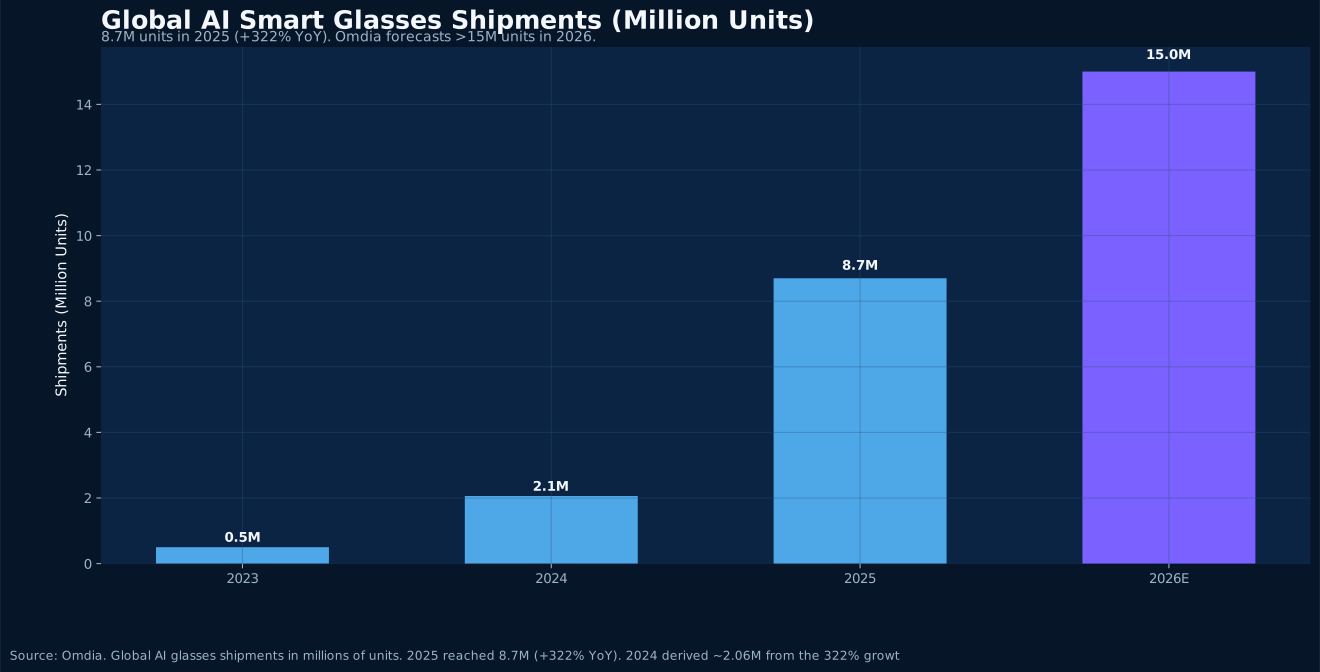
In 2025, AI smart glasses genuinely entered the mainstream. According to research firm Omdia, global shipments jumped from roughly 2.06 million units in 2024 to 8.7 million, a 322% year-on-year surge. That pace far outstrips mature categories such as smartphones and tablets, signaling that the center of gravity in consumer electronics demand is shifting toward lightweight, wearable AI gateways. Omdia further projects shipments will exceed 15 million units in 2026, as the industry moves into volume scaling.
The core driver of this boom is the fusion of generative AI with hardware. The new generation of glasses is no longer a substitute for Bluetooth earphones but a wearable AI terminal integrating real-time translation, visual recognition, voice assistants and cameras. Meta's Ray-Ban line, with fashionable design and ecosystem integration, held about 85.2% of the global market in 2025, an absolute lead. Yet such high concentration means that for brands hoping to enter the field, differentiated positioning and supply-chain efficiency will be decisive variables.
China, the Fastest-Growing Market: New Players and Price Wars
Within the global landscape, mainland China was the fastest-growing market in 2025. Omdia notes that, driven by dense product launches, a wave of new entrants and aggressive pricing, China shipped nearly 1 million units, about 10.9% of the global total, becoming the second-largest market after the US. Domestic vendor Rokid and smartphone maker Xiaomi quickly rose to global No.2 and No.3, while cross-industry players such as Li Auto joined in, reflecting how AI glasses are extending from a single consumer-electronics product into a smart-terminal ecosystem.
Price is China's key lever. Leveraging a complete consumer-electronics supply chain, domestic brands have pushed mainstream AI-glasses prices to half or less of overseas brands, rapidly cultivating user habits. Display-equipped AI glasses are especially notable—their global share rose from 3.3% in 2024 to 8.4% in 2025, reaching 730,000 units, with Chinese firms such as Rokid, Alibaba and Even Realities holding 71% of that premium segment. This means China leads not only in volume markets but is also penetrating the higher-tech display track.
Supply-Chain View: China's Structural Manufacturing Advantage
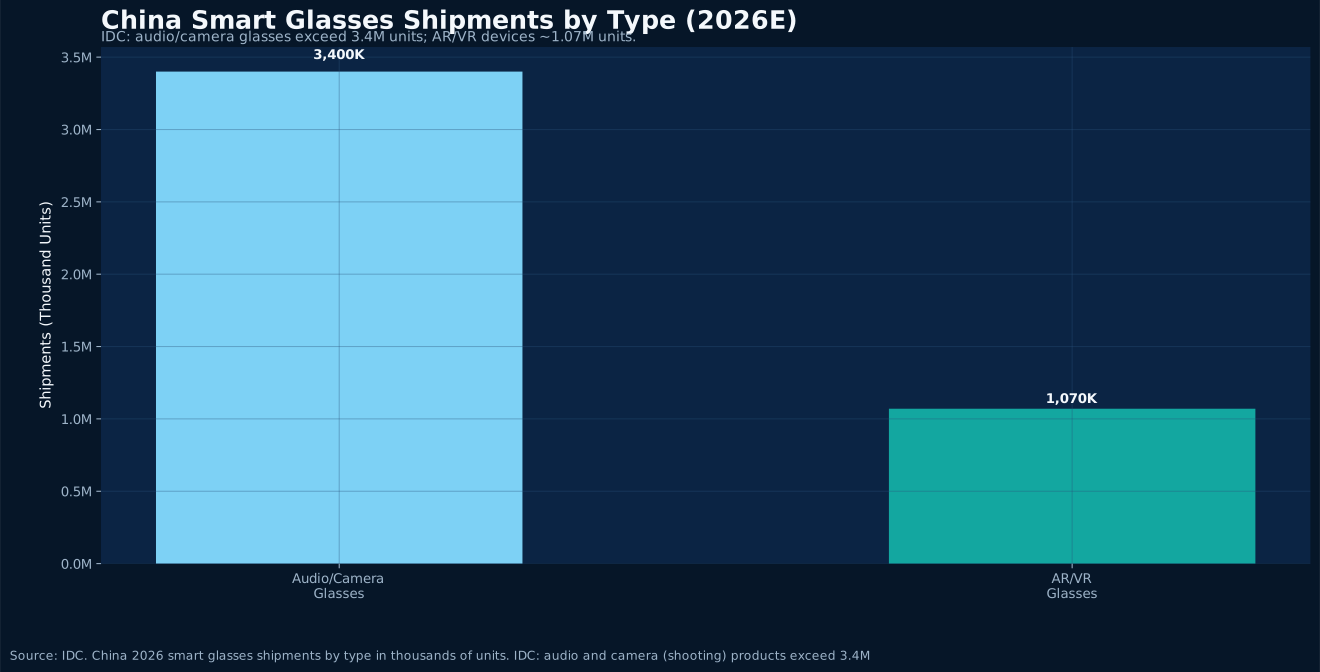
The bill of materials for AI smart glasses depends heavily on China's supply chain. Micro-displays (Micro-LED and diffractive waveguides), bone-conduction and directional acoustic modules, ultra-small batteries, flexible hinges and lightweight frames—the capacity for most key components is concentrated in the Yangtze River Delta and Pearl River Delta. This cluster effect lets Chinese contract manufacturers iterate from design validation to small-batch production within weeks, sharply compressing brands' time-to-market. IDC projects China will ship over 3.4 million audio and camera glasses in 2026 and about 1.07 million AR/VR units, with scale effects further diluting unit costs.
For Korean and global brands, this implies two clear paths: first, rapidly launching own-brand products via ODM/OEM using Chinese capacity; second, sourcing China's core modules (such as waveguides and acoustic units) for local integration and software differentiation. Korea has deep strengths in semiconductors, display driver ICs and AI algorithms, forming a natural complement to China's hardware capacity. MO-TEK has observed Korean small and mid-sized brands beginning to validate smart-glasses prototypes through Chinese supply chains, a trend expected to accelerate in 2026.
Korea Market Opportunity: Local Demand and Brand White Space
In its 2026 outlook, Omdia explicitly notes that the rise of local players in India, Japan and Korea will be an important driver of global market expansion. Korean consumers are highly receptive to new wearables and enjoy world-leading 5G networks and a rich content ecosystem, providing ideal ground for AI glasses in translation, navigation and content-consumption scenarios. Yet Korea's domestic AI-glasses brands remain at an early stage, leaving a clear brand white space—precisely the window that China-Korea supply-chain collaboration can fill.
For traders and buyers, the key lies in mastering three nodes: choosing mature module suppliers with display and acoustic integration capabilities, ensuring compliance with Korea's radio certification (KC) and wireless-spectrum requirements, and establishing stable after-sales and firmware-update mechanisms. Smart glasses involve cameras and privacy compliance; Korea's Personal Information Protection Act has clear rules on recording functions, and compliance-by-design can significantly reduce market-entry risk. These are all elements that must be jointly planned when Chinese supply chains and Korean channels collaborate deeply.
Outlook: From Hardware Race to Ecosystem Competition
As shipments head toward the 15-million-unit level in 2026, the center of competition in AI smart glasses is shifting from hardware specs to ecosystems and services. Battery life, weight and display clarity remain baseline thresholds, but what truly determines user retention will be the usefulness of AI assistants, the richness of app ecosystems and cross-device collaboration. Chinese vendors lead on hardware cost and iteration speed, while ecosystems and premium experiences still have room to improve—leaving ample space for China-Korea cooperation at the chip, algorithm and content layers.
For trading enterprises serving the China-Korea markets, 2026 is a critical window to position in the AI smart-glasses track. We recommend locking in high-quality module and OEM resources early, building a compliance framework, and validating localized demand through small-batch trial sales. MO-TEK will continue to track this category's supply-chain dynamics and certification requirements, offering clients one-stop support from product selection and sourcing to compliant market entry.
By Minghao, Shanghai MO-TEK International Trade (MO-TEK).