The Cooling Bottleneck of AI Compute: Air Cooling Hits Its Limit
The explosion of generative AI has brought unprecedented compute demand—and unprecedented cooling challenges. The power draw of a single high-end AI accelerator has climbed from hundreds of watts to the kilowatt level, with rack power density breaking 50 kW or even 100 kW. Traditional air cooling is overwhelmed at such heat densities. With thermal conductivity far higher than air, liquid cooling has become the inevitable choice to keep high-density GPU clusters stable, and the industry is undergoing a structural shift from air to liquid.
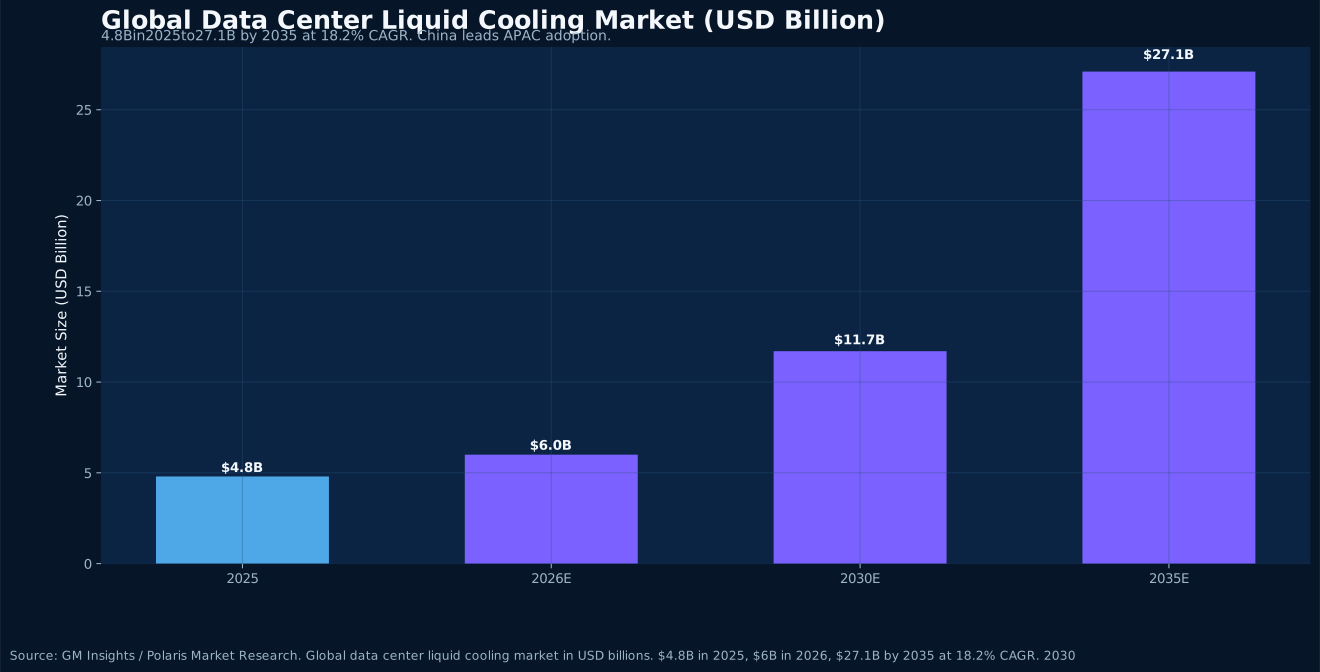
According to firms such as GM Insights and Polaris, the global data-center liquid-cooling market was about $4.8 billion in 2025, will grow to roughly $6 billion in 2026, and is expanding at an 18.2% CAGR to reach $27.1 billion by 2035. Behind this pace are hyperscale cloud investment, a wave of new AI data-center construction, and intense demand for energy efficiency and PUE (power usage effectiveness) optimization. Liquid cooling is no longer reserved for a few high-performance computing scenarios but is becoming the standard configuration for data centers in the AI era.
Technology Tracks: The Divergence of Direct-to-Chip and Immersion
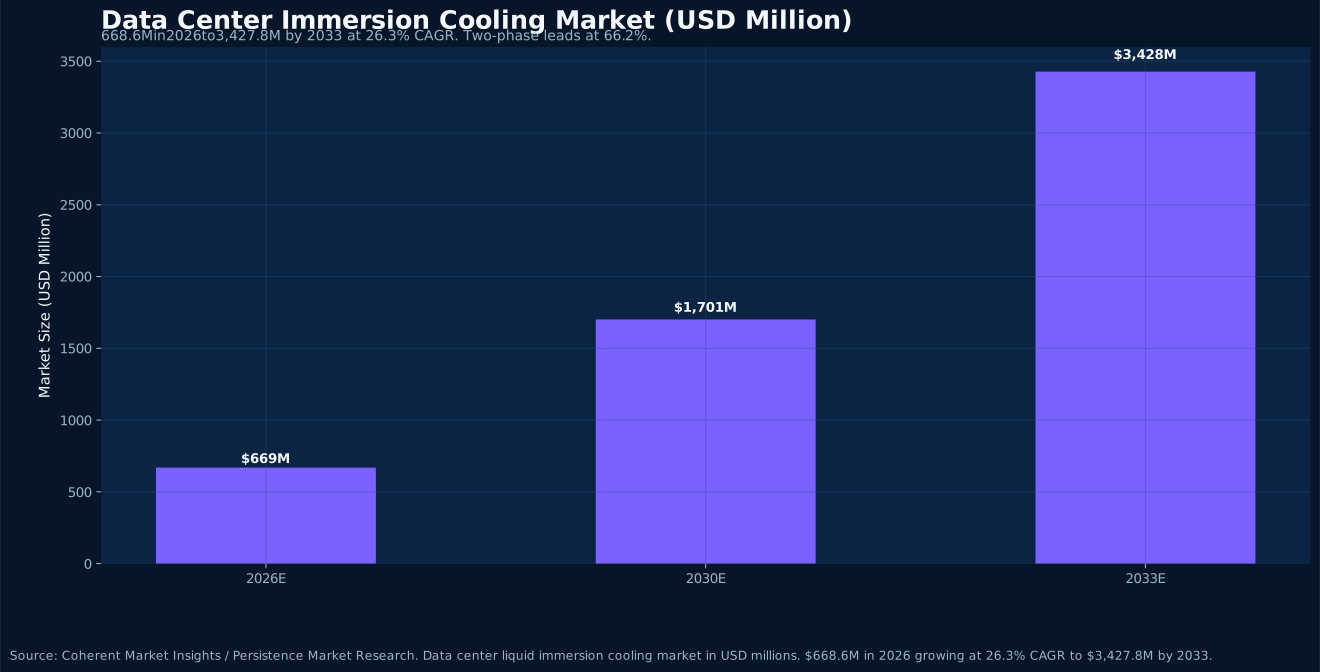
Liquid cooling currently splits into two technology tracks: direct-to-chip (cold plate) and immersion. Direct-to-chip removes heat via coolant circulating through metal cold plates pressed against the chips; with relatively low retrofit cost and good compatibility with existing rooms, it is the mainstream of current deployment. Immersion submerges entire servers in dielectric coolant for higher efficiency, especially suited to ultra-high-density GPU clusters. Immersion further divides into single-phase and two-phase, with two-phase—able to manage extreme heat loads—expected to hold about 66.2% of the immersion market in 2026.
Though immersion cooling has higher upfront cost, it is growing the fastest. Per firms such as Coherent Market Insights, the global data-center immersion-cooling market will grow from about $668.6 million in 2026 to $3,427.8 million by 2033, a CAGR of 26.3%. The two tracks are not mutually exclusive but complementary, addressing different power densities and retrofit needs. For equipment and materials suppliers, demand for core components—cold plates, quick connectors, CDUs (coolant distribution units), dielectric coolants and manifolds—is ramping in tandem.
China Leads APAC: Policy Mandates and Hyperscaler Deployment
China is the absolute leader in APAC liquid-cooling adoption, driven first by policy. The state imposes a strict PUE ≤1.3 efficiency standard for new data centers, with some tier-one cities requiring even lower—fundamentally driving liquid cooling at scale. Industry forecasts suggest that by 2025, over 40% of China's new hyperscale data centers will incorporate liquid-cooling capability, with both direct-to-chip and immersion gaining significant penetration. With mandates and subsidies working together, the growth certainty of China's liquid-cooling market far exceeds that of other regions.
Hyperscalers' practice confirms the trend. Alibaba Cloud uses immersion cooling in its AI-optimized data centers to support ultra-high-density GPU clusters; Tencent's liquid-cooled facilities serve gaming, social and AI; ByteDance's infrastructure powers recommendation algorithms and generative-AI research; and Huawei Cloud's regional facilities deploy advanced cooling architectures. The scale validation by these leaders is driving technical maturity and cost declines across the supply chain, while creating a stable demand base for upstream components and coolant materials.
Trade Opportunity: Equipment, Materials and China-Korea Collaboration
The rapid expansion of the liquid-cooling chain opens multi-tiered opportunities for traders. Upstream includes coolants (fluorinated fluids, synthetic oils), copper/aluminum cold plates, seals and quick connectors; midstream includes CDUs, manifolds and coolant-distribution systems; downstream covers full-rack liquid-cooling solutions and O&M services. China has a complete industrial chain and cost advantage in manufacturing, giving related equipment and materials huge export potential. For the Korean market, demand for high-reliability liquid-cooling components is rising rapidly as AI data-center construction accelerates.
Korea's stringent quality requirements in semiconductors and high-end manufacturing complement China's cost and capacity advantages in liquid-cooling components. MO-TEK recommends that traders entering the liquid-cooling chain focus on three areas: coolant material compatibility and environmental certification, long-term component reliability and leak protection, and compliance with the target market's safety and EMC standards. Establishing quality traceability and certification systems early is key to capturing this high-growth track.
Outlook: Liquid Cooling Becomes the Utility of the AI Era
As AI models keep scaling and per-chip power keeps climbing, liquid cooling is shifting from optional to rigid infrastructure for AI data centers—like water and power to industry. The global convergence of efficiency policies, tightening carbon constraints and rising electricity costs are all accelerating the process. Over the next five years, liquid-cooling penetration in new AI data centers is expected to keep rising, with immersion likely to expand its share further in ultra-high-density scenarios.
For enterprises deeply engaged in China-Korea trade, liquid cooling represents a high-certainty, moderate-barrier, continuously growing premium track. Seizing the policy window, binding quality manufacturing resources, and building compliance and quality moats will be the winning approach for years to come. MO-TEK will continue tracking liquid-cooling technology evolution and cross-border sourcing opportunities, helping clients position precisely amid the AI-infrastructure wave.
By Minghao, Shanghai MO-TEK International Trade (MO-TEK).