Korea’s World-Leading Robot Density: The Deep Advantage of Automation DNA
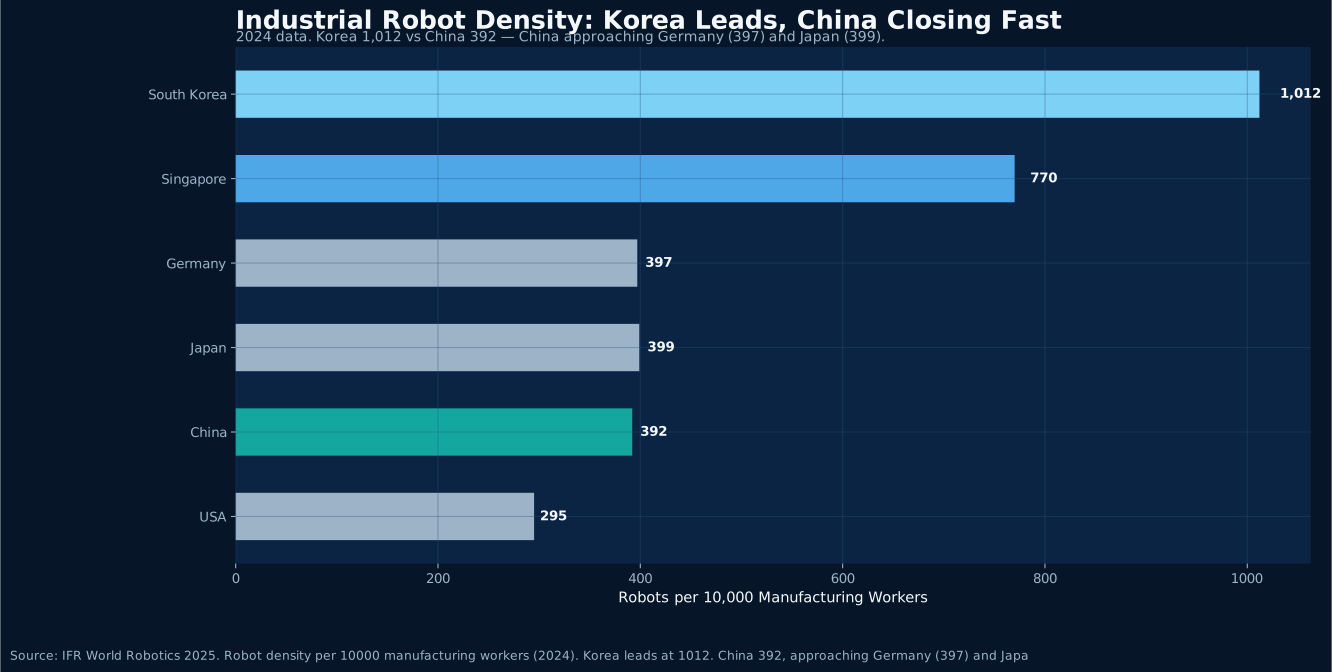
According to the latest data from the International Federation of Robotics (IFR), South Korea maintains its global leadership with 1,012 robots per 10,000 manufacturing workers, far ahead of Singapore (770), Germany (397), Japan (399), and China (392). This figure reflects Korean manufacturing’s deep reliance on automation technology and demonstrates the maturity of Korean companies in the smart manufacturing domain.
Korea’s Ministry of SMEs and Startups has elevated smart factory adoption as a national strategic priority, with the 2026 smart factory budget reaching KRW 402 billion (approximately $275 million), a 70% increase over 2025. The government plans to raise factory automation rates nationwide to 10% by 2030. This policy support creates opportunities for Chinese automation equipment and smart manufacturing solutions to enter the Korean market.
China’s Industrial Robot Installations: Scale Advantage and Quality Upgrades
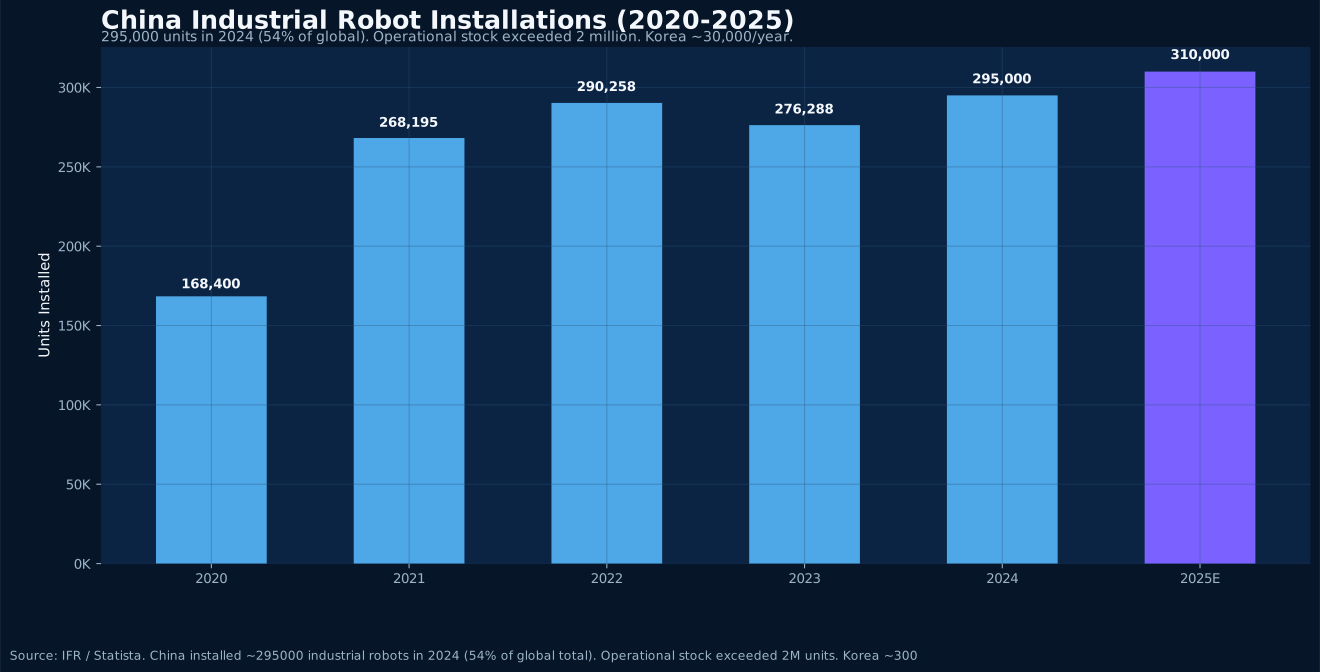
China has led global industrial robot installations for consecutive years. According to IFR data, China installed approximately 295,000 industrial robots in 2024, accounting for 54% of the global total, with operational stock crossing the 2 million mark for the first time. By comparison, Korea installs around 30,000 units and Japan approximately 44,500 units annually. China’s installation volume is nearly ten times Korea’s, reflecting the massive scale of China’s manufacturing automation transformation.
Notably, China’s robot density is also rising rapidly—from 140 in 2018 to 392 now, with annual growth exceeding 20%. At this trajectory, China will surpass Germany (397) within 12 months and could approach Japan (399) in the coming years. This rapid catch-up signals that Chinese manufacturing is transitioning from ‘quantitative expansion’ to ‘qualitative improvement,’ with sustained growth in demand for high-end automation equipment.
China’s Manufacturing Upgrade Blueprint: Large AI Models Enter the Factory
China’s Ministry of Industry and Information Technology (MIIT) released its Reference Guide for Promoting Digital Transformation in Key Industries in September 2025, setting ambitious targets: promoting 3-5 general-purpose large AI models for deep manufacturing application, launching 1,000 high-level industrial intelligent agents, building 100 high-quality industrial datasets, and promoting 500 typical application scenarios. By 2025, over 70% of large manufacturing enterprises in China had substantially completed digital networking.
This blueprint holds significant implications for China-Korea smart manufacturing cooperation. Chinese companies undergoing digital transformation need large quantities of sensors, control systems, and software platforms—areas where Korea possesses deep technological expertise. Meanwhile, China’s experience in large-scale smart factory construction and cost optimization can also serve the smart upgrading needs of Korean SMEs.
Analysis of China-Korea Smart Manufacturing Complementarity
The complementarity between China and Korea in smart manufacturing is evident. Korea’s advantages include rich application experience from its world-leading robot density, top-tier sensor and precision manufacturing technology, and core robot component companies represented by ROBOTIS. China’s advantages lie in its massive market scale and application scenarios, strong scaled production capabilities, and robust innovation in humanoid robots and AI applications.
This complementarity is already manifesting in actual cooperation. Korean company ROBOTIS partnered with MIT to develop ‘Physical AI’ technology, supported by Korea’s KIAT and the Ministry of Trade, Industry, and Energy. Chinese companies contribute valuable experience in scaled applications and cost control. Ten years after the launch of ‘Made in China 2025,’ China’s industrial robot installations maintain approximately 10% average annual growth, projected to continue through 2028.
Trade Outlook and Strategic Recommendations
Smart manufacturing is a key growth driver for China-Korea trade. As Chinese manufacturing shifts from ‘quantitative expansion’ to ‘qualitative improvement,’ demand for Korean high-end automation equipment, sensors, and control systems will continue growing. Meanwhile, China’s competitiveness in humanoid robots, collaborative robots, and AI vision inspection brings new products and solutions to the Korean market. MO-TEK International Trade (Shanghai), as a professional China-Korea trade service provider, will continue monitoring bilateral cooperation opportunities in smart manufacturing.
By Minghao, MO-TEK International Trade (Shanghai)