AI's Electricity Bill: From Compute Race to Power Race
What sustains the AI boom is not only chips but vast amounts of power. As model training and inference scale exponentially, a single hyperscale data center can consume as much electricity as a mid-sized city. International agencies project global data-center electricity use could reach about 1,300 TWh per year by 2035. When grid expansion cannot keep pace with compute growth, where the power comes from becomes the real bottleneck of the AI race.
Renewables are clean, but the intermittency of wind and solar struggles to meet data centers' round-the-clock baseload needs, while gas faces carbon and long-term price pressures. Against this backdrop, nuclear—able to supply stable, low-carbon power that can be sited near loads—is winning back the favor of tech giants, and the most watched option is the small modular reactor (SMR).
Why SMRs Win: Small, Fast, Flexible
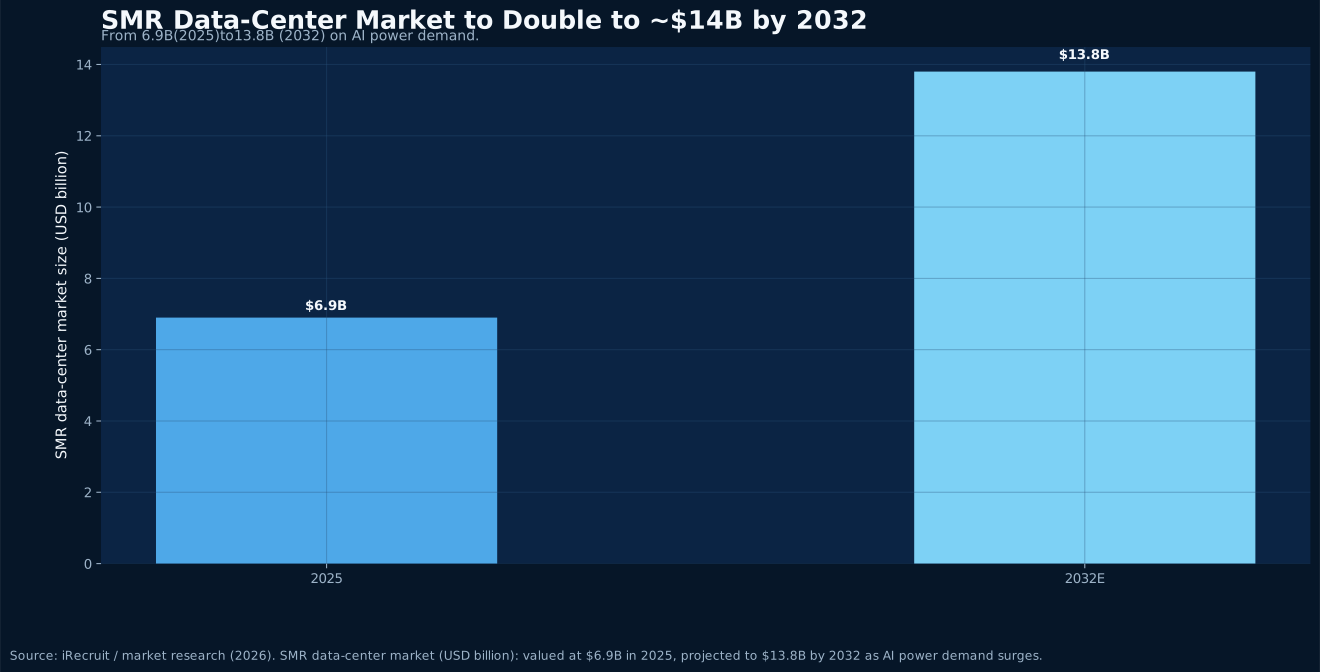
Compared with traditional gigawatt-scale plants, an SMR typically outputs tens of megawatts up to 300 MW, can be modularly prefabricated in factories and assembled on site, with shorter build times and more controllable upfront capital. Research projects the SMR data-center market growing from about $6.9B in 2025 to roughly $13.8B by 2032—doubling in seven years. That growth is driven almost entirely by AI data-center power demand.
SMRs' flexibility also shows in siting: they can be built near data-center campuses, even enabling integrated nuclear-plus-compute layouts that reduce long-distance transmission losses and interconnection waits. For AI superclusters that routinely need hundreds of megawatts of dedicated power, this power-follows-load model is exactly what traditional grids struggle to deliver quickly.
Giants Place Bets: Behind 9.8+ GW of Nuclear Orders
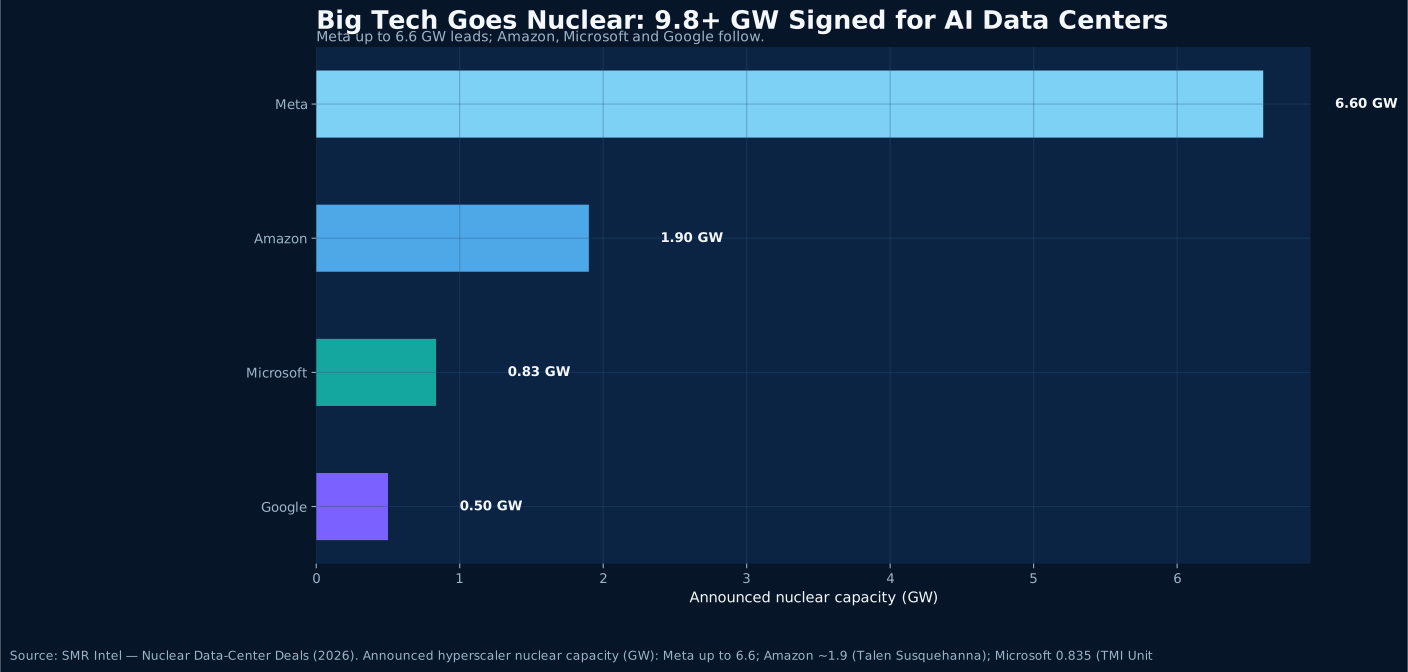
Tech giants have backed it with real money. By May 2026 the four largest U.S. tech firms had signed for over 9.8 GW of nuclear capacity across 13 announced projects. Meta leads at up to ~6.6 GW, spanning TerraPower, Oklo, Vistra and Constellation; Amazon has ~1.9 GW (Talen's Susquehanna) plus a $700M investment in X-energy; Microsoft signed a $16B 20-year PPA to restart Three Mile Island Unit 1 (~835 MW); and Google locked in ~500 MW of Kairos Power reactors.
These orders matter beyond the power itself. They give still-early SMR and advanced-nuclear technologies crucial first customers and cash flow, letting next-generation firms like TerraPower, Oklo, X-energy and Kairos advance demonstration reactors. In other words, AI is paying for nuclear's revival, while nuclear provides the energy foundation for AI's continued expansion—a tightly coupled positive feedback loop.
China's Head Start: Linglong One and Supply-Chain Strength
In the SMR commercialization race, China is gaining an early lead. CNNC's Linglong One (ACP100) is expected to enter commercial operation in the first half of 2026, becoming the world's first land-based commercial small modular reactor. The milestone is not only symbolic; it validates China's full SMR supply-chain capability from design and manufacturing to construction. In the global nuclear revival, those who build and connect to the grid first will accumulate valuable operating data and engineering experience.
For China-Korea trade, the nuclear revival drives demand not just for reactors but for vast supporting needs: nuclear-grade pumps and valves, pressure vessels, special steels, instrumentation and control systems, safety-class electrical gear and construction equipment. China holds cost and capacity advantages in nuclear-equipment manufacturing and scaled construction, while Korea enjoys an international reputation in nuclear EPC and equipment quality—leaving significant room for collaboration on third-market nuclear projects.
Real Constraints: Regulation, Timelines and Public Acceptance
Cool heads are needed amid the hype. Despite the promise, the vast majority of SMR projects remain in licensing, construction or demonstration, and large-scale grid power generally arrives around 2030. Nuclear's regulatory approval is rigorous and lengthy, and the cost and schedule of first projects remain uncertain; institutions like the Carnegie Endowment caution that there is a gap between hyperscalers' nuclear commitments and U.S. energy realities, leaving open whether some capacity will arrive on time.
Moreover, spent-fuel handling, nuclear-safety regulation and public acceptance remain long-term issues. But the direction is clear: AI's hard demand for stable low-carbon power is injecting nuclear with development momentum unseen in decades. For supply chains and trading firms, the rational strategy is to track the first demonstration reactors' milestones and regulatory progress, pre-position qualifications and capacity for nuclear-grade materials and supporting equipment, and wait for this long, high-certainty runway to play out.