Copper's Limit: AI Clusters Force an Optical-Interconnect Revolution
Training frontier models requires tightly interconnecting tens to hundreds of thousands of GPUs, with data shuttling between chips at high speed. As distance grows, copper's electrical interconnect loses bandwidth fast and burns far more power, becoming a bottleneck for AI compute. The industry broadly agrees that copper's usable reach is shrinking quickly beyond 112 Gbps per lane—the copper wall is in sight.
Optics offers the way out: using photons instead of electrons to move information between chips delivers higher bandwidth, longer reach and lower energy per bit. Silicon photonics integrates optical devices onto mature CMOS, enabling mass production of optical modules; co-packaged optics (CPO) goes further, packaging the optical engine and switch chip on the same substrate to shorten the electrical path and cut power. This is the central interconnect narrative of 2026.
Silicon Photonics: The Steadily Expanding Foundation
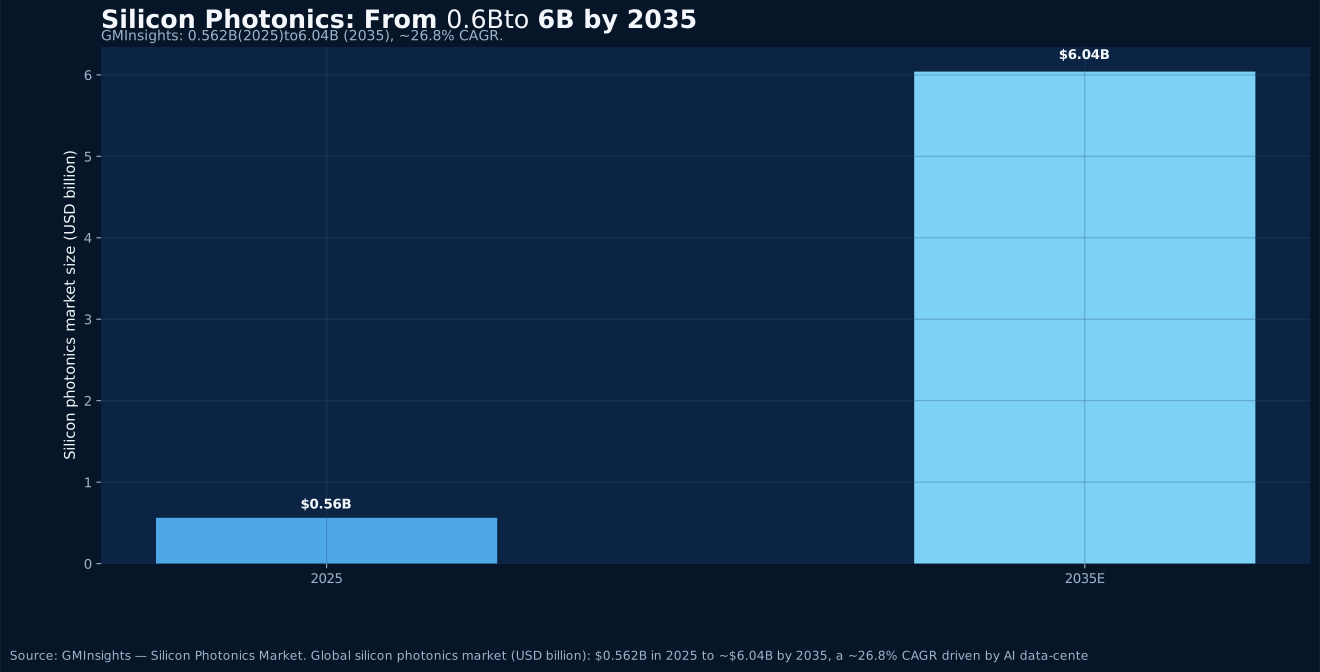
Silicon photonics is the technological foundation of the entire optical-interconnect revolution. GMInsights expects the global market to grow from about $0.562B in 2025 to roughly $6.04B by 2035, a CAGR near 26.8%. The growth engine is clear: AI data centers drive a surge in demand for 800G and 1.6T optical modules, joined by telecom, high-performance computing and emerging optical-computing applications—forming a steady, multi-supported curve.
For the supply chain, silicon photonics' maturity means optical devices move from discrete optics toward semiconductor-grade integration, tilting production toward fabs, advanced packaging and precision-alignment equipment. A segment once dominated by a few optical-communications firms is gradually opening to the broader semiconductor ecosystem, spreading procurement and supply opportunities across lasers, modulators, fiber coupling and test.
CPO: The Faster-Growing Cutting Edge
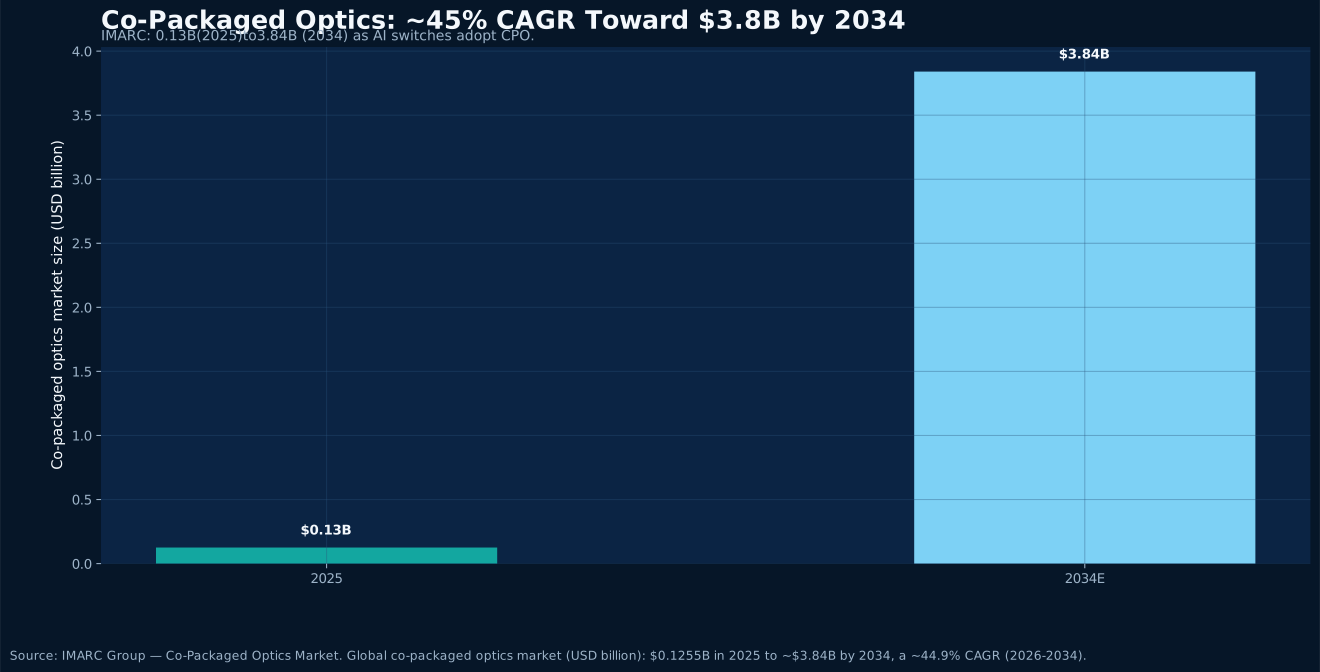
If silicon photonics is the foundation, CPO is the fastest-growing cutting edge atop it. IMARC expects the global CPO market to surge from about $0.126B in 2025 to roughly $3.84B by 2034, a CAGR near 44.9%—nearly double silicon photonics' overall pace. More bullish houses such as LightCounting and Coherent even project that, in scaled scenarios, the CPO market could reach $10-15B by 2030.
In 2026 CPO enters a pivotal qualification phase: 800G modules reach high volume, 1.6T completes early qualification, and CPO becomes the form factor for next-gen switches. The most telling signal comes from NVIDIA—its next-gen AI switches for large GPU clusters are pushing silicon-photonics and CPO integration, seen as the most commercially consequential CPO adoption case. Once leading accelerator and switch vendors switch over, CPO's penetration curve will steepen markedly.
Where China and Korea Fit: Advanced Packaging and Materials
CPO's difficulty is not whether light can be generated but how to package optics and electronics together at high quality. That falls squarely in advanced packaging, precision alignment, thermal management and fiber arrays—areas where China-Korea semiconductor supply chains hold deep strengths. Korea's lead in HBM and advanced packaging and China's scale in optical modules and fiber devices give the two complementary positions in the CPO value chain.
For a trader like MO-TEK, the CPO wave brings new demand for materials and components: high-purity optical materials, microlenses and fiber arrays, precision alignment and test equipment, and thermal-interface materials. As optical modules move from pluggable to co-packaged, the supply chain's precision and consistency requirements rise sharply, and suppliers offering stable quality and cross-border support gain a structural opportunity.
Risks and Cadence: The Technology Path Is Not Yet Settled
Despite its promise, CPO's technology path is not yet settled. NPO (near-packaged optics), CPO and XPO each carry trade-offs, and serviceability, yield and reliability remain real obstacles to large-scale deployment. Once the optical engine and switch chip are co-packaged, a fault in the optical path is costlier and more complex to repair or replace than with pluggable modules, keeping some operators cautious about switching.
Thus 2026-2028 is more likely a transition in which pluggable modules and CPO coexist, rather than an overnight swap. For supply-chain participants, the rational move is to position in both paths while closely watching leaders like NVIDIA for production milestones and yield breakthroughs. Whichever path prevails, the broad direction of optics-in, copper-out is set, and long-term demand around silicon photonics and advanced packaging will keep expanding.