From Niche to Default: SiC Hits Its Inflection
Silicon carbide (SiC) is a wide-bandgap semiconductor that operates at higher voltage, temperature and frequency with far lower losses than conventional silicon. It was long confined to niche industrial and rail applications by high cost; now, as substrate yields improve and capacity expands, SiC is rapidly entering mainstream markets—EVs, PV inverters and data-center power.
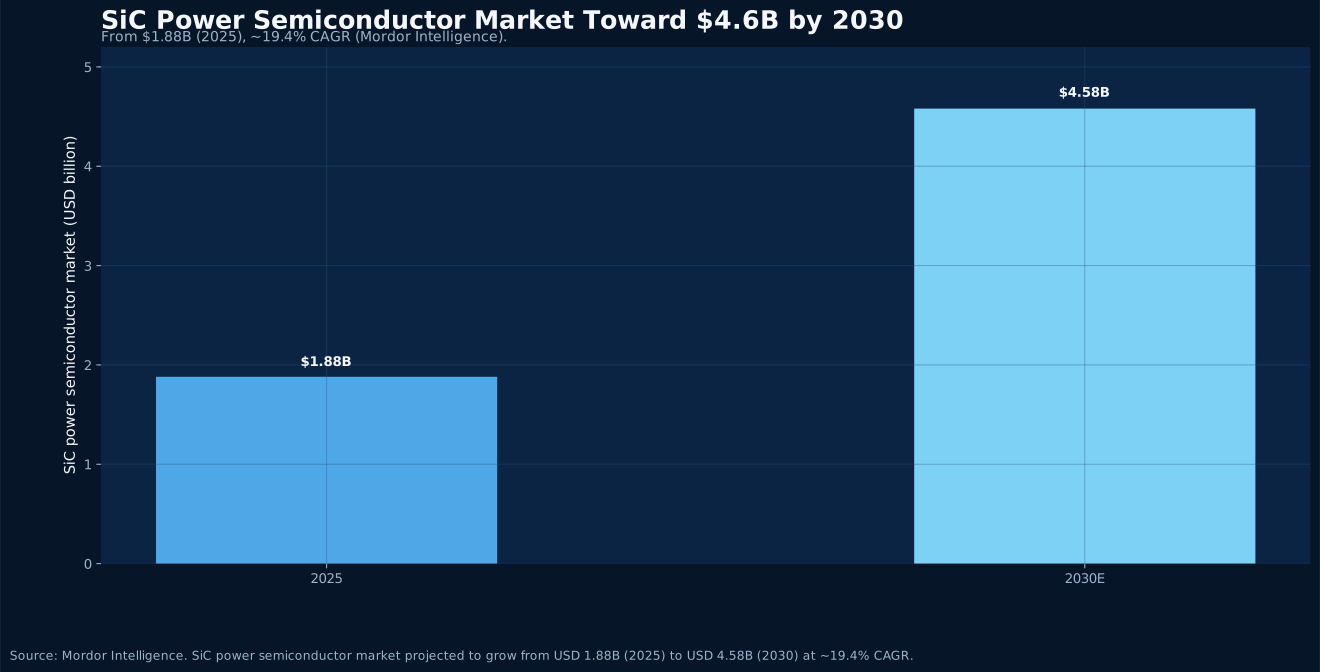
Per Mordor Intelligence, the global SiC power semiconductor market is set to grow from ~$1.88B (2025) to ~$4.58B (2030) at ~19.4% CAGR. That pace trails some explosive emerging curves, but wins on demand certainty—every EV moving to an 800V architecture creates rigid SiC orders.
EVs: The Prime Engine
Automotive is SiC's largest demand source, at about 62% of 2024 revenue. The core reason is a voltage-platform leap: moving a vehicle from 400V to 800V enables faster charging, thinner wiring and lighter systems—and SiC MOSFETs are the natural partner for 800V. Versus silicon IGBTs, SiC delivers roughly 2-4% efficiency gains, equivalent to a smaller battery pack or longer range.
For carmakers, 2-4% is not a small number. It means using fewer expensive cells for the same range target, or offering a stronger selling point at the same battery capacity. That is why more automakers now treat SiC as the 'default spec' for 800V models, turning demand from optional to standard.
The Longer Curve: A Decade of Device Demand
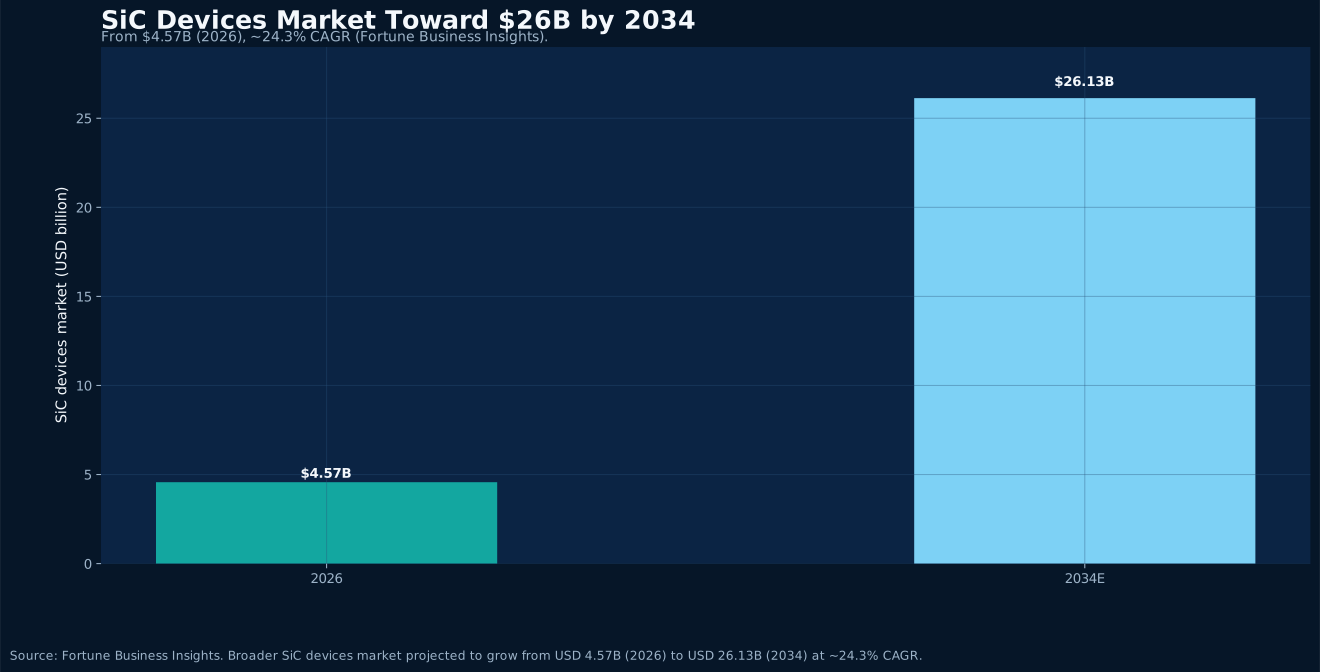
Widen the lens from 'power semiconductors' to overall 'SiC devices' and the growth curve steepens. Fortune Business Insights projects the global SiC devices market to grow from ~$4.57B (2026) to ~$26.13B (2034) at ~24.3% CAGR. Behind that curve is the layering of demand from EVs, energy storage, PV, industrial drives and data-center power.
The two datasets use different scopes but point to the same trend: SiC demand is broadening from a single automotive driver into multi-scenario resonance. For upstream material and equipment suppliers, that means smoothing capacity across applications and reducing sensitivity to any single end-market's cycle.
Value Heights: Substrates, Epitaxy and Modules
Profit is not evenly distributed along the SiC chain. Substrates—especially large 8-inch wafers—have long been the technical and cost bottleneck, and each breakthrough in yield and diameter rewrites the industry map; epitaxial-layer uniformity governs device performance; and module packaging determines thermal management, reliability and system integration. These three links form the steepest moats on the SiC value chain.
China has rapidly expanded SiC substrate and epitaxy capacity in recent years, pushing its cost curve down markedly; Korea holds an edge in automotive-grade module packaging and reliability validation. If the two can build complementary roles across 'substrate-device-module,' they can claim higher-value positions in this wave of expansion.
Risks and Rhythm: Capacity, Price and Qualification
Rapid expansion carries risks. As multiple players ramp simultaneously, substrate and device prices enter a downtrend, and periodic oversupply may emerge—testing firms' cost control and cash-flow resilience. Moreover, automotive-grade qualification is long and rigorous; new entrants often need 18-24 months to reach a mainstream carmaker's approved-vendor list.
So procurement and supply-chain decisions must balance 'seizing the window' with 'controlling risk'—capturing the cost dividend of falling prices while avoiding bets on capacity not yet automotive-qualified. For trade-services firms, helping clients identify suppliers with genuine automotive-delivery capability is more valuable long-term than mere price comparison.
MO-TEK's View: Positioning in the Automotive-Grade Chain
The silicon-carbide story is essentially a combination of 'certain demand + a steep learning curve.' For MO-TEK's clients, the most pragmatic path is not chasing the latest technical hype but anchoring on the certainty of 800V EVs—locking in China-Korea suppliers with automotive-grade systems and stable yields, and building inventory and contracts in tranches through the price-decline cycle.
We advise clients to focus on three target types: material makers with 8-inch substrate mass-production capability, automotive-qualified module packagers, and device fabs offering full batch traceability. MO-TEK will keep tracking ramp cadence and price curves, helping clients capture the cost dividend while safeguarding supply security through this SiC up-cycle.