From Concept to Runway: eVTOL Nears Commercial Liftoff
Over the past decade, electric vertical take-off and landing (eVTOL) aircraft have symbolized the future of transport while staying stuck in a loop of test flights and fundraising. In 2026 that is changing. Commercial air-taxi services could begin in the Middle East within the year, with US revenue operations expected in 2027. For the first time, the curves of technology, capital and regulation are converging in the same window.
For trade and manufacturing firms, the real signal is not a single successful flight but regulators issuing airworthiness criteria for specific aircraft. As the rules shift from proof-of-concept to type-specific approvals, certification timelines compress and the predictability of volume production and delivery rises—precisely the precondition for the supply chain to start stocking and building capacity.
The Certification Race: Joby Leads, Archer Chases
Type certification is the final and highest hurdle to eVTOL commercialization. In March 2026, Joby Aviation completed Stage 4 of the FAA's five-stage process, with its Type Certificate expected before year-end—making it the frontrunner for the first US commercial eVTOL operations. Archer Aviation sits at Stage 3, and both have secured airworthiness criteria for their JAS4-1 and M001 respectively.
Certification progress determines who can sell seats first. For upstream suppliers, that implies two parallel stocking rhythms: near-production-grade parts for the leader, and flexible capacity reserved for the chaser. Whoever locks into the approved-vendor list ahead of the certification milestone controls the terms of first deliveries.
Urban Air Mobility: The Bigger Map
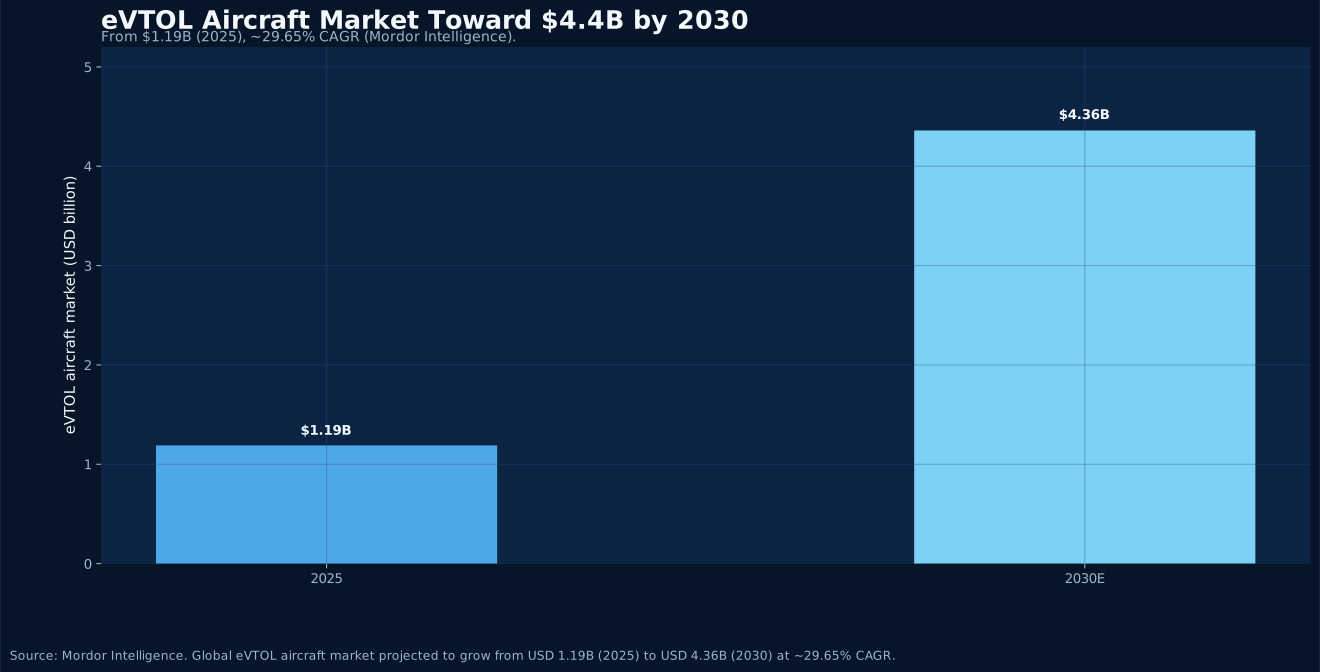
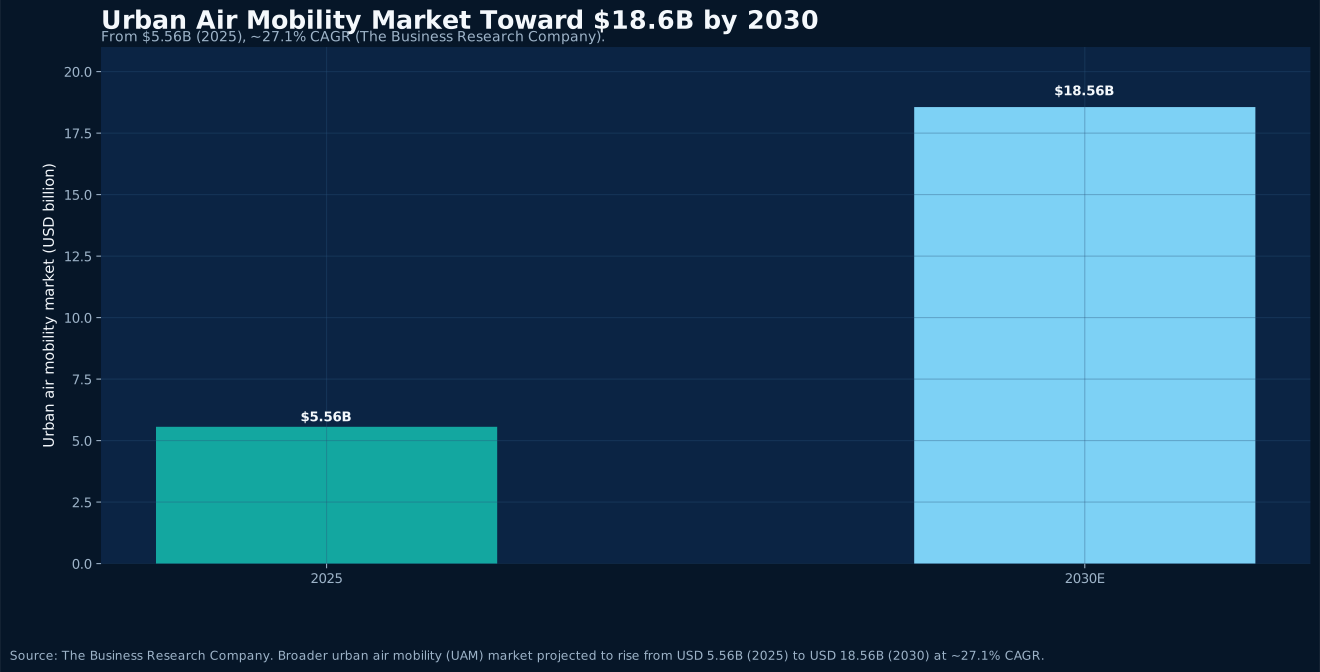
The aircraft market alone is still modest: ~$1.19B in 2025, heading to ~$4.36B by 2030. But widen the lens to the full urban air mobility (UAM) stack—aircraft, vertiports, air-traffic management, maintenance and operating services—and the market rises from $5.56B to $18.56B over the same period at ~27.1% CAGR, with passenger transport growing fastest.
The numbers reveal a key logic: the airframe is only the tip of the iceberg; the durable profit pools sit in supporting infrastructure and service networks. For Chinese and Korean firms eyeing advanced air mobility, rather than fixating on the aircraft, it pays to evaluate charging, vertiport ground equipment and composite structural parts—high-frequency, repeatable supply niches.
Supply-Chain Reset: Motors, Batteries and Composites
eVTOL component requirements sit almost exactly at the intersection of EVs and aviation: high-power-density motors, high-C-rate batteries, lightweight carbon-fiber structures and highly redundant flight-control systems. These map onto China's strengths in motors and batteries and Korea's in materials and precision manufacturing—naturally complementary supply chains.
Notably, aviation-grade certification demands far higher consistency and traceability than consumer electronics. To break in, suppliers must build an aerospace quality system (e.g., AS9100) and full batch traceability in advance. That is both a barrier and a moat—once on the approved list, switching costs are steep and order stickiness far exceeds ordinary consumer goods.
The Role of the China-Korea Value Chain
While US firms lead the global eVTOL airframe race, the opportunity for Chinese and Korean companies concentrates in the 'hidden champion' tiers. China holds cost and scale advantages in battery cells, rare-earth permanent-magnet motors and carbon-fiber precursors; Korea has deep expertise in specialty aluminum alloys, precision reducers and avionics. That division of labor lets both countries seize a window to climb from Tier-2/3 to Tier-1 supplier status.
Meanwhile, the Middle East and Southeast Asia—among the first commercial-operation markets—offer a demand-proximate geographic springboard for Chinese and Korean manufacturing. Building localized maintenance, spare-parts and training networks around these markets may yield longer-term, higher-value returns than merely exporting components.
MO-TEK's View: Trade Opportunities in the Low-Altitude Economy
For a trade and supply-chain services firm like MO-TEK, the lesson of the eVTOL wave is this: you need not wait for the day the sky fills with air taxis—the opportunity is already unlocking first in components and ground infrastructure. We advise clients to use 'certification milestones' as coordinates, map China-Korea suppliers with aerospace quality systems in advance, and lock in cross-industry reusable categories such as composites, connectors and thermal management.
Another layer of value in the low-altitude economy is its reuse of existing manufacturing capability—EV battery lines, consumer-electronics precision parts and PV-grade carbon fiber can all find premium space in aviation applications. MO-TEK will keep tracking certification progress and procurement moves in the first operating markets, helping clients secure supply-chain positions before the industry fully forms.