Crossing the Valley of Death: EGS's Commercial Moment
Conventional geothermal is constrained by geology, developable only where natural heat reservoirs are rich. Enhanced geothermal systems (EGS) borrow the horizontal drilling and fracturing techniques matured in the shale revolution to engineer heat reservoirs, in theory extending geothermal to almost anywhere. For years EGS was stuck in a 'valley of death' of cost and scale—technically feasible but hard to commercialize.
In 2026 that valley is being crossed. Fervo Energy secured a $421M non-recourse loan for its flagship Cape Station project in Utah—the first time financiers have endorsed EGS's cash-flow predictability via project finance. That is not just money; it is the capital market's stamp of 'bankability' on EGS.
Data Centers: The Unexpected Catalyst
The biggest force driving EGS commercialization comes, surprisingly, from AI. Data centers need round-the-clock, stable, zero-carbon baseload power—precisely geothermal's unique edge over wind and solar, since it is weather-independent and runs 24/7. Hyperscalers like Google and Meta are underwriting EGS commercialization through long-term power purchase agreements (PPAs).
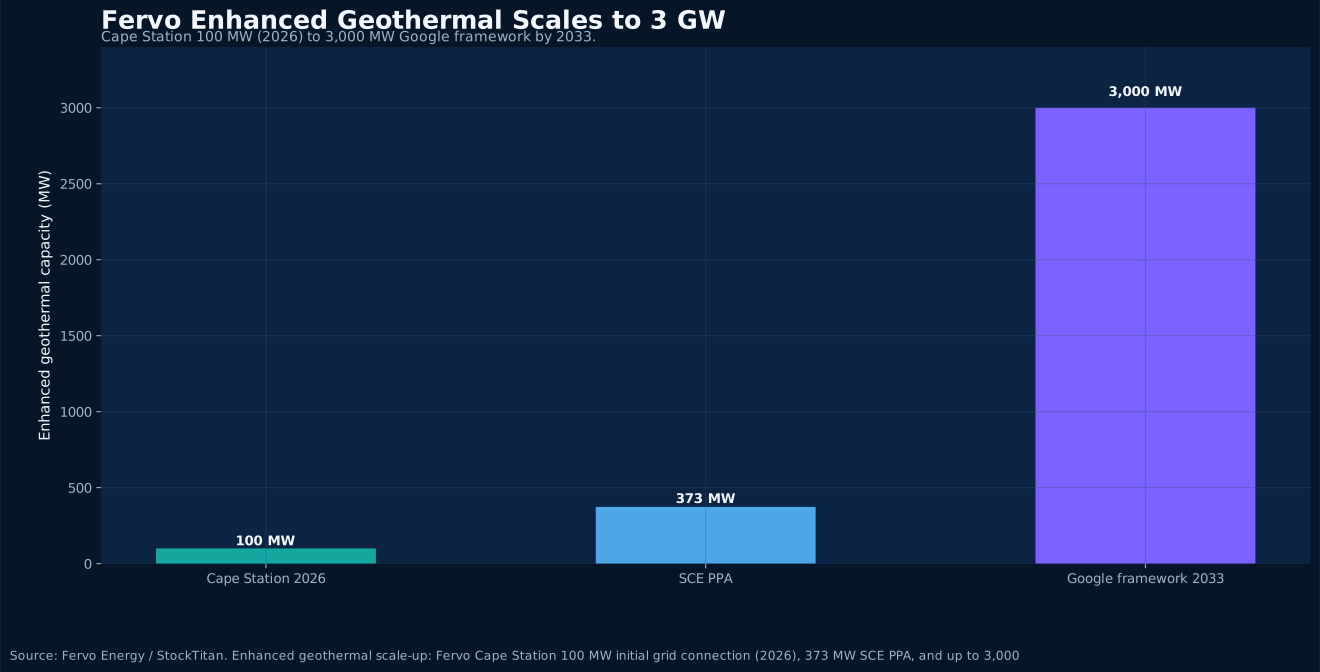
Fervo's framework agreement with Google supports up to 3 gigawatts (GW) of geothermal capacity through 2033; Cape Station's initial 100 MW grid connection is expected in 2026, alongside a 373 MW PPA with Southern California Edison (SCE). Corporate buyers' long-term commitments push EGS from 'demonstration project' to 'scalable power asset.'
From 100 MW to 3 GW: The Logic of Scaling
EGS economics depend heavily on a 'learning curve'—each additional well and project drives unit costs down a notch. Fervo's roadmap embodies this logic: from Cape Station's first 100 MW, to a 373 MW SCE PPA, to a long-term target of up to 3 GW under the Google framework, capacity leaps by orders of magnitude.
The significance of scaling is not only generation volume but cost. As projects move from megawatts to gigawatts, drilling efficiency, equipment standardization and supply-chain coordination all improve markedly, thinning unit costs and creating a positive feedback loop. This is what distinguishes EGS from conventional geothermal and makes it truly 'scalable.'
The Full Picture: Modest Totals, Steep Structure
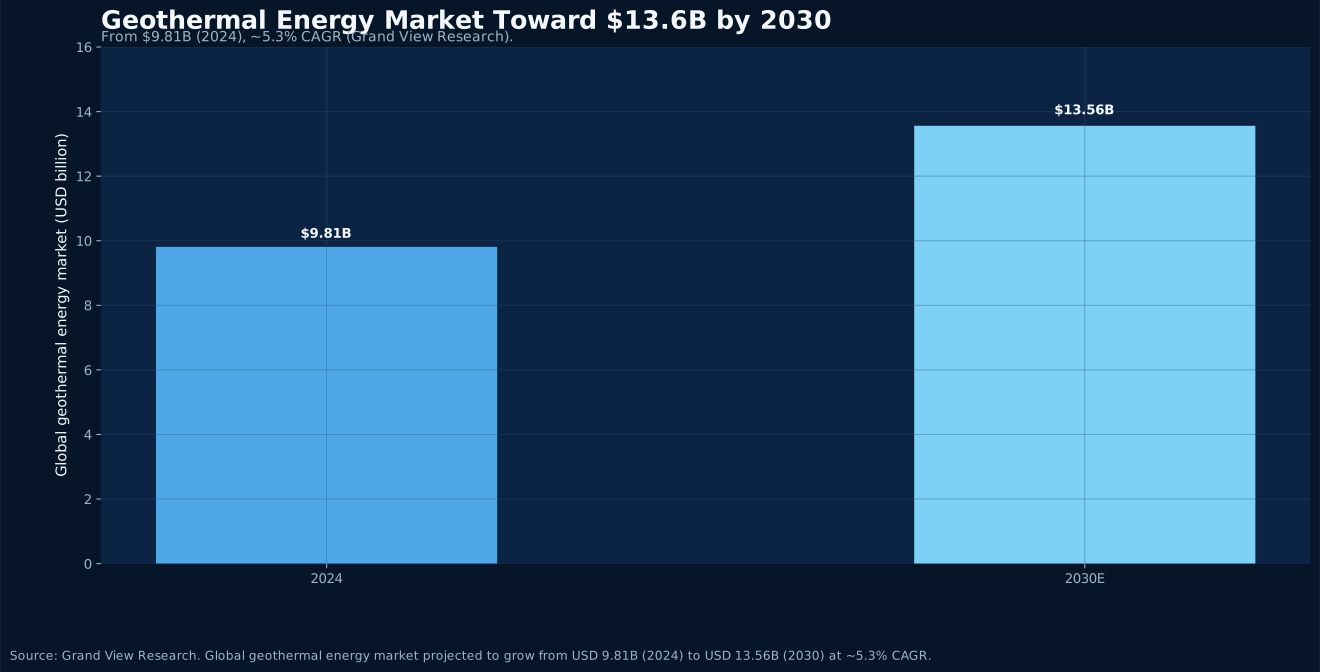
By totals alone, the geothermal market is unremarkable. Per Grand View Research, it grows from ~$9.81B (2024) to ~$13.56B (2030) at ~5.3% CAGR—well below solar or storage. But the modest total masks a structural shift: incremental growth is concentrating rapidly in EGS and data-center-linked 'new geothermal.'
In other words, this is an 'old total, new structure' market. Conventional geothermal is stable but slow-growing, while EGS—though small in base—sits at the confluence of AI power demand and a project-finance breakthrough. For supply-chain firms, the key to judgment is identifying which links benefit structurally as EGS scales, rather than being misled by headline growth rates.
Supply-Chain Opportunities: Drilling, Tubulars and Surface Equipment
EGS is essentially 'moving oil-and-gas drilling capability into power generation,' so its supply chain overlaps heavily with oil and gas: high-temperature drill bits, heat-resistant downhole tools, oil-country tubular goods (OCTG), high-temp/high-pressure pumps and valves, plus surface generation and heat-exchange equipment. China holds cost and capacity advantages in OCTG, pumps/valves and heat exchangers, while Korea excels in high-end alloys and precision equipment.
Notably, EGS demands higher temperature and pressure tolerance than conventional oil and gas, raising material and process thresholds. That means whoever first passes high-temperature validation can enter project supply chains backed by hyperscale buyers. For China-Korea manufacturing, this is a realistic path to 'translate' existing oil-gas and power-equipment capabilities into a high-growth new scenario.
MO-TEK's View: Bet on Structure, Not Totals
The lesson of enhanced geothermal for MO-TEK's clients is: don't be scared off by a 5% industry growth rate. The real opportunity hides in the structure—driven by AI data centers and a project-finance breakthrough, EGS-linked drilling, tubulars and high-temperature equipment face a structural ramp. MO-TEK advises clients to treat the procurement cadence of leading projects like Fervo's as a bellwether, and to position China-Korea suppliers able to pass high-temperature validation in advance.
For trade services, EGS carries a distinct extra value: it channels the mature capabilities of the oil-and-gas chain into zero-carbon power, offering a new overseas direction for traditional manufacturing and export firms under transition pressure. MO-TEK will keep tracking the progress of benchmark projects like Cape Station and PPA developments, helping clients find certain orders on this 'old capability, new scenario' track.