The Inflection Year for Custom Silicon
For years, AI training compute was almost synonymous with Nvidia GPUs. Entering 2026, that equation is loosening in earnest. Hyperscalers—Google, Amazon, Microsoft and Meta—are pouring resources into custom application-specific integrated circuits (ASICs), aiming to trade purpose-built chips for better cost-performance and supply security. Custom silicon is no longer a side option; it is becoming one of the backbones of AI infrastructure.
Driving this shift is a change in where AI value is created. As models move from training-first to inference-first, the massive, continuous and predictable inference workloads amplify the advantages of purpose-built chips: lower power per unit of compute, architectures tuned to specific operators, and bargaining room free of a single supplier. For clouds with tens of billions in capex, even a 10% gain in performance-per-watt compounds into significant savings.
44.6% vs 16.1%: The Growth Divide
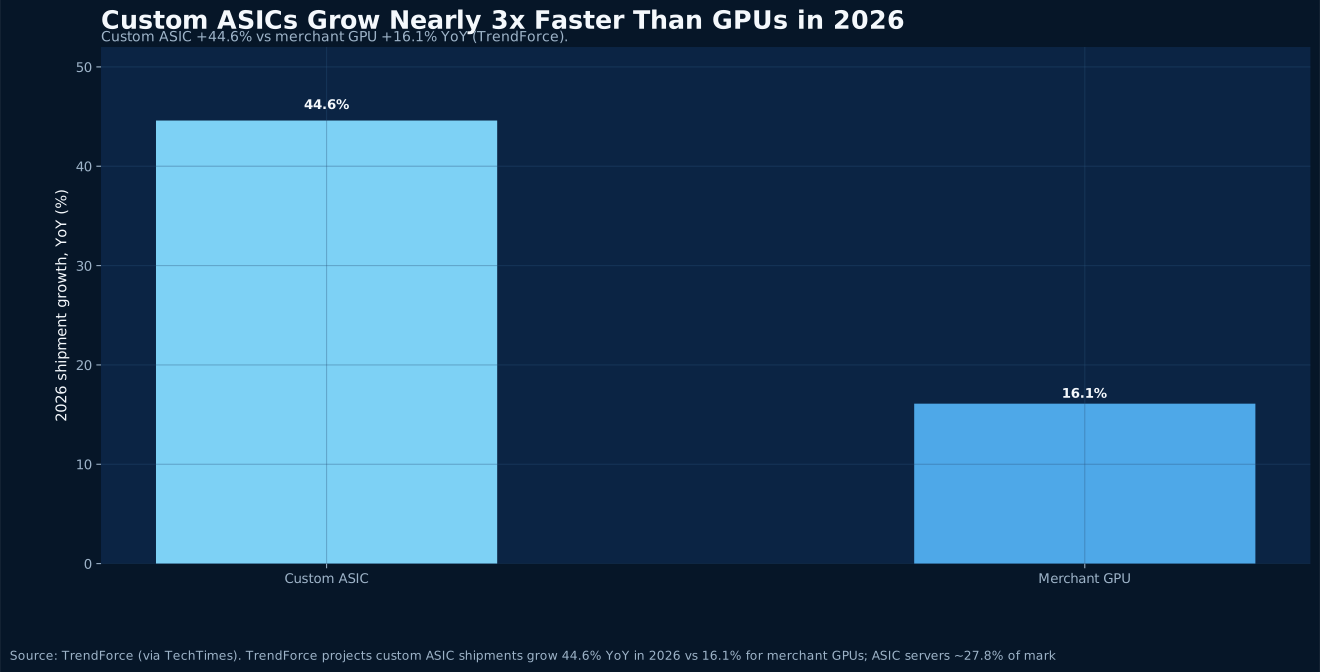
The numbers tell the story. TrendForce projects custom ASIC shipments will grow 44.6% year over year in 2026, versus roughly 16.1% for merchant GPUs—nearly three times faster. At the same time, ASIC-based AI servers are expected to rise to about 27.8% of the market, meaning more than one in four AI servers will run custom silicon. This growth gap is not a short-term blip but the start of a structural rebalancing.
It is important to stress this does not mean Nvidia is exiting. GPUs, with their generality, mature software ecosystem (CUDA) and flexibility, remain irreplaceable for frontier training and variable workloads; custom ASICs are gaining ground in large-scale, steady-state inference. The more realistic picture is dual-track coexistence: GPUs for training and exploration, ASICs for scaled inference—together enlarging the AI compute pie rather than replacing one another in zero-sum fashion.
Who Leads Custom Silicon
The custom-silicon value chain is highly concentrated. Broadcom is the biggest winner: it co-designs Google's TPUs and designs chips for Meta, OpenAI and others, and is estimated to hold roughly 60-80% of the AI ASIC market; its AI semiconductor revenue reached $8.4B in fiscal Q1 2026, up 106% year over year. Marvell, through design partnerships with Amazon AWS and Microsoft, holds an estimated 20-25%, forming a duopoly-plus-many-customers structure.
Demand is equally striking. Google's TPU shipments are projected at 4.3 million units in 2026, potentially topping 35 million by 2028; Amazon's Trainium, Microsoft's Maia and Meta's MTIA each iterate. To harden its supply chain, Google has assembled a multi-partner alliance with Broadcom, MediaTek and Marvell aimed at the inference market. Though largely not sold externally, these in-house chips are tangibly reshaping order structures across foundry, packaging, HBM memory and server boards.
A $604 Billion Accelerator Market
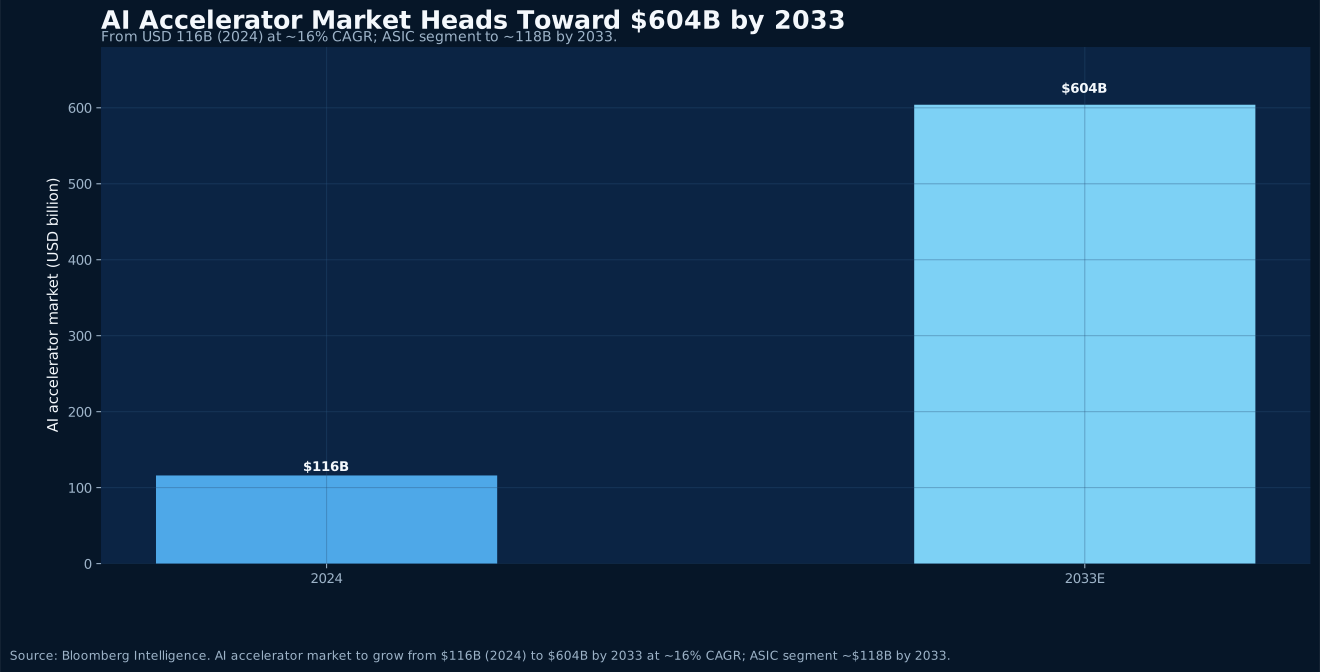
Zoom out, and the growth runway for the entire AI accelerator market is remarkable. Bloomberg Intelligence estimates it will expand from about $116B in 2024 to $604B by 2033 at a ~16% CAGR; within that, the custom-ASIC segment grows faster at ~27%, potentially reaching about $118B by 2033. In other words, of the incremental AI-hardware pie over the coming decade, custom silicon will claim an ever-larger slice.
Behind this market expansion lies unprecedented hyperscaler capex. The compute arms race in data centers is transmitting demand layer by layer along the value chain: advanced nodes and 2.5D/3D packaging, HBM high-bandwidth memory, liquid cooling, high-speed interconnects and power management all rise with the ramp of custom chips. For manufacturing and trade, it is a widening lane of relative certainty.
What It Means for the Supply Chain and MO-TEK Clients
For Chinese and Korean manufacturers and traders, the custom-silicon wave brings a structural opportunity rather than a single-point bet. The ASIC ramp lifts demand for complete servers, thermal modules, connectors, wiring harnesses, power and racks in tandem; the trend toward supplier diversification also opens new windows for components and foundries in the non-Nvidia ecosystem. Those who stay close to hyperscalers' iteration cadence will share the dividends of this expansion.
MO-TEK's view: rather than agonizing over Nvidia-or-ASIC, position around the certainty of compute expansion. We advise clients to invest in the layers that must grow regardless of chip roadmap—high-speed interconnects, cooling, power and precision structural parts—and to meet volatile customers and processes with flexible supply elasticity. As the form of compute changes, only a supply chain that changes with demand is a moat that endures across cycles.