A Space Economy Past $600B
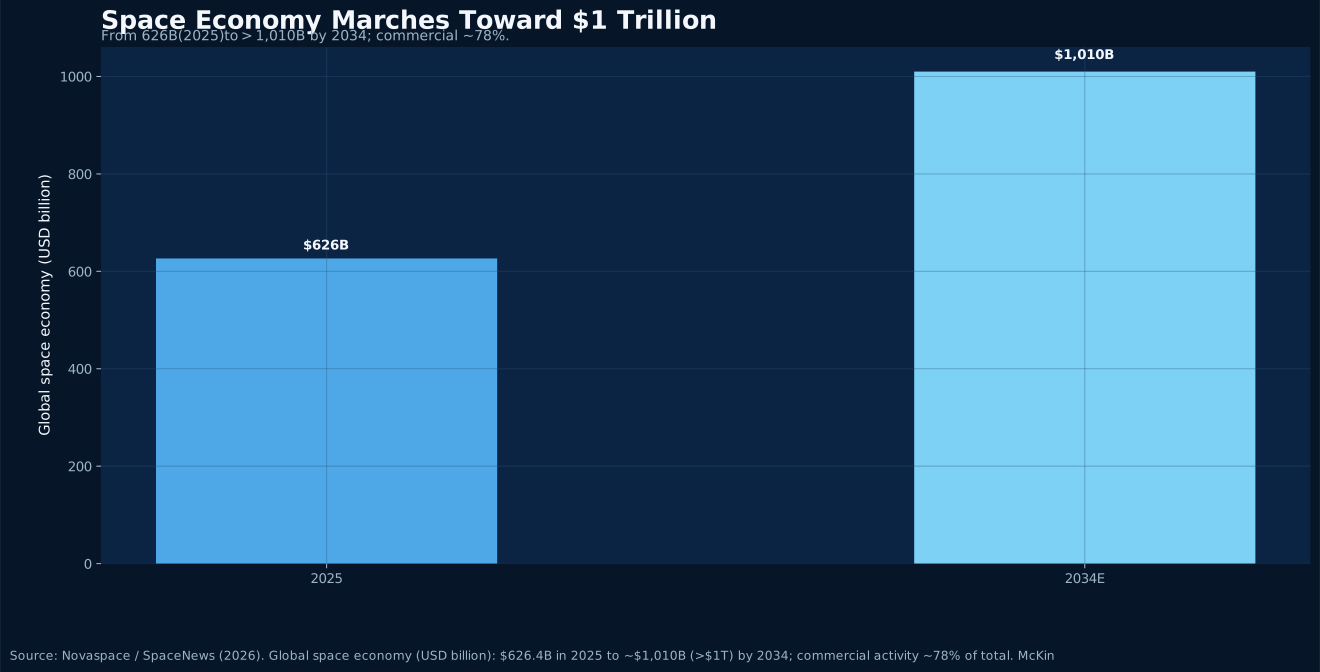
Space is no longer science fiction but a sizable, steadily growing real industry. Per Novaspace (formerly Euroconsult), the global space economy reached $626.4B in 2025, marking a new growth phase; many houses expect it to top $1 trillion around 2034, and McKinsey offers a long-run view of about $1.8 trillion by 2035. Whichever definition, the direction is unmistakable: space is becoming a new growth pole the global economy cannot ignore.
The structure of growth is notable too. The space economy is shifting from 'government-led' to 'commercially driven'—commercial activity has risen to about 78% of the total, up markedly from ~60% a decade ago. That means commercial segments—satellite manufacturing, launch services, satellite comms, Earth observation, ground equipment—are steadily replacing government budgets as the main engine. The industrial logic changes accordingly: demand no longer comes only from national space programs but increasingly from real paid applications by businesses and consumers.
324 Launches: A Record Year
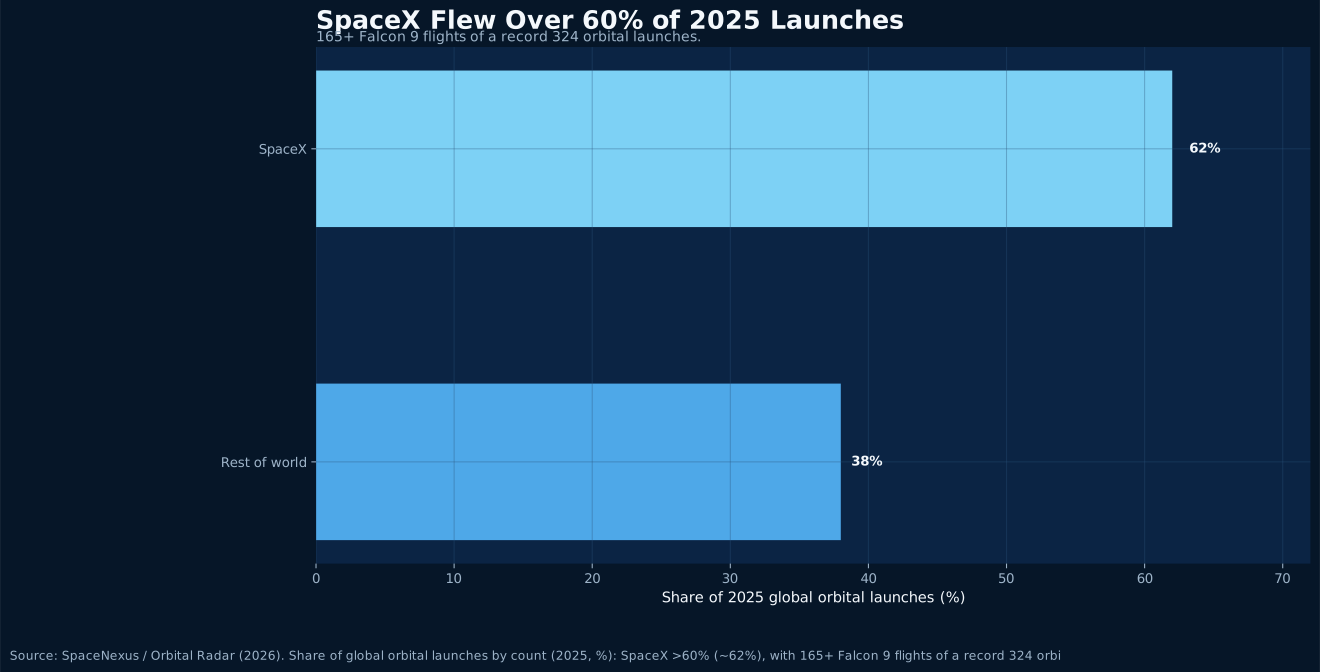
If market size is the slow variable, launch count is the most intuitive fast variable. In 2025, global orbital launch attempts hit a record 324, more than double five years ago. The jump in launch frequency directly reflects an explosion in orbital demand—from low-Earth-orbit comms constellations and remote-sensing satellites to all manner of commercial payloads, more applications need hardware in space. Launch is no longer a scarce national event but is becoming a high-frequency, routine commercial activity.
More notable is the market's high concentration. In 2025 SpaceX alone flew 165+ Falcon 9 missions, over 60% of global launches, an undisputed leader. Underpinning that dominance is the cost and cadence edge from reusability—individual boosters reused 20+ times, pressing unit launch cost to levels rivals struggle to match. This 'one-player dominance' is a triumph of efficiency but also raises worries about over-reliance on a single supplier.
Reusable Rockets Rewrite the Cost Curve
The technical bedrock of this space boom is the reusable rocket. In the expendable era, each launch consumed an entire costly vehicle, keeping orbital cost high; reusability lets boosters fly again and again like aircraft, cutting cost-per-unit-mass to orbit by an order of magnitude. The downward shift in the cost curve is the key to understanding the whole paradigm change—once launch price moves from 'astronomical' to 'a budgetable line item,' business models previously infeasible on cost are switched on one after another.
The first scenario switched on is LEO satellite internet constellations. Only when launch is cheap and frequent enough do mega-constellations of thousands or even tens of thousands of satellites become economically feasible. Beyond that, high-frequency remote sensing, in-orbit manufacturing, space tourism and future lunar and deep-space missions all rest on low-cost, highly reliable, reusable launch. Reusable rockets are not an isolated breakthrough but the 'enabling technology' of the entire space-commercialization era.
Satellite Internet and Downstream Applications
The value of the space economy must ultimately be realized on the ground. The most sizable downstream application today is satellite internet—broadband for remote regions, oceans, aviation and emergency scenarios via LEO constellations. As constellations scale and terminal costs fall, satellite comms is moving from 'filling gaps' to deep integration with terrestrial networks, even exploring consumer scenarios like direct-to-phone connectivity. This market's upside directly underpins robust demand on both the launch and satellite-manufacturing ends.
Earth observation (remote sensing) is another fast-growing downstream track. High-frequency, high-resolution satellite imagery is widely used for crop-yield estimation, disaster monitoring, urban planning, shipping tracking and supply-chain visibility. For cross-border trade, combining satellite remote sensing with AIS shipping data can capture port congestion, vessel movements and cargo flows in near real time, giving logistics decisions an unprecedented information edge. Space data is quietly becoming a new kind of infrastructure for the real economy.
Competitive Landscape and Risks
Though SpaceX runs far ahead today, competition in global launch and satellite manufacturing is intensifying. Many nations and firms are developing next-gen reusable heavy rockets to break the single-supplier structure; China's commercial space is rising fast, with several reusable rockets in test and maiden-flight stages. Intensifying competition is good for customers—more capacity supply means lower prices, more flexible slots and stronger resilience. The shift of launch resources from a 'seller's market' to a 'buyer's market' is happening slowly but surely.
Risks are just as real. Orbital congestion and space debris worsen as satellite numbers surge, making collision risk and spectrum coordination public problems the whole industry must face; geopolitics makes launch capability and satellite data highly sensitive, with export controls and national-security reviews possibly fragmenting global supply chains; and whether mega-constellations' long-run business models can turn a profit, and how orbital and spectrum resources are fairly allocated, remain open questions. Commercializing space is bound to seek balance between efficiency and governance.
Takeaways for Clients
For MO-TEK's clients, the space economy brings opportunity on two layers—'direct' and 'indirect.' Directly, the supply chain for satellite manufacturing and ground terminals—high-reliability electronics, precision structures, RF and optical components, specialty materials—is ramping with the surge in satellite launches, with high technical barriers and long qualification cycles that make an approved-supplier position quite sticky. Indirectly, satellite internet and remote-sensing data themselves are becoming new tools to boost logistics, agriculture and trade efficiency.
MO-TEK's advice: treat the space economy as a structural, 'long-runway, deep-snow' trend. Near-term, firms need not enter heavy-asset segments like whole rockets or satellites directly, but can find high-value, enterable niche components and materials within its vast, dispersed supply chain; meanwhile, make good use of increasingly accessible satellite comms and remote-sensing data services to empower their own cross-border logistics and supply-chain management. The real winners are often not those who build rockets, but those who learn earliest to exploit low-cost space capabilities.