From Demo to Therapy
Over the past two years, BCI's most viral images were paralyzed participants playing chess, moving cursors and playing video games by thought alone. These demos stun and prove that 'reading intent from the brain' is technically feasible. But like many frontier technologies, the real watershed lies not in dazzling demos but in whether a one-off breakthrough can become a repeatable, scalable, approvable medical solution. In 2026, the BCI field is crossing that threshold together.
The landmark node is Noland Arbaugh. In January 2024, the 29-year-old quadriplegic became the world's first to receive a Neuralink implant, playing chess and games by thought within weeks; by early 2026 he had logged thousands of hours of continuous neural-interface use. From 'first case' to 'long-term stable use,' that timeline is itself the best footnote to BCI's move from demo to therapy—it must answer not only 'does it work' but 'does it work reliably over the long haul.'
A Market Growing at 16.77%
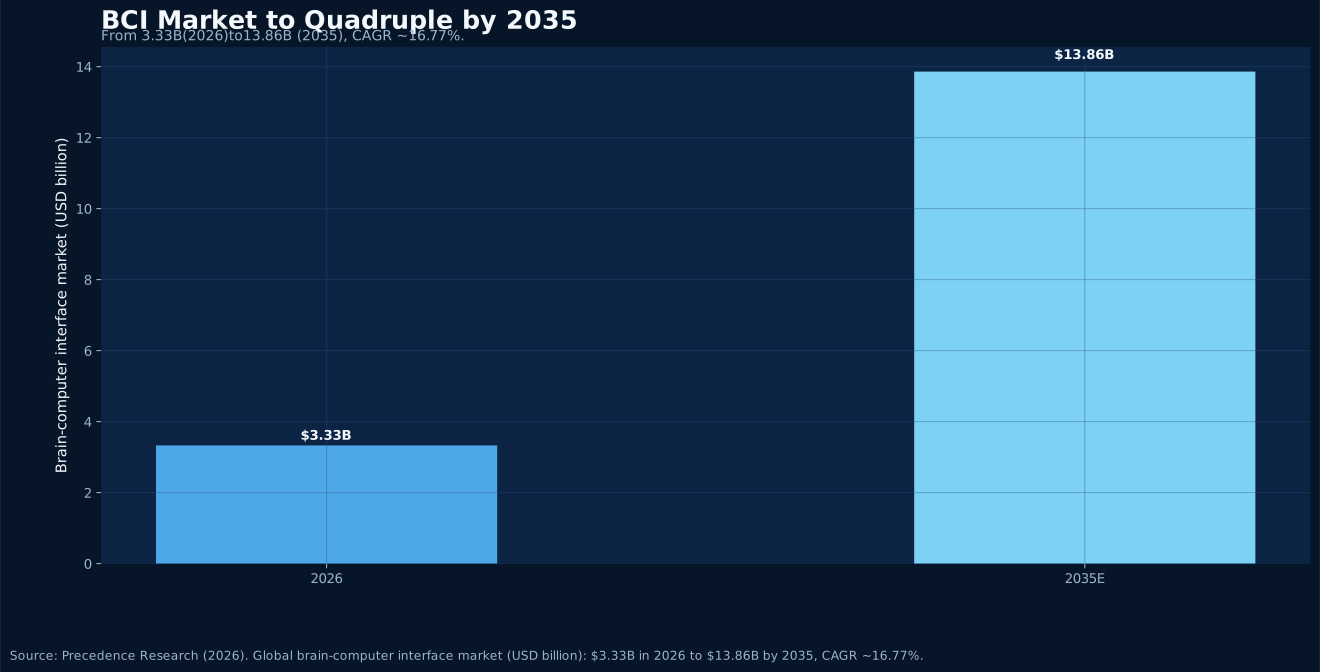
Market signals are equally clear. Precedence Research estimates the global BCI market will grow from about $3.33B in 2026 to roughly $13.86B by 2035, a CAGR of about 16.77%—roughly quadrupling in a decade. That far outpaces the medical-device industry overall, reflecting capital and industry's strong conviction in neural interfaces' long-run value. Note that BCI market definitions vary widely across houses, from hundreds of millions to tens of billions, depending on whether established neuromodulation devices are included.
Though absolute figures are debated, the direction is highly consistent: a market growing in double digits with ever-expanding application boundaries. Early demand centers on rehabilitation aids for severe neural injury—paralysis, ALS, aphasia; the mid-term could extend to treating neurological and psychiatric conditions such as epilepsy, depression and chronic pain; the long term is hoped to reach broader scenarios like cognitive enhancement. Each outward push of the boundary redefines the ceiling, which is the underlying logic behind investors' rich valuations.
Invasive vs. Non-Invasive
BCI splits fundamentally by technical route. The non-invasive route (EEG caps, functional near-infrared) needs no craniotomy, carries low risk and is easy to scale, still holding ~61.7% market share in 2026 as the mainstay of consumer and some medical uses. Its weakness is limited signal resolution, hard to support high-precision, high-bandwidth complex control. The invasive route (like Neuralink's implanted electrodes) captures clearer, higher-bandwidth neural signals but requires surgery, and long-term biocompatibility and stability are hurdles that must be cleared.
The two routes are not zero-sum but cover different needs. For consumer health monitoring, attention training and simple interaction, non-invasive suffices; for severely paralyzed patients to achieve smooth, fine thought control, high-bandwidth invasive signals are nearly indispensable. Expect both routes to advance in parallel and iterate over the coming years, spawning new branches in the middle ground (minimally invasive, semi-invasive). For the supply chain, that means long-run demand across sensors, flexible electrodes, low-power chips and neural-decoding algorithms.
From 21 People to International Reach
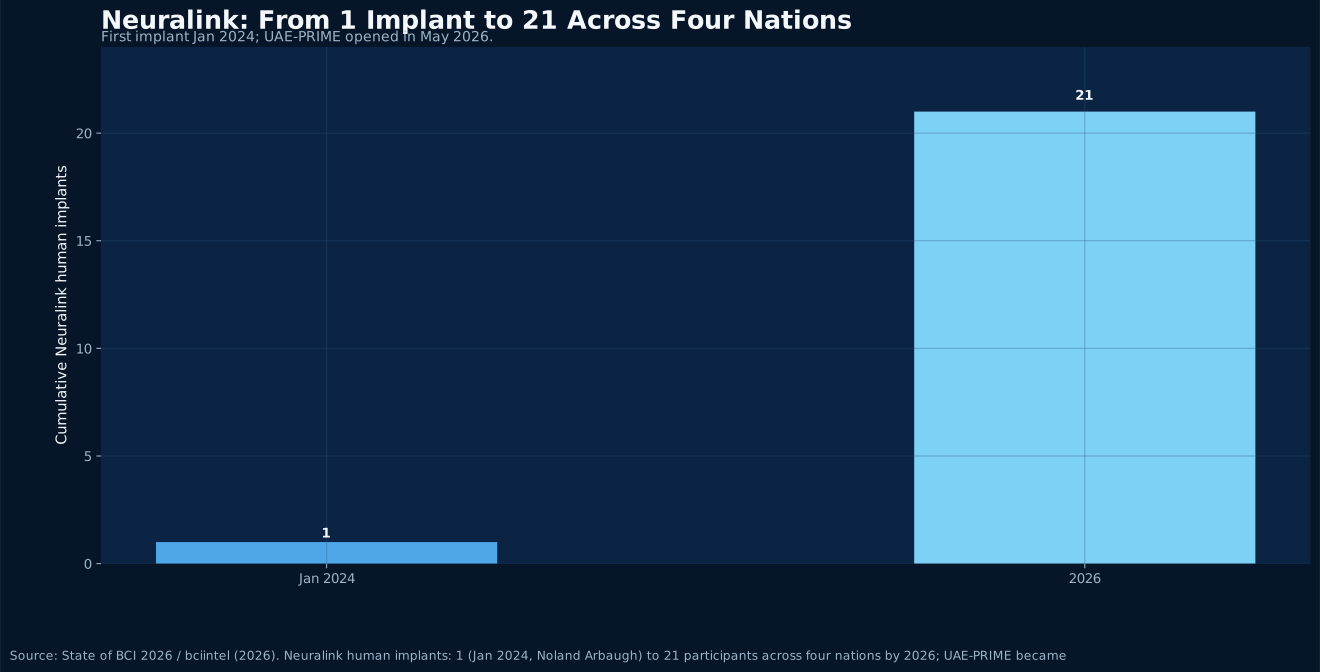
Neuralink's progress is the best window to watch BCI's clinical march. By 2026 the company had implanted 21 people across four nations, expanding from a single participant to a multi-center, multi-nation sample. Growing the sample is crucial—only by validating safety and efficacy across more and more diverse participants can regulators approve and products move from 'clinical trial' to 'approved and marketed.' Twenty-one may seem small, but in the high-risk, heavily regulated field of implantable devices it is a substantive leap in scale.
Internationalization is another key signal. In May 2026 Abu Dhabi's health authority announced Neuralink's UAE-PRIME trial, the first international site outside North America. Cross-border trials mean not only a more diverse sample but that BCI is entering a new stage of global regulatory coordination, cross-border data compliance and integration with local health systems. For Asian markets, it foreshadows that BCI's clinical and commercial wave will likely accelerate toward more countries, including China and Korea, in the coming years.
Ethics, Privacy and Regulation
The closer to clinical use and commercialization, the more ethics and privacy cannot be dodged. BCIs read humanity's most private data—neural activity itself. 'Mental privacy' became a high-frequency term in 2026's industry and regulatory debate: who may access brain-signal data? How to prevent misuse and secondary use? Once a recipient depends on a device, how are their rights protected if the maker shuts service or goes bankrupt? These have no easy answers, yet they directly decide public trust and whether the technology is socially accepted.
Regulatory frameworks are evolving in step. Implantable BCIs are top-risk-class medical devices, subject to rigorous trials and approval. National paths differ, but generally require ample safety evidence, long-term follow-up and transparent adverse-event disclosure. For the industry, compliance is not a burden but the necessary road to long-term trust—only by standing firm on ethics and regulation can BCI truly move from a few participants to broad patient populations. This echoes AI drug discovery's logic of being 'judged by clinical results.'
Takeaways for Industry Clients
For MO-TEK's health and high-end manufacturing clients, BCI remains an 'early but worth tracking' track. Its commercialization pace hinges on trial readouts and regulatory approval, with little chance of an explosive consumer ramp near-term. But the upstream supply chain it pulls—high-precision sensors, flexible implantable materials, low-power neural chips, medical-grade packaging and signal-processing algorithms—is already incubating real order opportunities, with high technical barriers and rich value-add.
MO-TEK's advice: treat BCI as a long-term theme, not a short-term hype cycle. Firms can enter from two directions—one, the near-term market from non-invasive consumer devices (EEG, attention monitoring), whose supply chains are more mature and validation cycles shorter; two, positioning early in the high-end materials and precision components invasive BCI needs, staking out segments with high barriers and few rivals. Either way, the key is to track clinical and regulatory milestones and calibrate spending by real clinical data, not conceptual buzz.