Two Storylines: On-Chain Dollars and Real Assets
The most notable thing about on-chain finance in 2026 is not any single price, but two fundamental storylines accelerating at once. The first is stablecoins—essentially 'on-chain dollars' that serve as the settlement and liquidity hub of the crypto world. The second is real-world asset (RWA) tokenization: mapping traditional assets like Treasuries, private credit, fund shares and even real estate onto the blockchain. The former supplies programmable money, the latter programmable assets; together they form an emerging on-chain financial operating system.
Seen together, the two lines explain 2026's structural shift: stablecoins solve 'how money moves on-chain,' RWA solves 'which assets deserve to be on-chain.' When compliant stablecoins become the default settlement currency and more institutional-grade assets are issued as tokens, on-chain finance moves from fringe speculation to mainstream infrastructure. That is why regulators, traditional banks and asset-management giants entered en masse this year—what they see is not speculation but a migration in clearing and custody paradigms.
A $320B Stablecoin Landscape
Stablecoins' scale can no longer be ignored. Per CoinDesk and industry data, total stablecoin market cap hit an all-time high of about $320B in May 2026, with supply holding above $313B and on-chain holders topping 241 million. That heft makes stablecoins one of the most liquid dollar vehicles globally, with daily settlement volumes at times exceeding major card networks. For corporate treasuries and cross-border traders, they offer a 24/7, near-instant settlement rail.
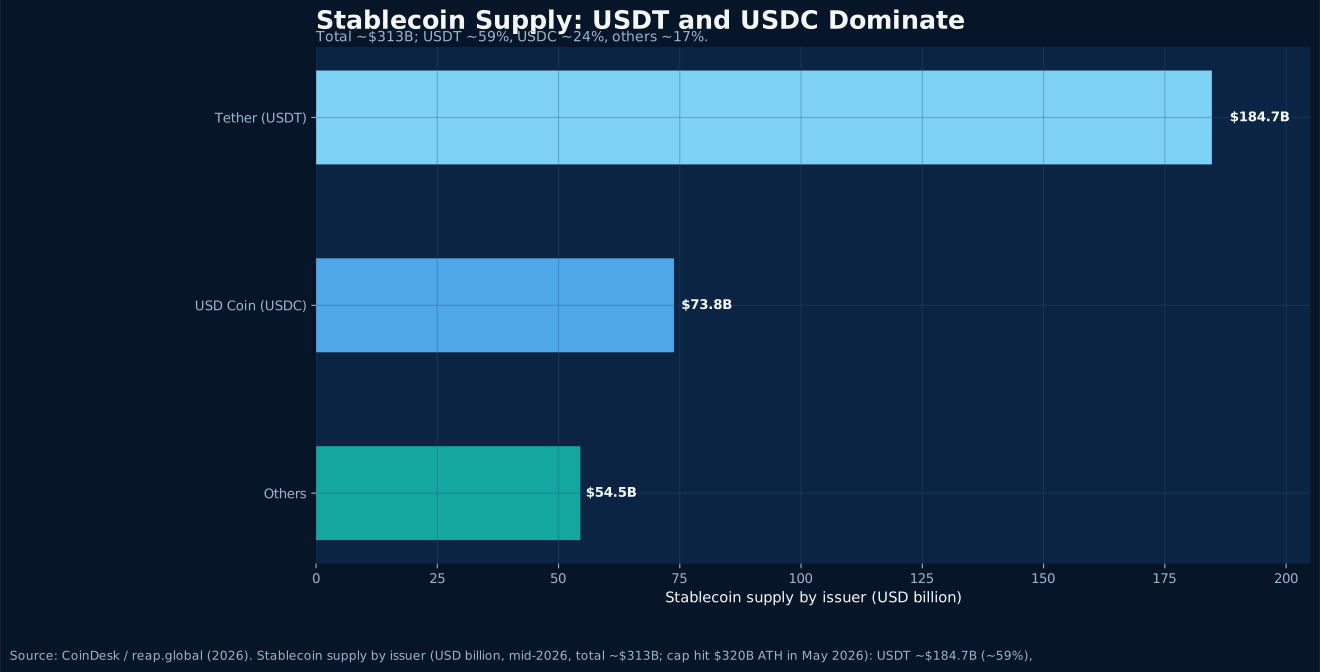
Structurally the market is highly concentrated. Tether's USDT is ~$184.7B (~59%), the clear leader; Circle's USDC is ~$73.8B (~24%), second; the remaining ~$54.5B is split among many issuers. This 'duopoly plus long tail' reflects incumbents' network effects and means compliance and transparency are now the entry bar for new issuers—reserve audits, redemption guarantees and licensing are replacing headline yield as the selection criteria.
RWA Tokenization: Up 256% in 15 Months
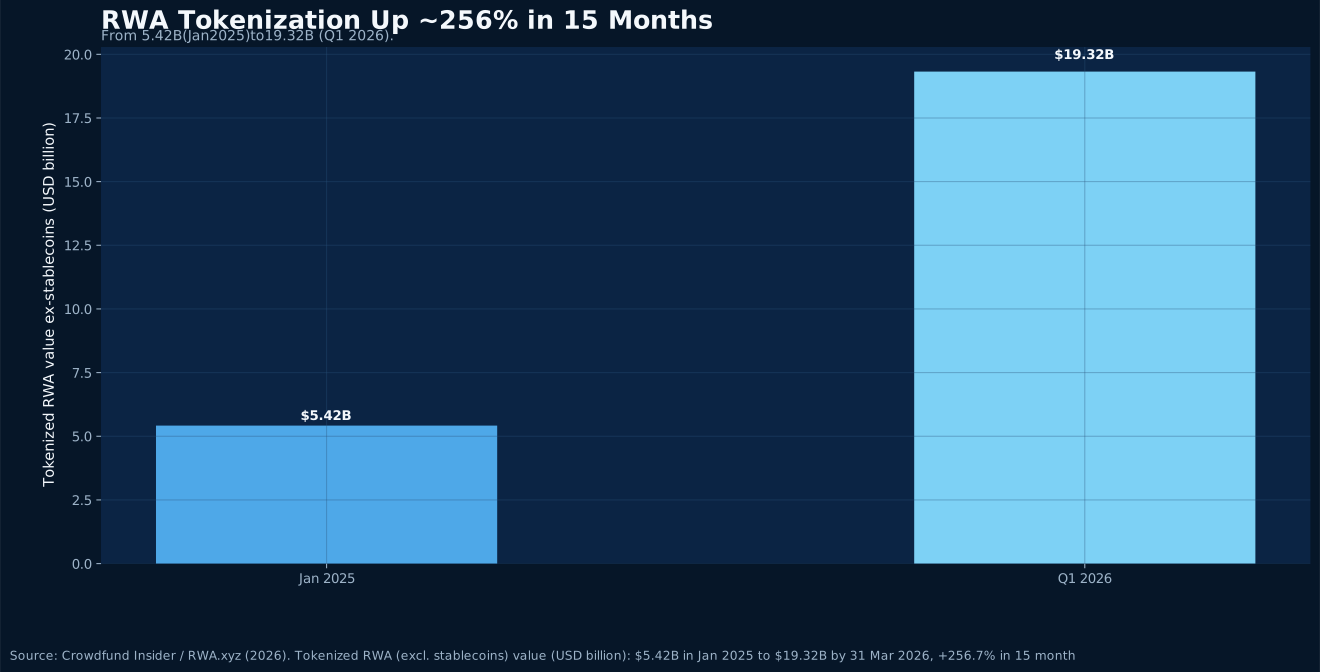
If stablecoins are the 'money side' of on-chain finance, RWA tokenization is the 'asset side'—and it is growing even faster. Per RWA.xyz and Crowdfund Insider, transferable RWA value excluding stablecoins grew from $5.42B in January 2025 to $19.32B by 31 March 2026, up about 256.7% in fifteen months. Counting stablecoins, total on-chain RWA value topped $31B by mid-2026, spread across ~167 platforms and held by over 960,000 addresses.
By category, tokenized Treasuries shine brightest at ~$12-15B, up sharply from ~$8.9B at the start of the year; on-chain private credit outstanding is ~$3.2B, up ~180% from early 2025. These assets went on-chain first because their cash flows are clear, credit is quantifiable and they are easy to standardize—the first tier on an 'easy-before-hard' path. The industry widely expects real estate, commodities and private equity to be the next wave as infrastructure matures.
Institutions Arrive, Compliance Turns
The core force accelerating both storylines is the substantive arrival of institutional money. Asset-management giants issue money-market and Treasury funds as tokenized shares, banks explore stablecoins for wholesale settlement, and payment firms embed stablecoins in cross-border remittances. Unlike the 2021 cycle driven by retail speculation, 2026's growth is powered by 'real utility'—settlement, collateral, yield management—rather than mere price bets. For the first time, on-chain finance has fundamentals that can survive a cycle.
The landing of compliance frameworks is another key inflection. Several jurisdictions clarified stablecoin reserve, audit and redemption rules across 2025-2026, giving issuers certainty. Compliance is no longer the opposite of growth—it is the precondition for attracting large institutional flows. For issuers, transparent proof-of-reserves and credible redemption are shifting from 'nice to have' to 'must answer'; for users, licensing and audits have become the first filter in choosing partners.
What It Means for Cross-Border Trade and Settlement
For China-Korea and broader cross-border trade, the maturing of stablecoins and RWA offers a pragmatic path to cut costs and boost efficiency. Traditional cross-border wires often take one to three business days, pass through multiple correspondent banks and incur FX and fee leakage; compliant stablecoin settlement can deliver near-instant receipt, transparent fees and traceable reconciliation. For small and midsize traders, that means shorter cash-conversion cycles and lower capital tied up.
Further, RWA tokenization opens the door to putting 'trade finance' itself on-chain. If receivables, warehouse receipts and letters of credit are issued as compliant tokens, they can be pledged, transferred and financed on-chain, easing SMEs' chronic financing gap. This path is still constrained by differing national regulation, capital controls and accounting standards, so timing varies by market. MO-TEK's read: stablecoin settlement will go mainstream before RWA financing—firms should start with the low-barrier scenario of 'receiving and paying in stablecoins' and build on-chain operating experience.
Risks and Outlook
Beneath the enthusiasm, risks cannot be dodged. Stablecoins' core risk is reserve quality and redemption runs—any de-peg spills into the whole on-chain system. RWA's core risk is whether the legal binding between 'on-chain token' and 'off-chain asset' holds: in a default or custody failure, whether token holders can truly claim rights to the underlying still needs mature legal and bankruptcy-remote mechanisms. Smart-contract bugs and cross-chain bridge security remain a technical sword of Damocles.
Looking ahead, several institutions offer trillion-dollar long-run forecasts, seeing RWA tokenization potentially reaching the tens of trillions over the coming decade. That number may be too optimistic, but the direction is clear: the fusion of on-chain dollars and real assets is re-architecting traditional finance's clearing, custody and financing layer by layer. For MO-TEK's clients, 2026 need not mean going all-in, but stablecoin settlement belongs in the treasury toolkit, and RWA's compliant landing in trade finance is worth close tracking—this is a long race about 'capital efficiency,' and those who grasp the rules earlier will enjoy the dividend sooner.