From 'Can Design a Molecule' to 'Can Cure Disease'
For years, AI drug discovery's most exciting story was that it can screen and design promising candidate molecules from vast chemical space in very little time, compressing lead discovery that traditionally took years into months. That ability has been validated repeatedly; whether AI 'can design a molecule' is barely in question anymore. But the real test never lay in lab simulations—it lies in human clinical trials. However elegant a molecule looks in a computational model, it must prove safe and effective in real patients.
For that reason, the industry widely sees 2026 as the key year for AI drug discovery to 'deliver on its promise.' The focus has shifted from 'can AI design drugs' to 'can AI-designed drugs win on rigorous clinical endpoints.' This is a paradigm leap: from algorithmic showmanship to being judged by clinical results. For the whole field, success or failure will no longer be measured by papers or patent counts, but by real efficacy data in patients.
A Market Growing at 25%
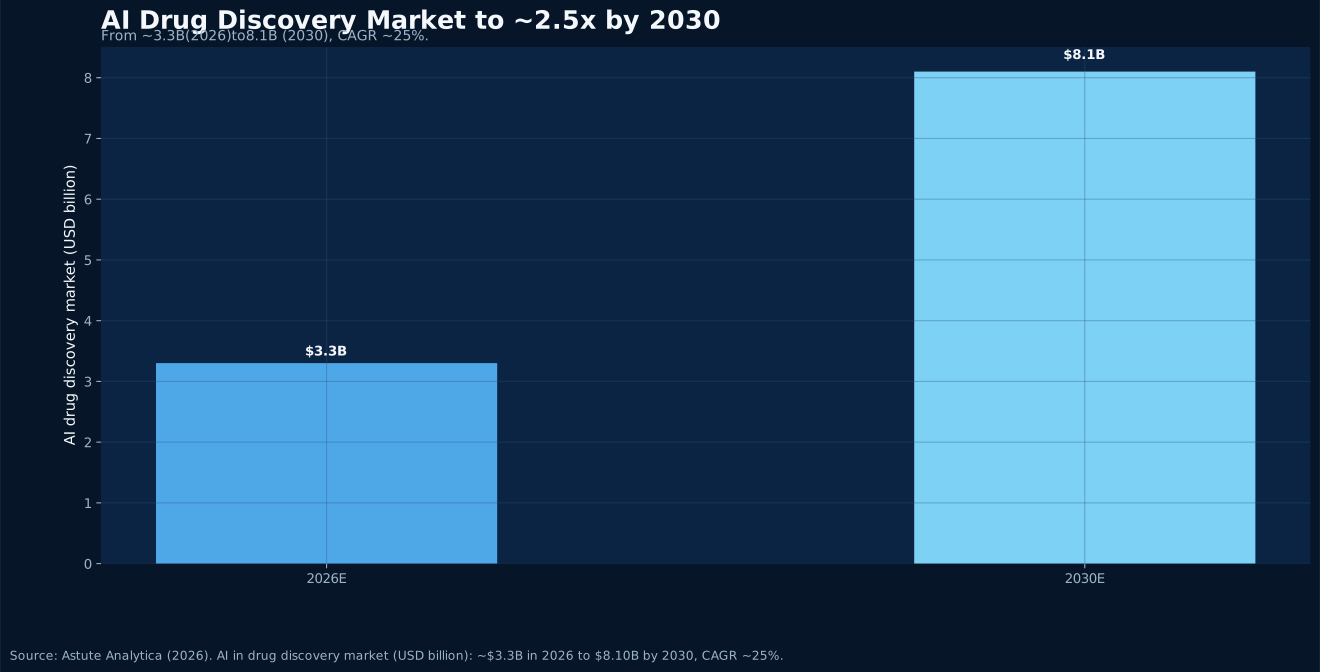
Market signals are equally strong. Astute Analytica estimates the global AI drug discovery market will grow from about $3.3B in 2026 to roughly $8.1B by 2030, a CAGR of about 25%. That far outpaces the pharma industry overall, reflecting how pharma is accelerating AI into R&D—from target discovery and molecule generation to trial design and patient selection, AI's penetration is moving from 'point tools' to 'end-to-end.'
As with other emerging tech, firms' AI-pharma market sizings differ widely—single-digit to tens of billions—depending on whether downstream clinical services and data platforms are included. But the direction agrees: a high-growth track with sustained double-digit growth and still-early penetration. For supply-chain participants, the point is not to argue over definitions but to grasp the sure trend of AI evolving from 'tool' to 'infrastructure.'
200+ Drugs in Trials: The Pipeline's Real Scale
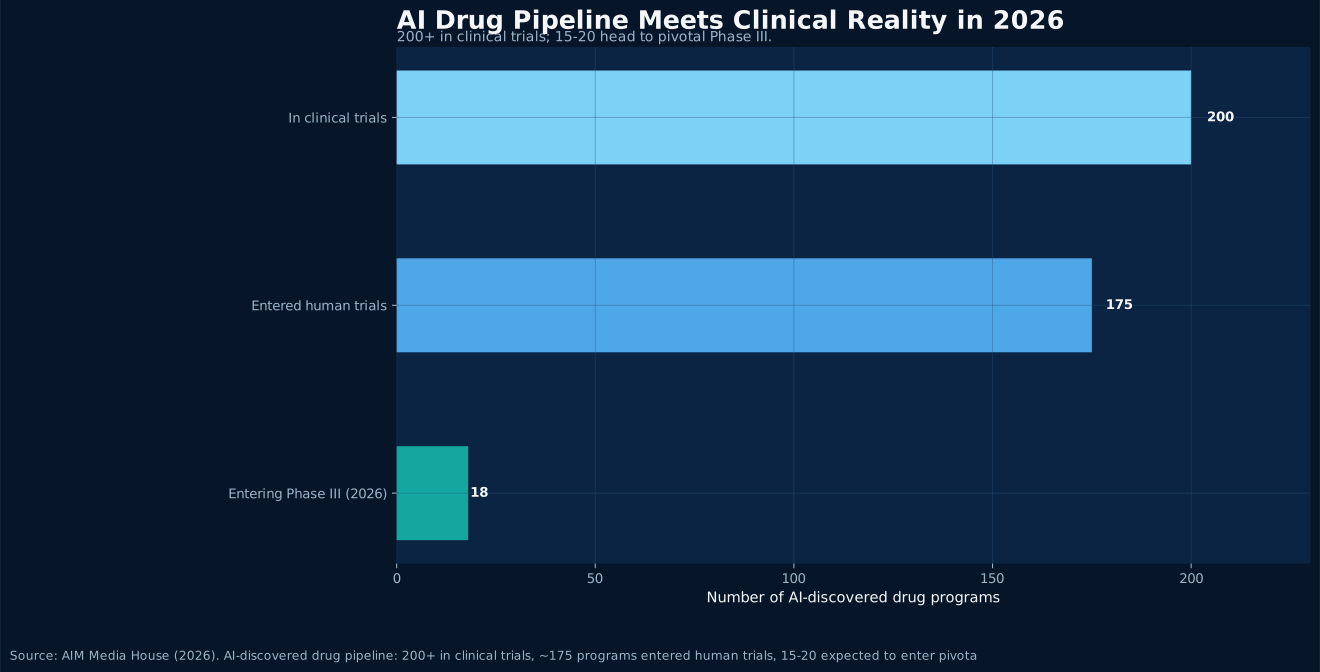
If market size is expectation, the clinical pipeline is today's hard metric. Per AIM Media House, 200+ AI-discovered drugs are now in clinical trials, ~175 AI-originated programs have entered human testing, and the field has drawn about $60B in investment since 2019. In 2026, an estimated 15-20 AI programs are expected to enter decisive Phase III trials—the most critical and expensive gate any new drug must clear before approval.
Yet the other side of the coin is just as clear: as of mid-2026, not a single fully AI-designed drug has won FDA approval. One of the furthest-advanced examples is Insilico Medicine's ISM001-055 for idiopathic pulmonary fibrosis, still in Phase 2. This reminds us that the pipeline's 'quantity' is already substantial, but the leap from volume to a 'first approval' still awaits the final verdict of clinical data.
Phase III: The Real Watershed
The heaviest storyline of 2026 is that Phase III readouts for several AI drugs will land one after another. Phase III is the largest, most expensive and most efficacy-revealing stage of drug development; its results directly decide whether a drug reaches approval and commercialization. For AI drug discovery, this is the first time it faces, at such scale and on such strict endpoints, the head-on question of whether 'AI-designed drugs actually work.'
Whatever the results, they will deeply reshape industry expectations. If several Phase III trials succeed, the valuation logic and capital flows of AI pharma will be rewritten, and 'AI + drugs' turns from story to methodology; if they fail in a row, the industry will be pushed to soberly reconsider AI's true boundaries and proper role in drug development. Either way, 2026 is destined to be a turning point where 'the data speaks.'
AI Didn't Cancel the Clinic—It Reshaped It
A common misconception treats AI drug discovery as 'skipping the clinic.' The opposite is true: AI greatly accelerates pre-clinical lead discovery and optimization but cannot waive the hard constraint of clinical validation. What it truly changes is the efficiency of the clinic itself—through sharper patient stratification, biomarker selection and trial-design optimization, AI can lower clinical failure rates, shorten timelines and control costs, so more candidates enter and pass trials with higher probability of success.
This lens matters especially for supply-chain participants: AI pharma's opportunity is not only in algorithm firms but spread widely across CRO/CDMO, clinical-trial services, biosamples and reagents, and data platforms. As AI pipelines pour into the clinic faster, these 'sell-the-shovels' links will see structural demand growth—a steadier, more cash-flow-adjacent way to participate.
Implications for China-Korea Biopharma Cooperation
The AI pharma wave opens new imaginative space for China-Korea biopharma cooperation. China has a huge patient base, fast-iterating AI capability and complete API and CDMO capacity; Korea has deep strength in biosimilars, clinical-research quality and select innovative drugs. Across AI-driven discovery, clinical-trial collaboration, manufacturing and cross-border registration, the two hold significant complementarity and cooperation potential.
Of course, pharma is heavily regulated, long-cycle and compliance-intensive; cross-border cooperation must proceed carefully under both countries' drug-regulatory frameworks and data-compliance requirements. MO-TEK's role is to help clients, along this high-value chain, steadily connect materials, manufacturing, clinical services and compliance resources—turning AI pharma's dividend into executable, deliverable cross-border sourcing and partnership plans, rather than mere imagination about the hype.