Breaking the 'Always Thirty Years Away' Curse
Fusion has long carried a self-deprecating line: whenever you ask, the answer is 'still thirty years away.' That captured both the extreme difficulty of fusion engineering and a past reality of slow, almost entirely government-led progress. But into 2026, stacked signals are shaking the curse: engineering breakthroughs keep coming in high-temperature superconducting magnets, plasma confinement and net energy gain; private companies push prototypes far faster than before; and capital markets are backing the field with hard money.
More important is a fundamental shift on the demand side. Fusion long lacked an urgent 'anchor customer' willing to pay a premium; now AI data centers play that role—their near-limitless hunger for clean, steady, predictable, load-adjacent power gives fusion unprecedented commercial pull. When technology push and demand pull align for the first time, the number 'thirty' finally starts to loosen.
A Steadily Rising Market Curve
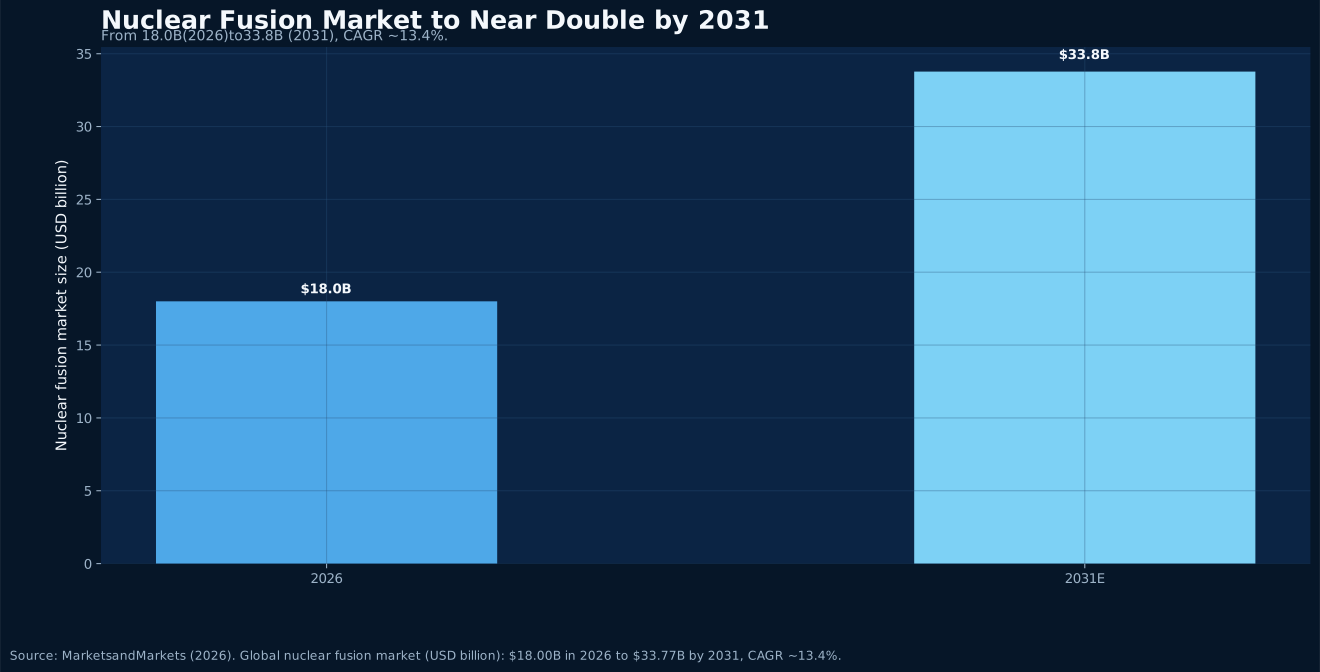
MarketsandMarkets estimates the global fusion market will grow from about $18.0B in 2026 to roughly $33.77B by 2031, a CAGR of about 13.4%. Note this basis covers the broad fusion supply chain—magnets, vacuum systems, diagnostics, engineering services—rather than only grid-connected commercial plants; genuinely commercial fusion power plants are expected by most bodies only in the mid-to-late 2030s.
In other words, current growth on this curve comes mainly from experimental devices, demonstration projects and supply-chain build-out—not power sales themselves. That means fusion's commercial opportunity need not wait for 'the first light'—procurement demand around device construction, critical components, materials and engineering services is already ramping in real terms. For trade and supply-chain providers, that is the most reachable entry point today.
Capital Votes With Its Feet: CFS Pulls Away
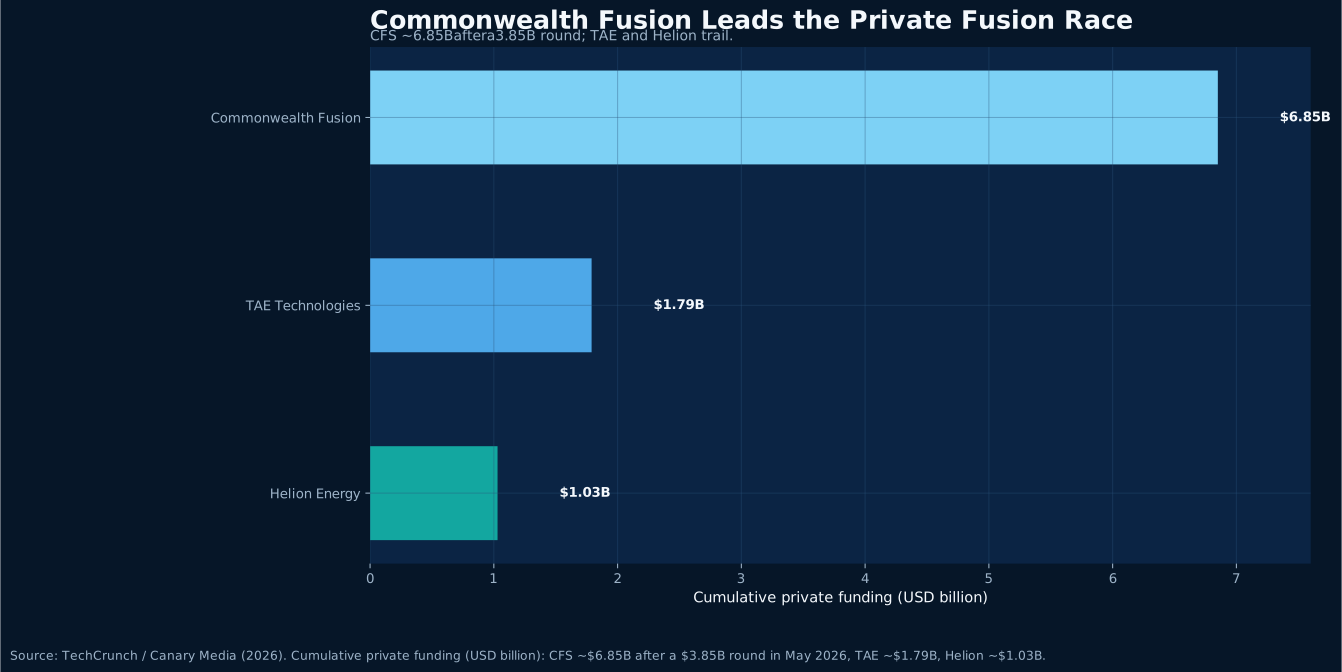
The rush of private capital is the strongest footnote to this fusion wave. Per TechCrunch and Canary Media, Commonwealth Fusion Systems (CFS) closed a round of up to $3.85B in May 2026, bringing cumulative funding to ~$6.85B and making it the largest-funded private fusion company globally by a wide margin. Behind it are TAE Technologies (~$1.79B cumulative) and Helion Energy (~$1.03B cumulative). Prominent backers—Nvidia, Google, OpenAI's leadership and Bill Gates's Breakthrough Energy—have all stepped in.
Notably, the investor rosters are full of tech and compute giants. That is no coincidence: for these firms, funding fusion is both a financial position and a strategic hedge on future power supply—they know better than anyone that AI expansion will hit a power wall. The shift in capital structure from government-led to diversified private-led is itself a key sign of the fusion industry maturing.
AI Power Draw: Fusion's Strongest Demand Engine
The bedrock driver of the fusion wave is, ultimately, AI's near-runaway hunger for power. A single hyperscale data center can already draw as much as a mid-sized city, while global AI compute keeps expanding exponentially. Renewables like wind and solar are clean but intermittent, hard to support 24/7 high-stability load alone; fusion promises carbon-free, controllable, extremely energy-dense baseload power—exactly the missing piece.
This explains why tech firms sign power-purchase intentions or inject capital before fusion is even commercial. They are making a long bet: once fusion crosses the threshold, whoever locked in capacity and partnerships early controls the energy lifeline of future compute expansion. This 'bind first, deliver later' logic mirrors the scramble for scarce resources like AI chips and HBM.
A Cool Head: Risks and Uncertainties
Beneath the enthusiasm, a cool head is equally needed. Fusion commercialization still faces huge uncertainty: from 'lab net energy gain' to 'repeatable, economically viable continuous generation' lies a string of unsolved challenges—material durability, the tritium fuel cycle, system reliability and cost reduction. Most authoritative bodies still cautiously place the first commercial fusion plant's grid connection in the mid-to-late 2030s, with slippage possible.
So the rational move is not to bet on a specific commercial date but to focus on nearer, surer windows: procurement demand for device construction, critical components and materials, precision manufacturing and engineering services is already ramping. MO-TEK's value is to help clients separate 'narrative heat' from 'executable orders'—on this long, snowy slope, locking in the real supply and partnership opportunities that exist today rather than being swept along by sentiment.
Implications for China-Korea Energy and Supply Chains
Fusion's high barriers still leave clear room for China and Korea to participate. China has deep capacity and cost advantages in superconducting materials, large magnets, vacuum and cryogenic engineering, and precision manufacturing, plus several large fusion research devices; Korea brings strength in nuclear engineering, precision components and system integration. Both are important players in the global fusion engineering supply chain and huge potential demand markets for future clean baseload power.
For MO-TEK, fusion is not distant sci-fi but a high-value supply chain taking shape and worth positioning for early. Helping clients connect to critical components, materials and manufacturing capacity for engineering devices, identifying cross-border cooperation within compliance, and turning 'energy thirty years away' into 'sourcing and partnerships you can start today'—that is exactly the real value we aim to create for clients.