From Sidekick to Bottleneck: Why HBM Decides the AI Race
The past decade put AI's spotlight almost entirely on GPUs and other compute chips, while the memory feeding them was treated as a supporting act. The large-model explosion upended that: training and inference must move enormous volumes of parameters and activations in tiny time windows, so memory bandwidth—not raw compute alone—increasingly decides whole-system performance. HBM stacks multiple DRAM layers vertically and links them with through-silicon vias, lifting bandwidth far beyond conventional memory and binding tightly to the GPU as an indispensable core of the AI server.
That role change shows up directly in how value is split. In a high-end AI server's bill of materials, HBM often ranks just behind the GPU—and in some configurations approaches the compute chip itself. Whoever can secure HBM reliably and with priority can protect the pace of their AI compute expansion. That is why memory is no longer a passive, follow-the-leader commodity but a strategic chokepoint for the entire AI supply chain.
A ~7.6x Climb: The Steep Market Curve
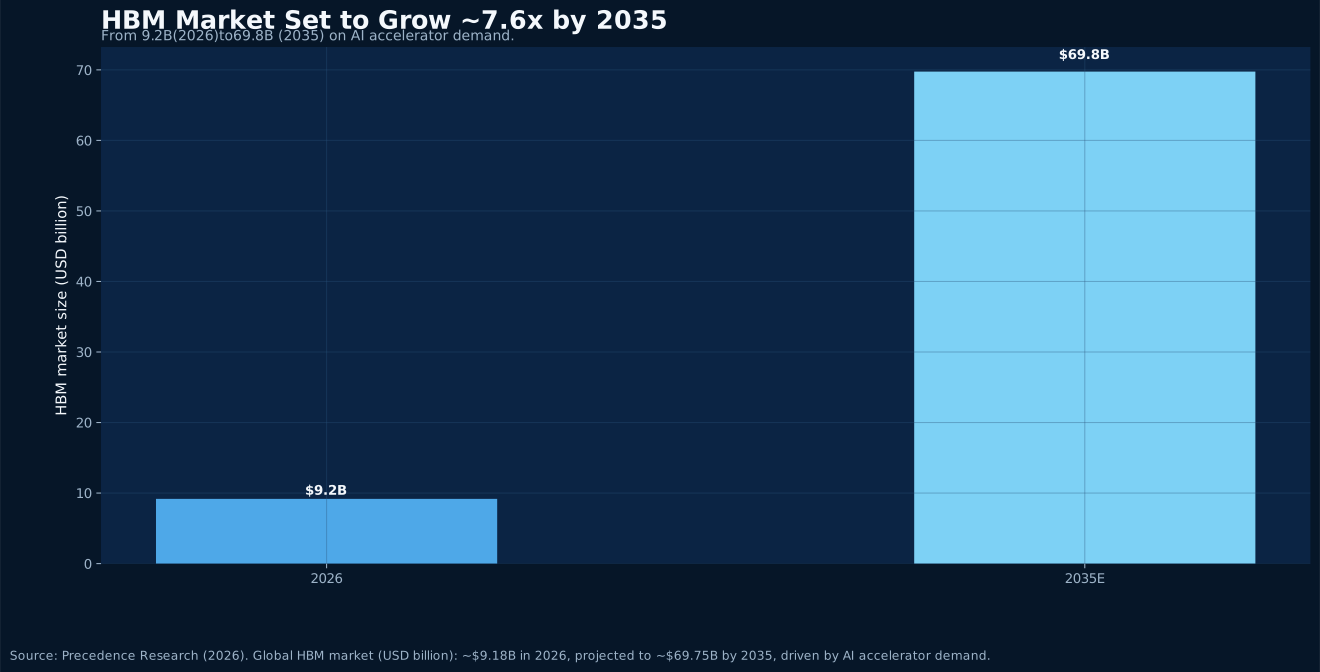
The pace of market expansion is striking. Precedence Research estimates the global HBM market will climb from about $9.18B in 2026 to roughly $69.75B by 2035—nearly 7.6x in a decade, a CAGR of about 25%. A curve this steep is rare among semiconductor sub-categories; it is essentially the flood of AI capital spending projected directly onto the memory layer.
A caveat: research firms define the HBM market very differently—some price by chip shipments, others fold in modules and packaging—so absolute figures range from single-digit to tens of billions of dollars. Whatever the basis, the direction is the same: demand growth far outpaces ordinary memory and will not peak for several foreseeable years. For buyers, the point is not to fixate on a precise number but to accept that this is a structural, long-cycle shortage.
The Big Three: SK Hynix Leads, Micron Overtakes Samsung
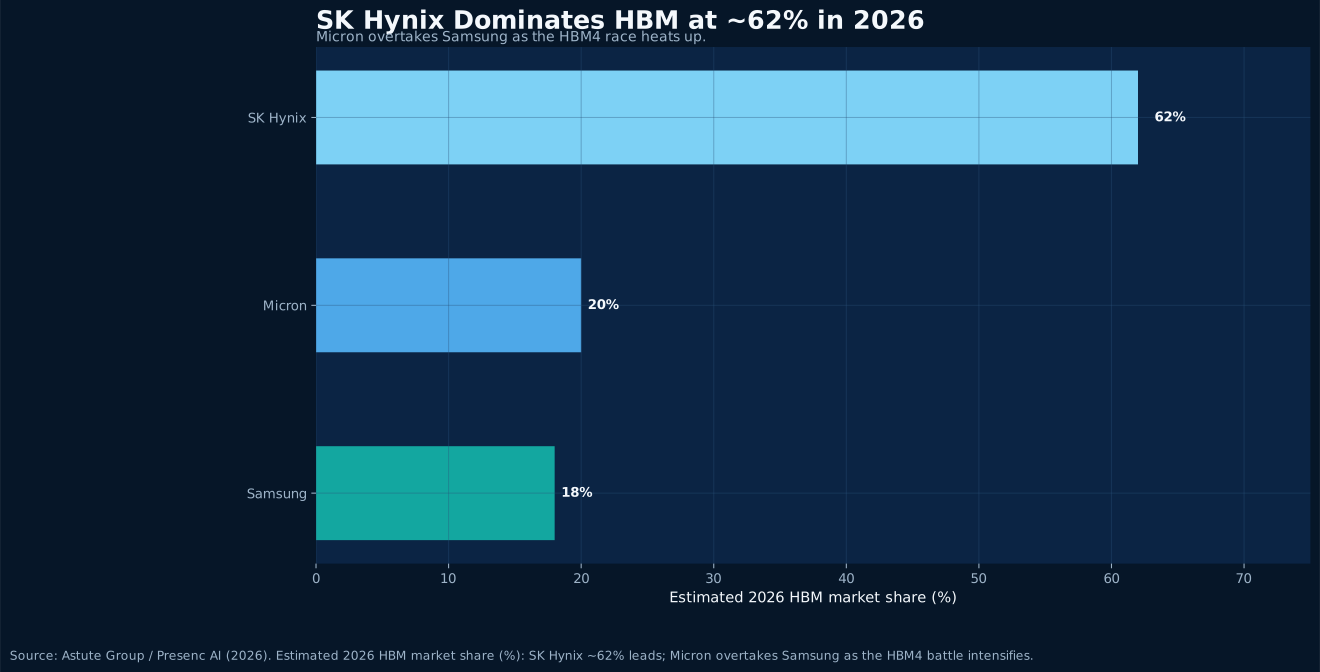
Supply-side concentration is the key to HBM pricing power. Astute Group and Presenc AI estimate that in 2026 SK Hynix sits firmly first with ~62% share—its HBM3E yields and delivery cadence winning priority allocation from big customers like Nvidia. Micron, positioned on HBM4 technology and expanding aggressively, has overtaken Samsung on some orders to take second place, while Samsung races to reclaim the main track via HBM4. The three together almost monopolize global supply.
This oligopoly means HBM supply is highly inelastic. New wafer capacity takes years to build, and advanced packaging (TSV stacking and CoWoS support) is a global bottleneck; a yield wobble in any link amplifies into system-level delivery. So even when demand signals are strong, supply cannot be released quickly in the short run—precisely what separates this supercycle from an ordinary memory price cycle.
The HBM4 War: 2026's Technical Watershed
By 2026 the competitive focus has shifted fully to sixth-generation HBM4. Versus prior generations, HBM4 leaps forward in bandwidth, stack height and energy efficiency, and for the first time makes the logic base die customizable—enabling co-design of memory with a specific accelerator. Samsung has moved first on HBM4 commercial shipments and expanded collaboration with AMD on HBM4 supply for next-gen Instinct GPUs; SK Hynix and Micron follow closely. Whoever first hits HBM4 volume yield can lock in the core supply slot for the next GPU platform.
For OEMs and system integrators, HBM4's customization cuts both ways: it raises the ceiling on performance and efficiency but deepens the binding of memory to accelerator, weakening flexibility for later substitution or second-source procurement. Sourcing decisions must therefore move up to the platform-selection stage—once you board a given accelerator ecosystem, its HBM supply cadence is essentially locked in.
How Tightness Propagates: From Memory to Servers, Storage and Cooling
HBM's structural tightness does not stop at memory; it propagates layer by layer along the AI server's bill of materials. When HBM capacity is locked up by GPU giants on long-term deals, smaller integrators and new entrants often face quota limits and price premiums—which in turn push up system quotes and stretch lead times. At the same time, HBM's high power and heat density amplify demand for high-end cooling—liquid cooling in particular—turning thermal management from an option into a default.
For the tech-supply-chain clients MO-TEK serves, this means procurement must be front-loaded and bundled: don't watch the spot price of a single component, but lock volume and timing on GPU, HBM allocation, storage and cooling as one delivery whole. Building diversified supply relationships early, securing long-term deals on critical part numbers, and buffering for delivery volatility will be the practical levers for navigating this supercycle.
Implications for China-Korea Tech Trade
The HBM supercycle places China and Korea at the same critical node of one value chain. Korea's SK Hynix and Samsung command the vast majority of global HBM supply and are the most direct beneficiaries of this cycle; China is the huge demand side for AI servers, data centers and end applications, while holding cost and scale advantages in memory packaging-and-test, cooling and system assembly. The strong complementarity of the two ends creates wide room for cross-border sourcing, contract manufacturing and joint solutions.
Of course, advanced memory and related equipment sit under export controls and geopolitical uncertainty, so cross-border cooperation must be designed carefully within compliance frameworks. MO-TEK's role is exactly this: on a high-value, high-volatility chain, help clients identify viable supply combinations, manage compliance and delivery risk, and turn structural tightness into executable sourcing and partnership plans—rather than passive anxiety over price hikes.