Breaking Silicon's Efficiency Ceiling
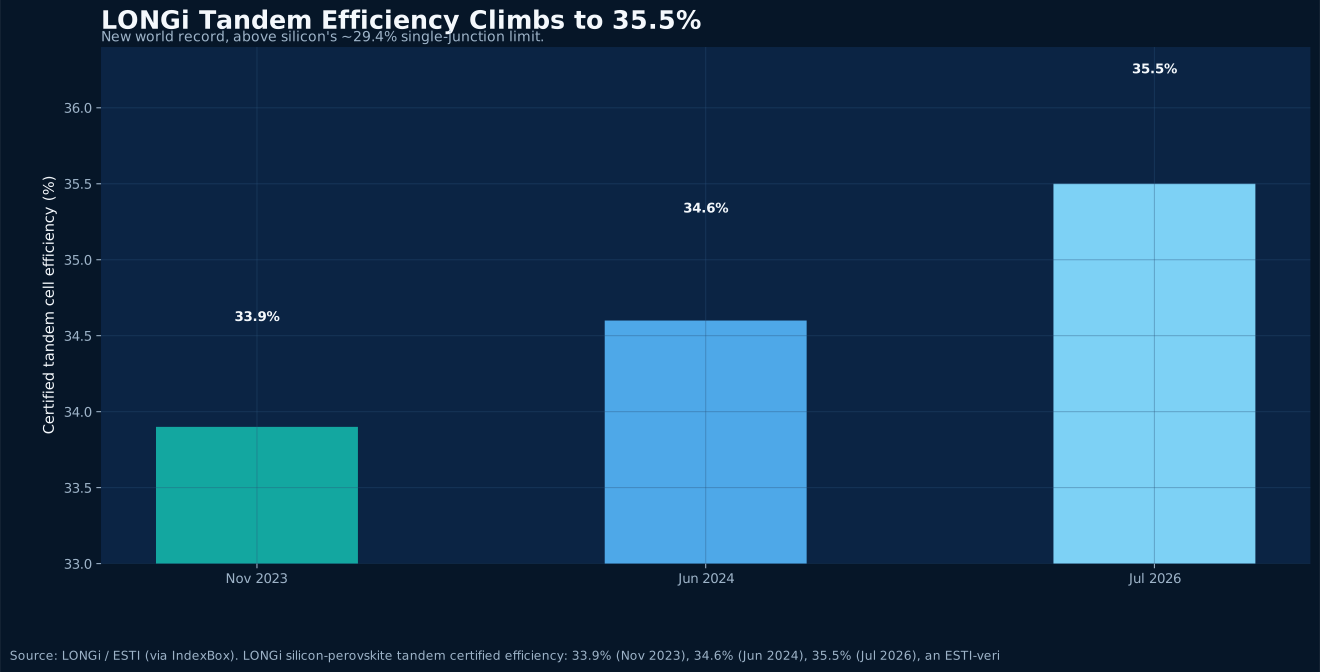
Solar-cell efficiency has long been capped by single-junction silicon's ~29.4% theoretical limit (the Shockley-Queisser limit). To breach that ceiling, the industry is betting on tandems—stacking a perovskite layer atop silicon so the two materials absorb different light bands, converting more sunlight into electricity. In July 2026, LONGi announced its silicon-perovskite tandem cell reached 35.5%, certified by the European Solar Test Installation (ESTI), setting a new world record.
The significance of 35.5% is more than a new number. It means that, for the same illuminated area, a tandem cell can produce roughly 20% more electricity than mainstream single-junction modules—an attractive value proposition for space-constrained rooftops and for utility plants chasing the lowest levelized cost of energy. Each percentage point of efficiency compounds along module-system-LCOE into meaningful economic gains.
A Record Curve That Keeps Climbing
LONGi's latest peak is the newest point on a steadily rising curve. Tracing its silicon-perovskite tandem record: 33.9% in November 2023, rising to 34.6% in June 2024, and climbing further to 35.5% by July 2026. In just over two years, efficiency improved by 1.6 percentage points—a rare cadence of iteration for the mature PV industry.
Behind the records is an industry-wide relay. Beyond LONGi, Oxford PV, various research institutes and equipment makers keep breaking through on different combinations (such as perovskite-CIGS tandems). The race to reset records is a contest of research prowess and, more so, a collective vote of capital on perovskite's commercial future. Together they are turning the theoretically-more-efficient narrative into an engineering-achievable reality.
From Lab to Production Line
Record efficiencies dazzle, but the crux of industrialization is whether lab data can land on production lines. Here we must be clear-eyed: lab-scale small-area tandems already top 33%, while commercial perovskite modules on the 2026 market land more realistically in the 18%-22% range. Between champion cells and scaled modules lie the trials of large-area uniformity, long-term stability and yield ramp.
The good news: the first step of industrialization is taken. As early as September 2024, Oxford PV delivered its first commercial tandem modules at about 24.5% to U.S. utility customers, proving production lines are no paper exercise. Most analysts expect that, after accumulating 20-year field data around 2027-2029, perovskite tandems could see utility-scale deployment. In other words, the next two to three years are the pivotal window for perovskite to prove reliability and establish bankability.
The Growth Logic of a $24 Billion Market
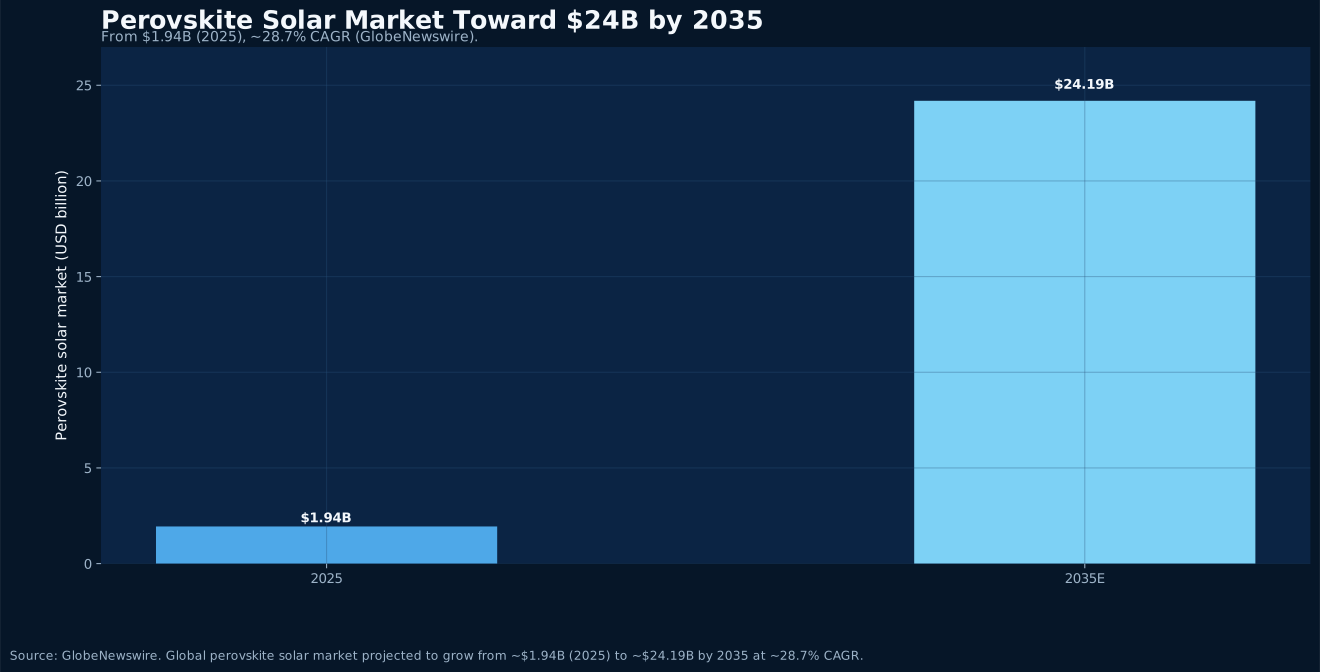
Market expectations for perovskite are rising alongside efficiency records. Per a forecast cited by GlobeNewswire, the global perovskite solar market could grow from about $1.94B in 2025 to roughly $24.19B by 2035—more than an elevenfold rise over the decade at a ~28.7% CAGR. To be clear, estimates differ across research houses, but the direction of rapid growth is a consensus.
Underpinning the high growth is a triple logic: first, ongoing expansion of global PV installations offers a vast replacement and incremental market for higher-efficiency technology; second, tandem-driven LCOE declines could, over time, bring perovskite modules near single-junction silicon's price around 2035; third, deposition equipment, encapsulation materials and perovskite precursors are forming a whole new high-value supply chain. Efficiency, cost and supply chain together form this arena's growth engine.
MO-TEK's View: Entry Points in a New Supply Chain
For Chinese and Korean manufacturers and traders, perovskite's value lies not only in the cell itself but in the entirely new supporting chain it spawns. Deposition and coating equipment, glass and encapsulation materials, flexible substrates, specialty precursor chemicals—and even the frames, junction boxes and mounting structures of tandem modules—each layer is being redefined by perovskite's industrialization. For firms adept at staking positions in emerging supply chains, this is a not-yet-solidified blue ocean.
MO-TEK's advice to clients: stay enthusiastic, but stay clear-eyed. Enthusiastic, because the tandem direction has been repeatedly validated and early positioning of supplier ties can build hard-to-copy first-mover advantage; clear-eyed, because large-area stability and long-term reliability still need time to prove—never mistake champion-cell efficiency for mass-module performance. The prudent path is to watch the production milestones of leaders like Oxford PV and LONGi, completing technical alignment and capacity reserves before their supporting demand ramps.