1. March's rebound means China moved back into the core of Korea's quarterly rhythm
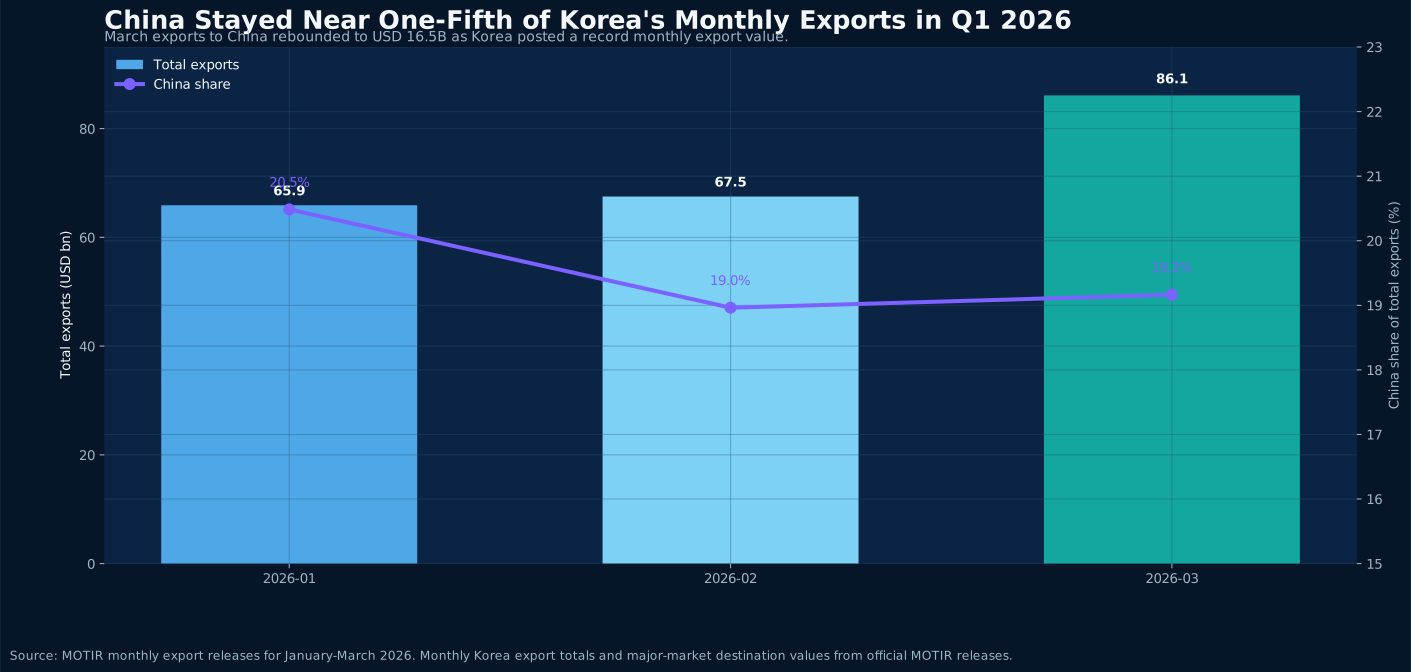
In its April 1, 2026 release, Korea's Ministry of Trade, Industry and Resources reported that March exports to China reached USD 16.5 billion, up 64.0 percent year-on-year and marking a fifth consecutive month of growth. Put back alongside January and February's official releases, China does not look like a one-off spike in Q1 2026. It looks like a market that stayed elevated at USD 13.5 billion, 12.8 billion, and then 16.5 billion. For Korean exporters, that changes China from a nice-to-have recovery story into a variable large enough to affect the whole-quarter judgment.
What matters more is that the rebound happened while Korea's total exports were also setting records. March was the first month in which Korea's exports surpassed USD 80 billion, reaching 86.1 billion. That means the China rebound was not a statistical illusion caused by weakness elsewhere. It happened while the United States, ASEAN, and the EU were also expanding. This is more meaningful than a simple high growth rate because it suggests China's recovery is not replacing diversification. It is unfolding alongside it.
2. Korea is not returning to a single-market bet; it is raising China's weight inside a multi-engine structure
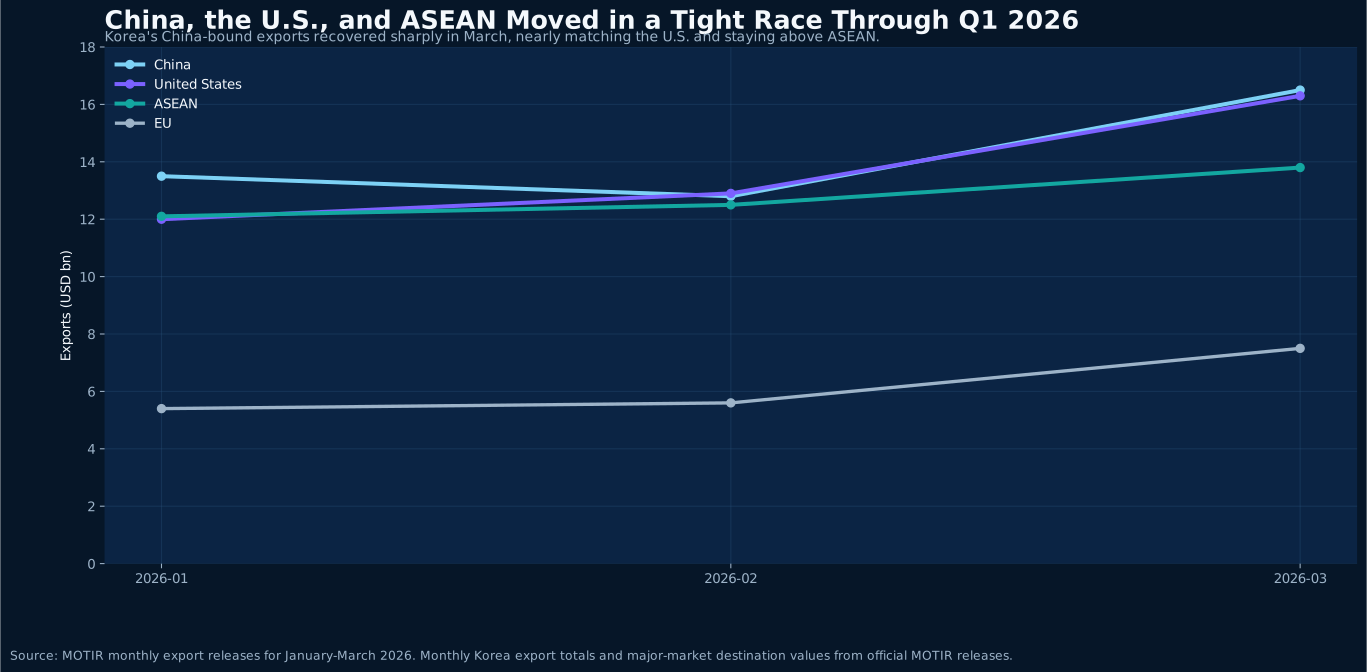
If one looks only at China's year-on-year growth rate in March, it is easy to overstate the story and claim Korea is turning back toward China. But month-by-month performance across major destinations suggests something more precise: Korea is rebuilding a multi-engine structure. In January, the United States stood at USD 12.0 billion, ASEAN at 12.1 billion, and China at 13.5 billion. In February, the United States was 12.9 billion, ASEAN 12.5 billion, and China 12.8 billion. In March, China climbed to 16.5 billion, the United States to 16.3 billion, and ASEAN to 13.8 billion. The three lines are now close enough that Korea's export outlook no longer rests on one destination alone.
For sectors tied to China-Korea trade, the implication is direct. China is no longer just Korea's old giant market, nor is it an engine fully displaced by others. It sits alongside the United States and ASEAN, but it still has deeper pull in electronics chains and fast-response consumer goods. That is why companies exposed to China-Korea trade need to think in structural splits. A recovery in exports to China does not mean the same thing across semiconductors, computers, cosmetics, and higher-value components. A single quoting logic will misread the opportunity very quickly.
3. The strongest force behind the rebound is not old bulk trade, but higher-value and faster-refresh categories
Korea's official monthly releases make clear that semiconductors were the main engine in Q1. Semiconductor exports rose from USD 20.5 billion in January to 25.2 billion in February and 32.8 billion in March, repeatedly setting records. Computers also climbed from 1.6 billion to 2.6 billion and then 3.4 billion, showing that AI-linked infrastructure demand and higher-specification electronics are still pulling the regional supply chain. This matters because recovery in China-Korea trade no longer means a simple return of low-value material flows. It increasingly reflects the linkage between chips, computers, components, equipment, and supporting consumer electronics.
At the same time, Korea's January and March releases both noted monthly records in consumer categories such as cosmetics. That means the recovery is not only a B2B industrial-chain story. When channels revive, inventories rotate faster, and consumer-side content and launch cycles accelerate, consumer goods can also regain a stronger role in exports to China. For trading companies, that changes the practical judgment. China-Korea opportunity is no longer reserved only for large industrial contracts. It also belongs to suppliers able to sample fast, replenish fast, and handle specification differences quickly in consumer-facing categories.
4. For China-Korea supply chains, the next battleground is delivery density rather than simple low pricing
When China moves back into the center of Korea's quarterly export judgment, the market does not automatically revert to old commodity-style price competition. In fact, the more the trade mix tilts toward higher-value electronics and faster-refresh consumer goods, the more suppliers are asked to coordinate lead times, specifications, customs handling, packaging, and replenishment rhythm. Korea's March release also explicitly noted ongoing logistics and geopolitical risks. That means any company hoping to benefit from the China-Korea recovery must solve execution resilience before relying on low-price positioning.
In other words, the most dangerous mistake now is to read a rebound in exports to China as permission to keep selling exactly as before. The more accurate reading is that China still matters, but the source of that importance is changing. Many orders used to be won mainly on capacity and price. More are now won on specification response, quality stability, document accuracy, predictable delivery, and the ability to keep up with channel shifts. That shift matters especially for glass, packaging, household goods, consumer products, components, and cross-border replenishment chains, because these sectors feel timing pressure earliest.
5. What matters next is not one Chinese monthly number, but how China's role changes inside Korea's export structure
To judge whether China-Korea trade will keep strengthening, at least three public signals matter next. First, whether China's share in Korea's monthly exports stays close to one-fifth or climbs further in seasonal peaks. Second, whether categories such as semiconductors, computers, and cosmetics continue rising together, since they reflect both industrial-chain and consumer-side demand. Third, whether the United States and ASEAN continue growing in parallel with China. If they do, Korea will likely maintain a multi-engine export allocation rather than returning to one-market dependence.
For businesses watching China-Korea trade, the most important move now is not to chase headlines mechanically, but to identify what kind of China opportunity their category actually belongs to. Is it a higher-specification coordination play inside electronics? A fast-response opportunity created by consumer-channel recovery? Or an indirect upstream-support opportunity tied to Korean exporters? Once that distinction is made correctly, the Q1 2026 rebound stops being just a news item and starts functioning as an operating signal for the next several quarters.