1. Korean purchases from China are no longer a traffic spike, but a stable quarterly consumption structure
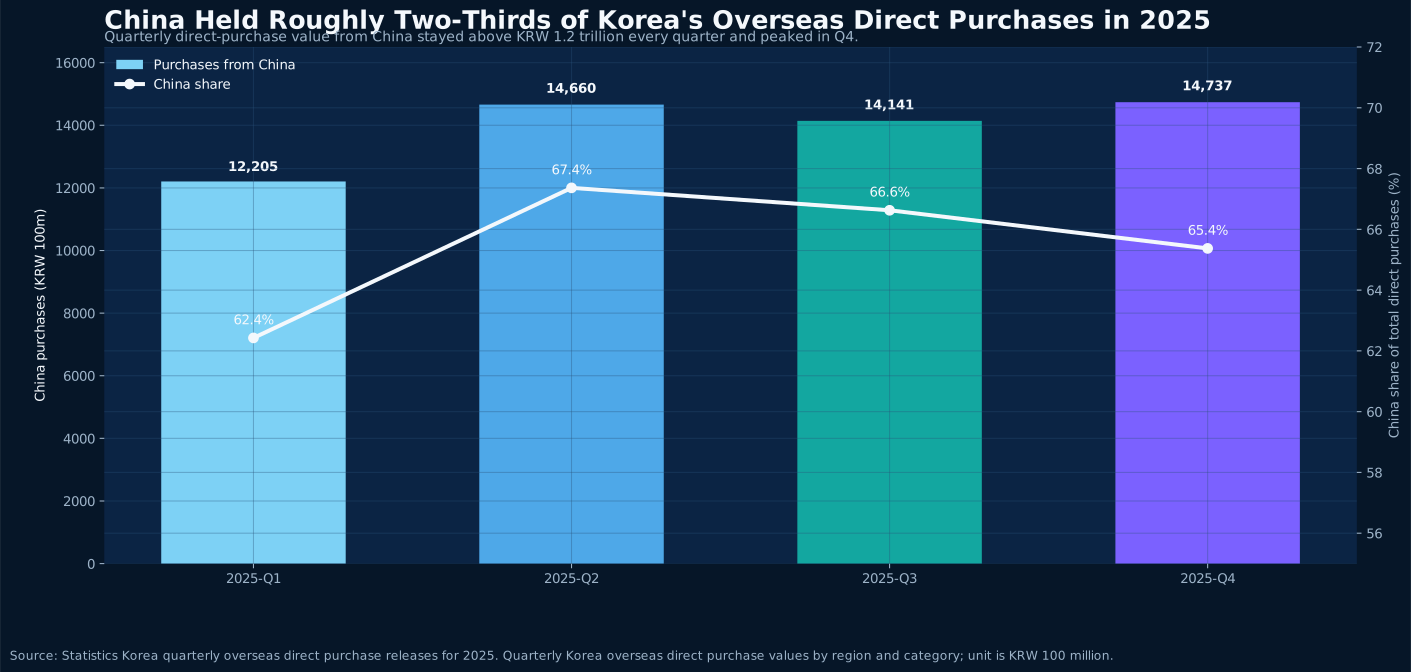
Statistics Korea's quarterly overseas direct-purchase data for 2025 points to a very clear conclusion: China remained Korea's largest source in every quarter. Direct purchases from China totaled KRW 1.2205 trillion in Q1, rose to 1.4660 trillion in Q2, softened to 1.4141 trillion in Q3, and climbed again to 1.4737 trillion in Q4. Relative to both the United States and Japan, China stayed in a clearly higher range, and its share of total direct purchases held above 60 percent throughout the year. That tells us Chinese platforms and Chinese-origin supply have become a recurring part of everyday Korean purchasing behavior.
That stability is more important than headline growth rates. In cross-border ecommerce, a single promotion or subsidy can distort one quarter, but it is much harder to stay elevated across all four. The fact that China never fell out of the lead range in 2025 suggests demand is being driven by more than discounting. Korean consumers increasingly appear to treat China-linked supply as a default option for replenishment, breadth of assortment, and acceptable shipping speed. Once that mental model forms, it becomes much harder to reverse than a single promotional burst.
2. The key question is not who is cheaper, but who can keep filling the Korean consumer's repeat basket
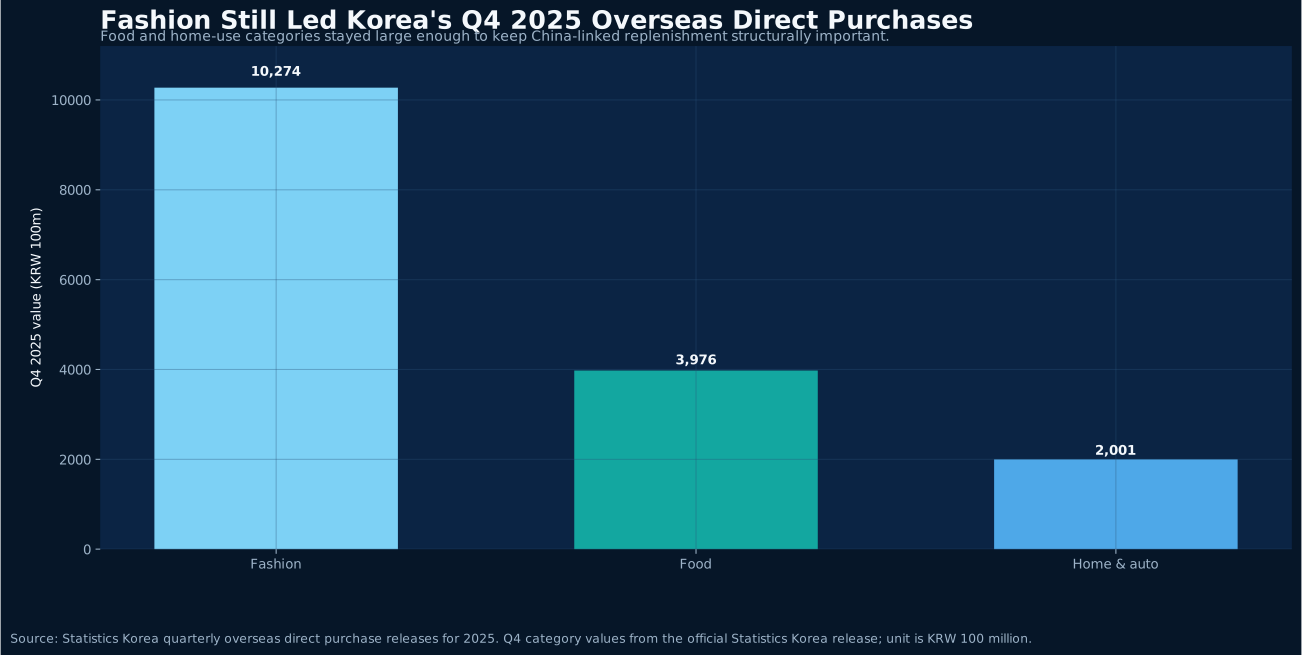
Looking at the category mix published by Statistics Korea, the largest overseas direct-purchase category in Q4 2025 was still fashion-related goods at KRW 1.0274 trillion, followed by food at 397.6 billion and home-auto goods at 200.1 billion. These categories share a common feature: they are not driven only by one-off content buzz. They are closely tied to replenishment, seasonality, household consumption, and repeat buying. That is why China's advantage is not simply price. It is its ability to keep covering these recurring consumption bands.
This also explains why Korean reliance on Chinese platforms has not faded quickly over time. As long as a platform can consistently supply fashion, daily-use, and food-related goods while maintaining acceptable fulfillment beyond price alone, it begins to evolve from a bargain channel into a habitual channel. For sellers and supply-chain operators, that change is crucial because it moves competition away from first-time acquisition and into repeat purchase, where assortment depth, inventory organization, customer support, and recovery during disruptions matter much more.
3. Persistent Chinese direct-purchase volume makes replenishment logistics and lightweight supply chains more important
Many observers still interpret Korean purchases from China mainly as a platform competition story, but from a supply-chain perspective it is rewriting a much finer trade lane. Korean consumers are not buying an abstract discount mechanic. They are buying batches of goods that need to arrive repeatedly, predictably, and with low friction. The more that fashion, food, home, and light consumer goods dominate the mix, the clearer it becomes that small batches, frequent orders, stable fulfillment, inventory turns, and cross-border last-mile delivery are the real center of gravity. For logistics, packaging, customs, and warehousing players tied to China-Korea trade, this demand is no longer peripheral.
In other words, the real future competition in China-Korea ecommerce will not live only at the front-end traffic layer. More of it will shift into the back-end replenishment chain. The firms that can handle seasonality, promotion peaks, policy shifts, and cross-border timing with greater stability will be the ones that keep repeat Korean demand. That logic may not apply in the same way to heavy industrial goods, but it is highly relevant to packaging, household products, light manufacturing, consumer goods, and related services because these sectors depend far more on rhythm than on one large contract.
4. The next Korean concern is whether compliance transparency and fulfillment resilience can keep up with scale
A high Chinese share does not automatically guarantee long-term stability. If scale keeps expanding, the Korean market will increasingly focus on platform responsibility, product compliance, tax declaration, returns handling, and consumer protection. The reason is straightforward: once direct purchase moves from the edge into the mainstream, regulators and public opinion stop treating it as an experimental behavior. For platforms and suppliers, the dangerous phase is not failure to scale. It is scaling while keeping rough operating practices in place.
That is why the next stage of stability in Korea's China-linked direct-purchase market will depend on more than access to low-price goods. It will depend on whether fulfillment becomes less error-prone, less opaque, and less painful after the sale. For the China-Korea trade-service ecosystem, that means more value will move toward compliant packaging, traceable logistics, standardized declarations, and localized support. The companies that strengthen these back-end layers will be better positioned to retain the volume they have already attracted.
5. The real public-data signal is not platform heat, but how deeply Chinese supply sits inside Korean everyday consumption
Much of the old discussion around Chinese platforms focused on downloads, active users, and marketing battles. Statistics Korea's quarterly purchase data tells a more useful story. Downloads show interest; order value shows actual consumption. A one-month search trend shows attention, but four consecutive quarters of category structure show habit. The public numbers for 2025 already suggest that the most important part of China's position in Korea is not a single platform war, but the steady movement of fashion, food, and daily-use goods into a repeat-purchase system.
That is why companies operating in China-Korea cross-border trade now need to do more than chase traffic. They need to decide whether they can enter this repeat replenishment chain. If they can, the next job is fulfillment and compliance. If they cannot, even heavy marketing will produce only short-term orders. At the level of the overall trade lane, what the 2025 direct-purchase data really reveals is a longer structural change: China's supply into Korea is starting to resemble infrastructure more than opportunistic arbitrage.