1. Direct sales to China did not disappear; China remains one of Korea's densest online export destinations
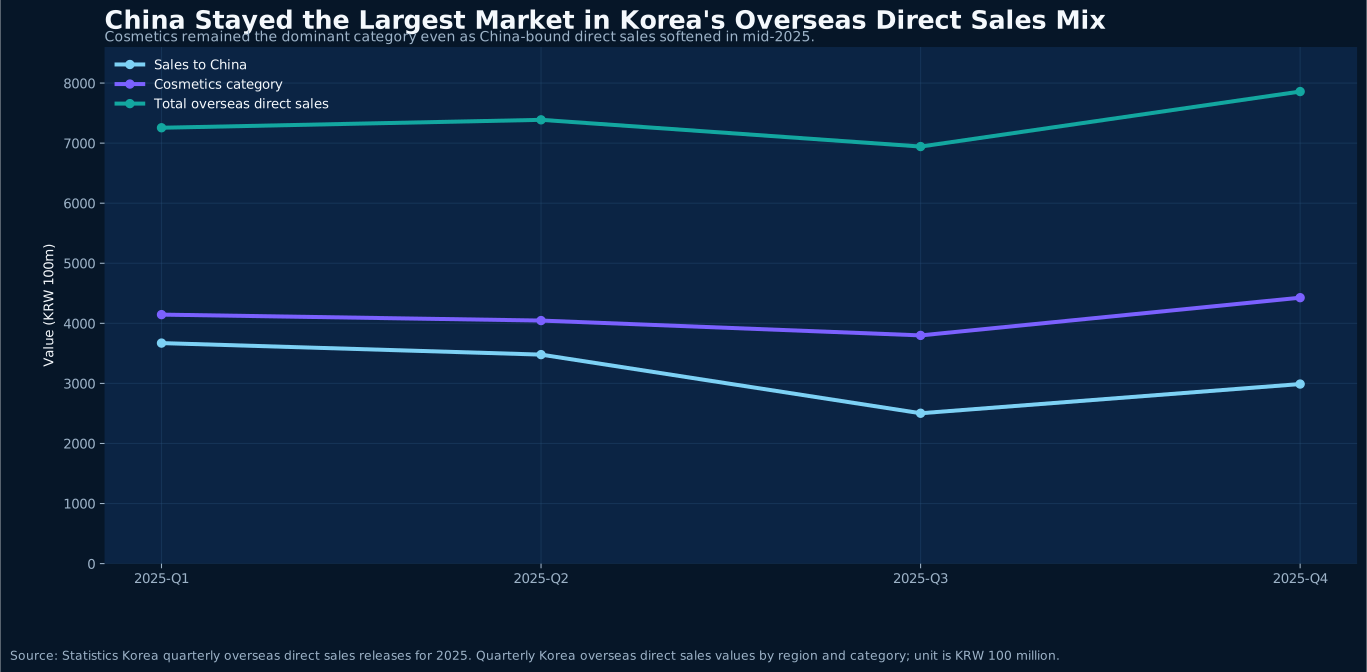
Statistics Korea's quarterly overseas direct-sales data for 2025 shows China staying on top throughout the year. Sales to China reached KRW 367.1 billion in Q1, 347.9 billion in Q2, 250.3 billion in Q3, and recovered to 298.9 billion in Q4, ranking first in every quarter. Because competition in China has intensified and brand expansion models have diversified, it is easy to misread the market and assume China has lost its value for Korean brands online. The official data suggests otherwise: China did not leave the core destination set. What changed is the transaction model and the competitive logic.
That matters for packaging, warehousing, filling, and brand-service operators tied to China-Korea trade. As long as China remains at the top tier of Korea's overseas direct-sales structure, work tied to China-facing samples, labeling compliance, packaging fit, inventory positioning, and cross-border fulfillment does not move to the margin. It stays at the front of the project and often enters planning earlier than before. In that sense, China's value today is not only sales volume itself. It also shapes how brands organize the execution rhythm of online expansion.
2. Cosmetics kept leading the mix, which means the hard part is shifting from finding orders to executing details
In Korea's overseas direct-sales mix for 2025, cosmetics ranked first in every quarter: KRW 414.5 billion in Q1, 404.6 billion in Q2, 379.9 billion in Q3, and 442.7 billion in Q4. That structure shows the base for K-beauty's online expansion is still solid. The question is no longer whether demand exists. It is what kind of products, what type of channels, and what fulfillment details that demand lands on. Fast launch cycles on the consumer side force packaging samples, label confirmation, legal review, filling switches, and low-volume replenishment to move earlier on the brand side.
That is also why packaging and compliance keep rising in importance. A traditional distribution model can absorb many operational mistakes inside the channel. D2C and direct-sales models expose those mistakes to the consumer much faster. A poor dispenser, incomplete translated labeling, damaged packaging, or unstable shipping speed can turn quickly into bad reviews and return pressure. For supply chains serving China-Korea beauty trade, the more important question now is how to reduce detail-level error rates rather than how to force one more bestseller spike.
3. Korean authorities are now reinforcing ecommerce HS support and export models, showing that rule thresholds are moving earlier
In November 2025, Korea Customs published HS-code and classification support for the top 100 ecommerce export items, explicitly aiming to improve filing accuracy and ease for SMEs. The agency also noted that categories such as cosmetics, fashion, and media goods were central to ecommerce exports. This matters because it shows regulators now treat ecommerce exports as a formal channel that requires precise support and precise declarations rather than as a peripheral format. Once authorities begin to publish more detailed HS guidance, the margin for error in product selection, packaging, labels, and customs documentation gets smaller.
Later in 2025, MOTIR's release on new K-beauty export models noted that Korea's cosmetics exports reached USD 10.2 billion in 2024 and highlighted cross-border D2C platforms as a growing route. The government's emphasis on new export models and customs' emphasis on more accurate declarations are really two sides of the same story: one expands the route to market, while the other tightens the standard of execution. For supply-chain operators in China-Korea beauty trade, that means future competition will depend not only on how fast a product can go live, but on who can make fewer errors while keeping both regulation and fulfillment in sync.
4. For packaging, filling, and logistics firms, the most valuable capability next is compliance-ready fast response
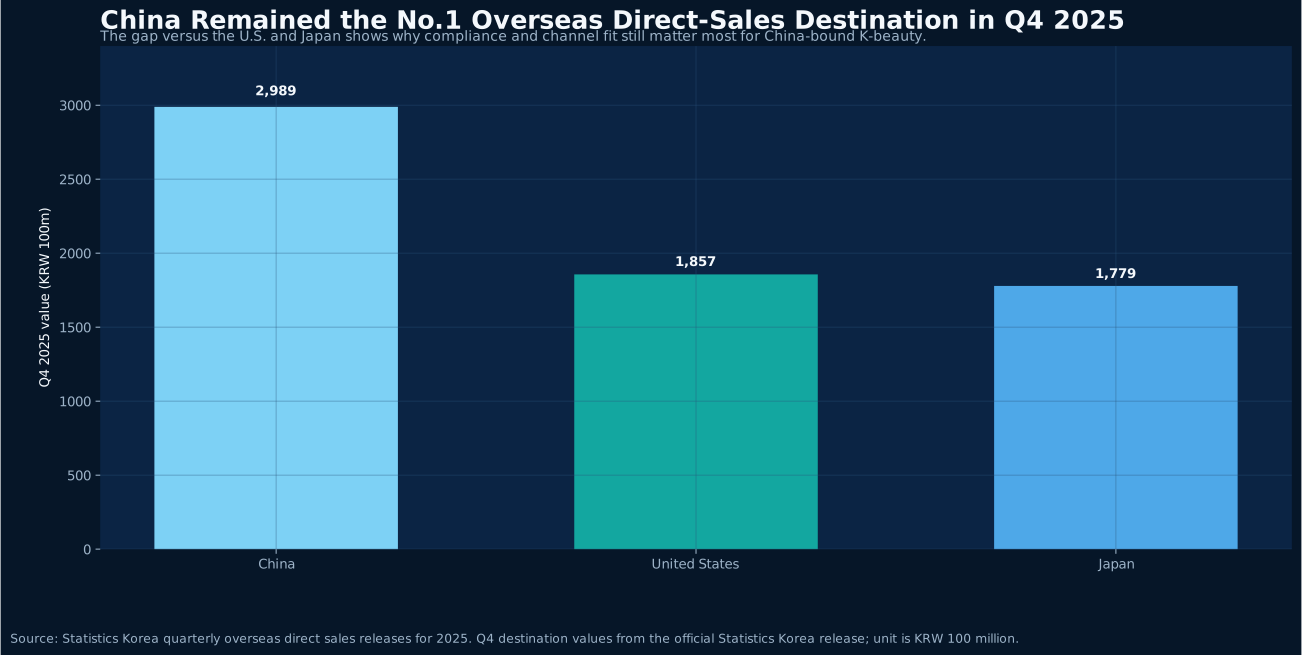
When China stays the top direct-sales destination, cosmetics stay the largest category, and authorities keep strengthening HS and ecommerce-export support, the high-value layers of the chain become clearer. First is packaging and filling capacity that can support samples and low-volume trial orders quickly. Second is compliance capacity that can handle labels, ingredients, packaging marks, and declarations more cleanly. Third is warehousing and logistics capacity that can keep fulfillment stable through promotions and launch cycles. These used to be treated as support functions. They are now moving closer to the transaction itself.
This is why the next phase of China-Korea beauty trade increasingly looks like a battle of detail management. Hits, traffic, and channels still matter, but they now depend on a quiet premise: the back end cannot fail repeatedly. If labels, packaging, filings, or fulfillment break too often, even strong marketing gets swallowed by after-sales friction and platform rules. By contrast, if a supply-chain team can package compliance and speed into a repeatable capability, rising complexity in China becomes an advantage rather than a burden.
5. The next thing to watch is the split between brands that can sell steadily in China and those that sell only occasionally
What the 2025 public data tells us is not whether China will remain important, but how that importance will be distributed. The winners will not necessarily be the brands that spike the hardest in one campaign. They are more likely to be the brands that keep getting labels, packaging, shipping, and after-sales details right. For supply-chain partners, the most valuable clients may not be the ones with the largest single order, but the ones willing to build compliance, speed, and repeat-purchase systems together. Those are the brands that can turn China from a short-term demand burst into a steadier operating base.
So for anyone looking to participate in China-Korea beauty trade, the right question today is not 'can we still sell to China?' but 'does our part of the chain support selling to China in a stable, compliant, repeatable way?' If the answer is yes, then 2025's direct-sales data and official compliance moves are positive signals. If the answer is no, then the larger the China market becomes, the more visible the execution pressure will be. That is the clearest industry warning embedded in the 2025 data.