1. The easiest mistake this year is to read renewed talks as easier trade
At the turn of 2026, Korean authorities sent two signals that look aligned on the surface but mean different things. The first came from MOTIR. At the Korea-China trade ministers’ meeting on December 30, 2025, both sides agreed to hold regular in-person meetings from 2026 onward and accelerate follow-up negotiations on services and investment under the bilateral FTA. That means the agreement is no longer being treated as a static framework from 2015, but as something both sides are trying to modernize through services, investment, and rule coordination.
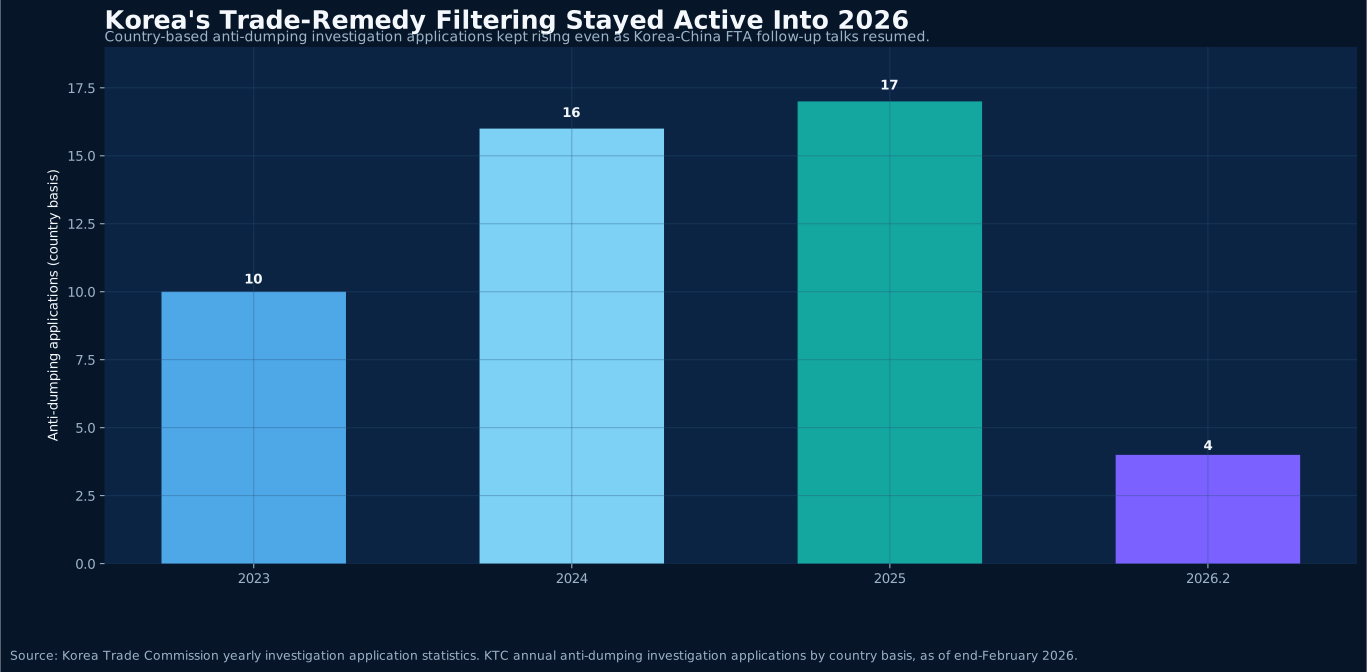
The second signal came from Korea’s trade remedy and customs enforcement system. Public KTC statistics show anti-dumping applications on a country basis at 10 in 2023, 16 in 2024, 17 in 2025, and already 4 by the end of February 2026. In other words, Korea is not loosening goods-side scrutiny because it wants to upgrade services and investment rules. The modernization track and the defense track are moving together. Looking only at the first creates false optimism; looking only at the second creates false pessimism. The more accurate reading is that cooperation is expanding while filtering is getting stricter.
2. Why services and investment are becoming key variables again
From the perspective of bilateral trade structure, services and investment matter again not because they immediately create more tariff cuts, but because Korea-China trade increasingly works as a bundle of goods, services, and execution networks. In cross-border e-commerce, regional warehousing, channel entry, after-sales response, testing, certification, and brand landing, comparing factory FOB prices is no longer enough. Buyers are evaluating whether a supplier can make the business run more steadily, not merely whether it can ship products.
That is also why some firms feel the Korean market is opening up while others feel it is becoming harder. The former are usually offering something closer to service-enabled supply: packaged solutions, execution support, accurate paperwork, labeling coordination, and forward inventory. The latter are still relying on the assumption that low prices alone will pull orders. If the FTA continues to deepen in services and investment, the biggest winners will not be the cheapest sellers, but the firms that reduce transaction friction most effectively.
3. Trade remedies are not fading; they are warning that low-value paths are harder
The KTC statistics published as of end-February 2026 deserve repeated attention. They show a trade remedy system that is not sporadic, but continuously receiving applications, launching cases, and issuing measures. At the same time, the KTC site and public notices still show China-related proceedings or follow-on reviews, including a midterm review on PET film and ongoing cases involving H-beams and coated cold-rolled steel products. In practice, Korea remains strongly defensive toward goods that are standardized, easily substitutable, and highly price-sensitive.
For companies involved in Korea-China trade, the practical message is straightforward: do not confuse policy cooperation with enforcement leniency. An FTA can improve rules, communication speed, and institutional predictability, but it does not replace Korea’s willingness to defend specific domestic industries. Any business model still trying to win orders through commodity goods, thin documentation, weak after-sales support, and slow response will get stuck more easily than before in review, certification, supplementary filing, warranty, and repricing stages.
4. The real opportunity is goods trade that carries service capability
When Korea’s public policy shifts, channel behavior, and buyer expectations are read together, the more valuable move is not simply sending more quotations but embedding service capability inside the supply process. Can one shipment satisfy different labeling requirements across channels? Can Korean, English, and Chinese trade documents be aligned in one pass? Can replenishment be planned around promotion cycles? Can compliance alerts and risk boundaries be explained before the buyer even asks? These may not look like classic product strengths, but they increasingly decide whether business stays.
This matters especially in glass, packaging, household goods, components, beauty, and cross-border retail support, where specification gaps, logistics timing, labeling, documentation, and channel rhythm collide most often. The firms that can turn those moving parts into a delivery model that buyers can order, reorder, and approve internally with less friction will be better positioned in the next reshuffle of Korea-China trade.
5. The next question is not whether the market opens, but where openness lands first
In the months ahead, the more useful thing to track is not a broad statement that bilateral ties are warming or the FTA is moving forward. What matters is which concrete links in the chain get easier first. Historically, the first improvements do not appear in the most sensitive commodity goods. They appear where service delivery, investment setup, distribution networks, and online-offline channel integration matter most. That means the earliest beneficiaries are less likely to be pure price competitors and more likely to be firms already prepared to deliver product, paperwork, logistics, channels, and after-sales support together.
So the more accurate question for Korea-China trade is not whether companies should continue engaging, but with what structure they should continue. If firms remain trapped in old bulk-shipment and pure price competition models, warmer policy signals may not translate into profit. If they can embed service and execution capability into the deal, they can still build more stable and sophisticated buyer relationships even in a demanding policy environment. That is the real direction hidden inside the latest public policy signals.
If this shift has to be reduced to one practical sentence, it is this: follow-up FTA talks will not bring Korea-China trade back to an older era of price-first selling and execution-later thinking. Instead, service capability, documentation discipline, and risk control are moving from the back end of the deal to the front-end threshold. The earlier a company accepts that reality, the more likely it can convert positive public policy signals into business certainty.