1. Why KOREA PACK is no longer an ordinary trade show
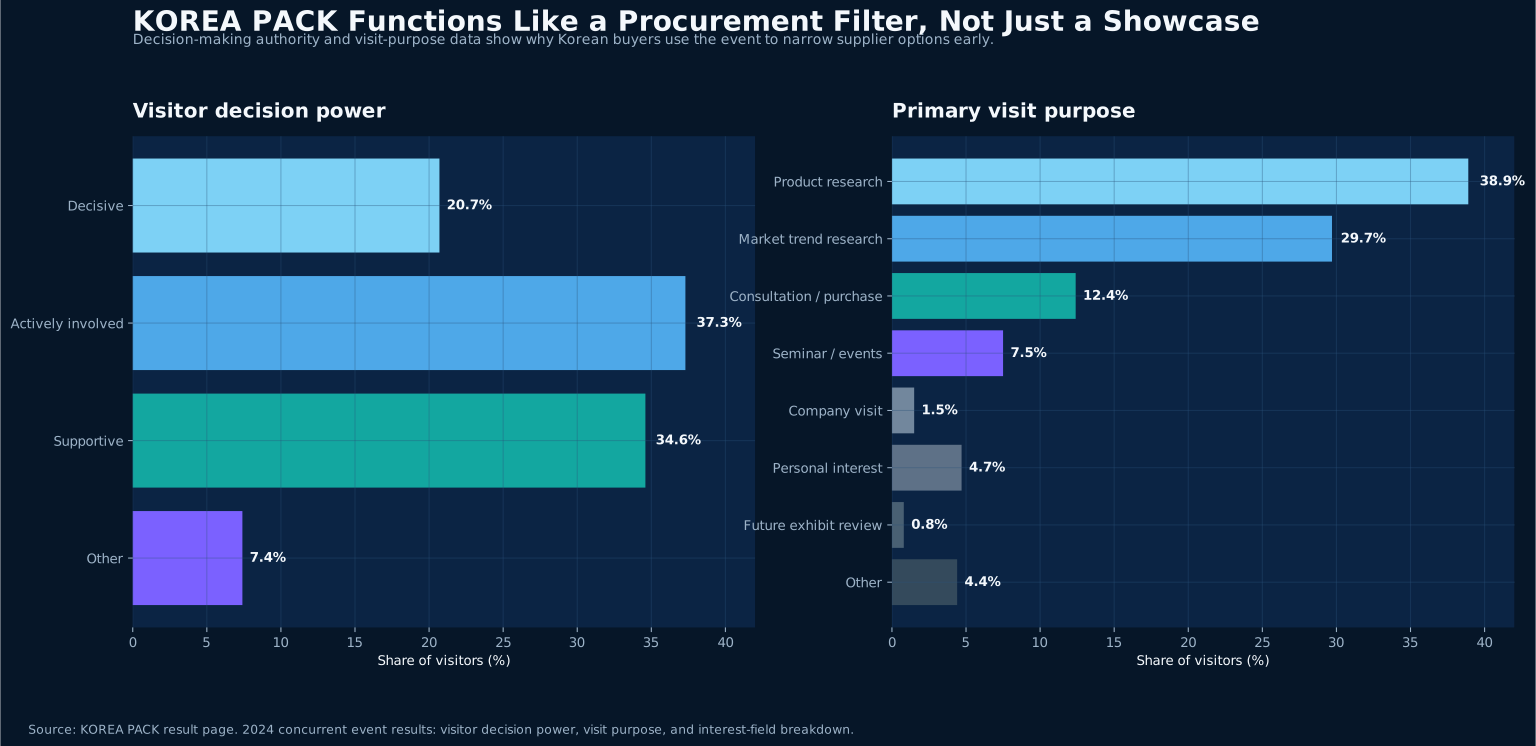
The most important part of the KOREA PACK results page is not the total scale, but the visitor structure. The 2024 combined-event statistics show 60,804 visitors, but a large share were not casual passersby. 20.7% held decisive purchasing power and 37.3% were actively involved in purchasing decisions, for a combined 58.0%. That means more than half of the traffic was close to real orders, line upgrades, material substitution, and supplier screening.
That changes how suppliers should interpret the Korean market. Many still treat shows as awareness-building first and business discussion later. But if the audience is already close to actual decision making, the value of the exhibition is not just exposure. It is early entry into the buyer’s evaluation list. Whoever gets remembered, compared, and technically validated at this stage is more likely to receive a second conversation after the event.
2. Korean buyers come to decide what to change next
Another decisive structure in the official data is visit purpose. 38.9% came for product research and information gathering, while 29.7% came to study industry and market trends. Together that is 68.6%. Korean buyers in packaging, manufacturing, and consumer-related sectors are therefore not attending only to place orders on site. They are using the event to compare technologies, costs, trends, and substitution routes quickly. In practice, this is front-end screening for the next purchasing model.
For Korea-China supply chains, that means exhibitions should no longer be treated as a follow-up-first process. They are now a before-during-after sequence: preparation before the event, validation during the event, and fast movement after it. If suppliers only start organizing specifications, samples, lead times, and certifications after the show, they are already late. The more effective approach is to bring alternative paths, constraints, and comparison-ready material before the meeting even begins.
If the 2026 exhibition timing itself is added to the background, the signal becomes even clearer. KOREA PACK 2026 just ran from March 31 to April 3, which means the annual screening window for Korean packaging and manufacturing buyers is happening right now, while the 2024 result page remains the most complete and traceable structural sample. For Chinese suppliers trying to enter Korea, that result page is not stale information. It is a manual for how post-show follow-up will likely work in the next round.
3. Interest distribution shows materials, equipment, and manufacturing are rebundling
The interest breakdown makes the same point from another angle. Packaging machinery took 18.4%, packaging materials 12.0%, manufacturing and packaging equipment 9.4%, pharma and cosmetics machinery 8.4%, food machinery 8.2%, and packaging robots 7.6%. Buyers are not looking at isolated materials. They are evaluating whether materials, lines, automation, and end-use applications can work together reliably.
This is especially important for Chinese suppliers, many of whom still enter the Korean exhibition environment talking mainly about unit price, MOQ, and lead time. Korean buyers often do not evaluate materials in isolation. They evaluate them together with filling rhythm, packaging consistency, equipment compatibility, certification packs, and application fit. Suppliers who can speak in system language are more likely to get attention from manufacturers, brand owners, and equipment-side partners at the same event.
4. Why this is a trade signal, not just an exhibition story
Many exhibition updates look like ordinary event news, but for Korea-China trade, result pages like KOREA PACK have forecasting value. Korean buyers often use exhibitions to compress their long list first, eliminating mismatched suppliers before they move into sample validation and commercial talks. In that sense, visitor structure is an early signal of how the market will choose its next partners.
That signaling effect is even stronger in packaging, beauty, food, household goods, cold chain, and pharma-related chains, where channel shifts, regulation, cost pressure, and delivery stability all collide. Buyers no longer ask only who is cheaper. They ask who is more stable, faster, and easier to coordinate with. Once exhibition channels start framing the decision at that level, subsequent competition no longer stays at the level of simple quotations.
5. Suppliers need answers beyond the material price sheet
If suppliers still treat Korean shows as places to collect business cards, they miss the real conversion point. A stronger preparation model is to front-load the answers buyers actually need: what lines and applications the material fits, how tolerance is controlled, how pilot runs are arranged, whether documents and labels can be completed in one pass, and whether the supply chain can keep up when the buyer needs to switch channel versions quickly.
The KOREA PACK results are telling the market that Korean procurement questions are moving earlier, becoming more systematic, and becoming more detailed. For Korea-China supply chain players, that is not just pressure. It is a sign that the filtering logic is becoming visible in public. The earlier a supplier prepares those answers beyond price, the more likely the exhibition channel becomes a real entry point into Korean business.
Viewed over a longer horizon, this also explains why Korean exhibitions are becoming better places to design cooperation paths rather than merely display products. Buyers come to see whether a supplier can shorten internal evaluation cycles, lower trial-and-error cost, and improve switching efficiency afterward. Suppliers that can answer those questions are more likely to survive into the second comparison round even if they are not the cheapest. Those that arrive only with catalogs and price sheets are more likely to be treated as replaceable from the start. The value of Korean exhibitions is moving from exposure toward filtration.