1. The key message in January online retail is structure, not just total value
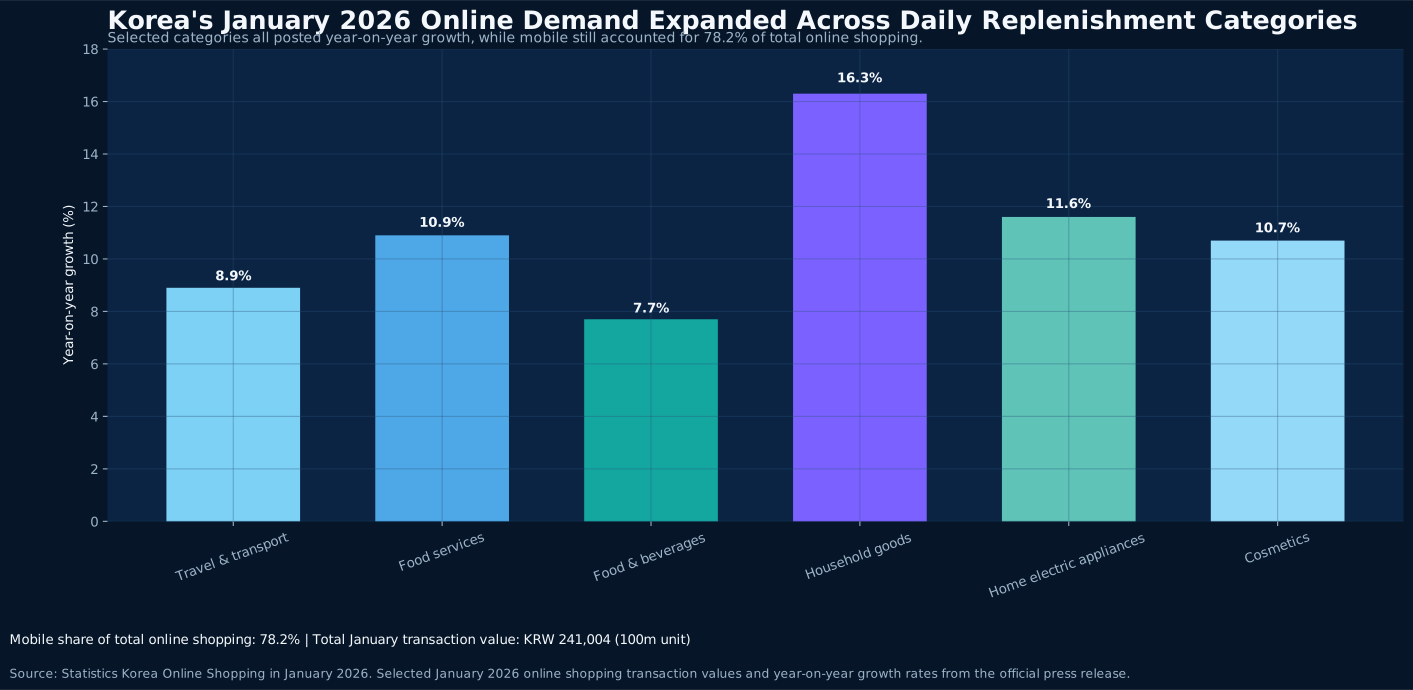
Statistics Korea reported online shopping transactions of KRW 24.1004 trillion in January 2026, up 8.6% year on year, with mobile transactions at KRW 18.8554 trillion, up 8.0%, for a mobile share of 78.2%. Read only at that level, the release may seem to say nothing more than Korean online demand is still growing. For Korea-China suppliers, however, the more useful question is how that growth is composed.
What stands out this time is that the increase was not driven by a single craze. Multiple high-frequency scenes moved together: travel and transportation services rose 8.9%, food services 10.9%, food and beverages 7.7%, household goods 16.3%, home electric appliances 11.6%, and cosmetics 10.7%. That means Korean platform demand is not relying only on campaign bursts. It is returning to denser everyday purchasing and more frequent replenishment.
The fact that these numbers appear at the start of the year matters on its own. January usually captures both post-holiday normalization and the first platform-side read on annual operating rhythm. If high-frequency services and daily-consumption categories are already rising together at that point, demand for fast turns and stable replenishment is less likely to be a short-lived blip and more likely to be the opening pattern of the year.
2. Why this directly changes Korea-China supply timing
When growth clusters in high-frequency categories, the first impact on supply chains appears in ordering rhythm rather than annual totals. Daily-use goods and platform-led services usually mean shorter replenishment cycles, smaller but more frequent orders, greater stockout sensitivity, and more frequent page or pack updates. For Chinese suppliers, that means the Korean market can no longer be served well only through quarterly shipment planning. Batch flexibility around channel rhythm matters more.
This is even more pronounced in household goods, appliances, beauty, and food and beverage categories, where pack size, information accuracy, and SKU management matter heavily. Buyers increasingly care less about whether production is possible and more about whether replenishment can stay stable across different channels, campaign timings, and page updates without documentation errors. The more frequent the platform business, the lower the tolerance for supply mistakes.
3. A 78.2% mobile share means decisions are fragmented and always on
Another number that gets underestimated is the 78.2% mobile share of total online shopping. This is not merely a traffic metric. It means consumers and platform operators are making more decisions in real time. Products are discovered, compared, added to cart, and converted increasingly on phones. That compresses the gap between marketing rhythm, page rhythm, and replenishment rhythm. Small mistakes that once could be absorbed over longer cycles are now amplified more quickly.
This is why accurate packaging information, one-pass documentation, and controllable replenishment batches are becoming more valuable in Korea-China trade. Once mobile becomes the main conversion environment, any mismatch between page information and physical delivery is exposed faster. Buyers find errors faster and switch suppliers faster. Mobile commerce is not only changing the selling side; it is forcing greater precision on the supply side as well.
4. Read with direct-purchase data, China still sits in the fastest-fill role
The picture becomes fuller when January 2026 online shopping is read together with Korea’s 2025 overseas direct-purchase data. China remained the largest source market in all four quarters last year, with fashion, food, and home-related goods taking a large share. This suggests Korea’s reliance on Chinese supply is not only about extreme discount pricing. In many everyday categories, China still serves as one of the fastest and broadest replenishment sources.
The more relevant question today is not whether Korea will keep buying from China, but on what rhythm Korean platforms and channels will keep buying. If the rhythm is right, even smaller orders can build stable repeat business. If it is wrong, even a large one-off order can be replaced quickly. For Chinese suppliers serving Korea, replenishment speed, pack sizing, labeling control, and response time to exceptions are becoming more important long-term indicators than one-off quotations.
5. The most valuable capability is not shipping once, but matching rhythm repeatedly
The real industry signal inside the January data is that platform-led consumption in Korea is continuing toward fragmentation, mobile decision making, and higher frequency. Markets like this do not reward supply models built only for large infrequent orders. They reward supply chains that can handle many SKUs, smaller lots, faster turns, and lower error rates. For Korea-China trade players, that means opportunity is still present, but its shape is clearly changing.
The most competitive supplier in the next stage will not necessarily be the one with the largest inventory or the lowest price. It will be the one that can keep daily replenishment running smoothly. The supplier that supports Korean buyers across page refreshes, promotional windows, channel switches, and daily repeat demand with stable execution is more likely to turn 2026’s online growth into durable bilateral business.
That is why the capability worth watching most in Korea’s 2026 online market is not one-off price compression but the systems ability to keep high-frequency orders flowing smoothly. The more mature the platforms become, the more dominant mobile gets, and the more fragmented categories become, the more supply chains must normalize small batches, multiple versions, and fast turns rather than treat them as exceptions. For Chinese suppliers, the Korean market still has volume, but that volume increasingly depends on the combination of stable replenishment, information accuracy, and version control. Focusing only on one-off gross margin risks missing the relationships that actually last.