1. Korea’s solar slowdown: policy shift and market reality
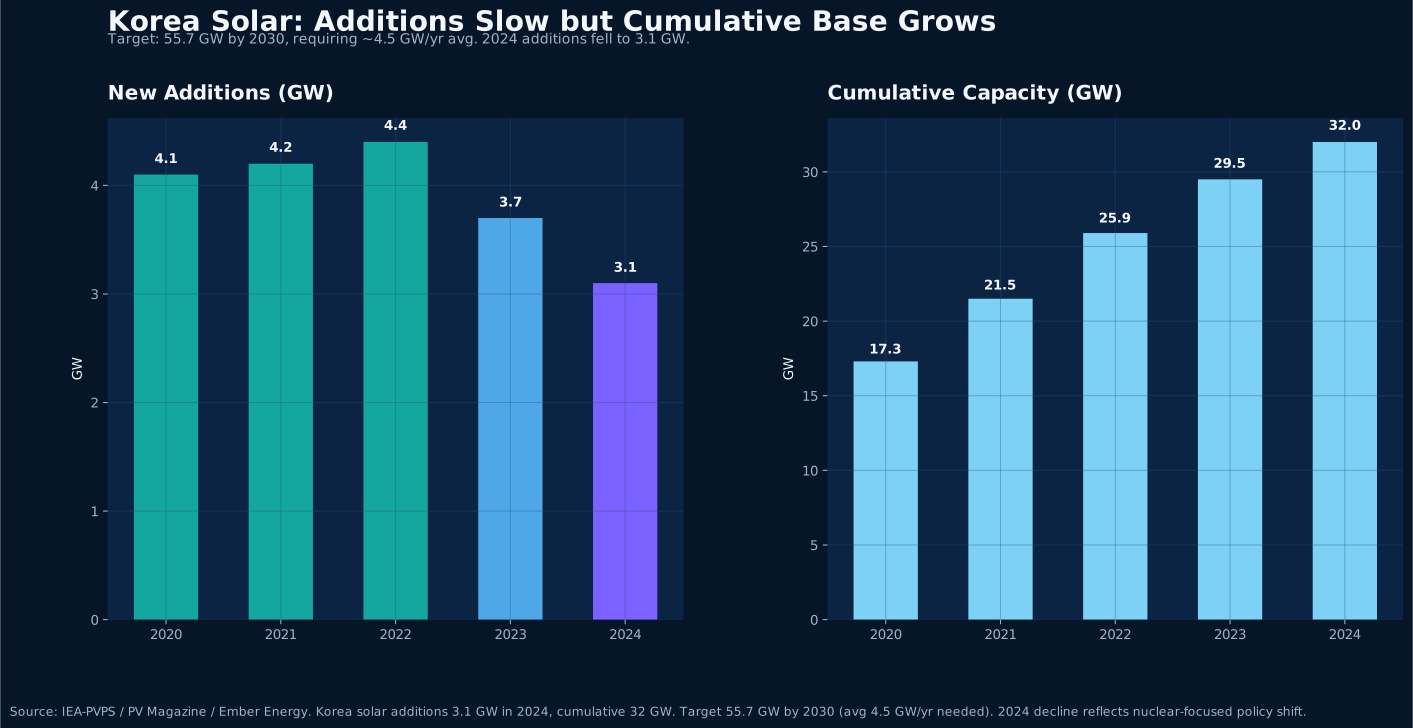
Korea’s annual solar additions held above 4 GW between 2020 and 2022 but dropped to 3.7 GW in 2023 and contracted further to approximately 3.1 GW in 2024. By the end of 2024, cumulative solar capacity reached 32 GW, with about 86% accounted for by power generation businesses. Although the cumulative base keeps expanding, the declining trend in new additions creates a visible gap against the government’s 2030 target of 55.7 GW. Meeting that target requires averaging roughly 4.5 GW of new capacity per year from now on, and recent performance falls well short.
The core driver of the slowdown is a shift in Korea’s energy policy priorities. The current government has positioned nuclear power as the preferred baseload option, correspondingly reducing budget support and renewable portfolio standard (RPS) targets for renewables. Solar subsidy cuts, more complex grid connection approval processes, and tighter land-use restrictions collectively create headwinds for new additions. However, this does not mean Korea has abandoned solar. Long-term carbon neutrality commitments and international pressure still underpin solar’s fundamental role in Korea’s energy mix.
2. China’s absolute PV supply chain dominance: from polysilicon to modules
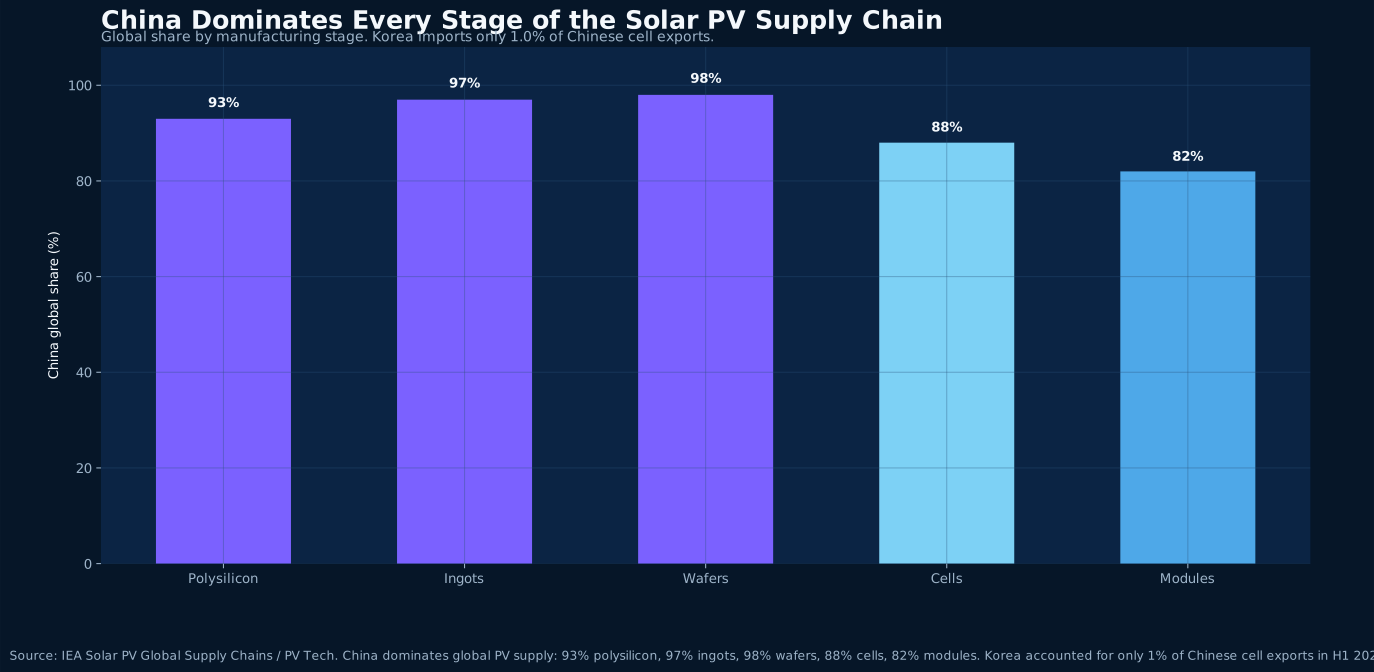
According to the International Energy Agency (IEA), China’s dominance in the global PV supply chain has reached historic levels. China accounts for 93% of global polysilicon capacity, 97% of ingots, 98% of wafers, 88% of cells, and 82% of modules. This means virtually any country seeking to expand solar capacity cannot avoid Chinese-manufactured upstream materials and intermediates. Korea is no exception — although it has some domestic capacity in solar cell and module manufacturing, it remains heavily dependent on imports for upstream raw materials and key intermediates.
Notably, Korea accounts for only about 1% of Chinese solar cell export destinations. By comparison, India takes 48%, Indonesia 17%, and Turkey 10%. This partly reflects Korea’s relatively stronger domestic cell manufacturing capability, but it also indicates that Korea’s import needs concentrate on more upstream stages like wafers and polysilicon. As Korea’s long-term solar expansion needs grow, this dependency on China’s upstream supply chain will only deepen unless Korea can establish alternative supply sources domestically or among allied countries.
3. Trade dynamics: balancing supply chain security and cost efficiency
Korea faces a classic security-versus-efficiency dilemma in its solar supply chain. On one hand, the Korean government and industry are increasingly concerned about supply chain concentration risk, particularly as geopolitical tensions escalate. Over-reliance on a single Chinese source is viewed as strategic vulnerability. On the other hand, China’s cost advantage in PV products is overwhelming. Chinese solar module manufacturing costs are substantially lower than Korea’s and other competing countries’, with continued leadership in technology iteration speed and economies of scale. Completely decoupling from the Chinese supply chain is economically almost unfeasible.
Under this tension, Korea is more likely to pursue diversification rather than decoupling — maintaining cooperation with the Chinese supply chain while gradually introducing alternatives from Southeast Asia, the US, or Europe, and supporting domestic upstream capacity. But this process requires time and significant capital investment. In the short to medium term, China will remain the core backbone of Korea’s solar supply chain. For Chinese PV companies, understanding Korea’s policy rhythms, compliance requirements, and procurement preferences is key to maintaining competitiveness during this transition.
4. Korea’s solar supply chain localization attempts and practical bottlenecks
Korea has several domestic companies in solar cell and module manufacturing, with firms like Hanwha Q Cells holding meaningful presence in the global PV market. But even leading Korean companies are increasingly locating manufacturing capacity overseas, including large-scale investments in the US and Malaysia. This shows that even Korean domestic players are pursuing global manufacturing footprints driven by market forces rather than relying entirely on domestic production. Korea’s domestic PV manufacturing costs are constrained by land, electricity, and labor costs, putting it at a disadvantage in direct price competition with China.
Localization bottlenecks also manifest in technology iteration speed. China’s PV industry’s R&D investment and commercialization pace in next-generation technologies like TOPCon, heterojunction (HJT), and perovskite far outstrip Korea’s. Technology leadership shows not only in efficiency metrics but also in rapidly declining mass production costs. If Korea aims to build competitive domestic upstream PV capacity, policy subsidies alone will not suffice — it also needs to find differentiated positioning in technology pathway selection and supply chain coordination.
5. Opportunities and strategy recommendations for Chinese PV suppliers
Although Korea’s solar installation growth has slowed, the long-term demand outlook remains clear. Korea’s carbon neutrality targets, international climate commitments, and power system decarbonization needs ensure that solar will play an irreplaceable role in Korea’s future energy mix. For Chinese PV suppliers, Korea is not the largest single market globally, but its high requirements for quality, certification, and supply stability make it well-suited for companies with differentiation capabilities to cultivate deeply.
On specific strategies, Chinese companies should focus on several entry points: first, Korea’s distributed solar market still has growth room, with relatively stable demand for small-to-medium modules and customized solutions; second, participating in Korean quality certification and standards systems to build compliance credibility; third, exploring joint ventures or OEM partnerships with Korean domestic firms to mitigate trade risk while staying close to end-customer needs; fourth, paying attention to Korea’s rapidly growing energy storage requirements, as integrated solar-plus-storage solutions may become an important differentiation vector.
6. Outlook: a new China-Korea PV trade equilibrium under clean energy targets
Over the medium to long term, Korea’s solar installations will inevitably reaccelerate. Even though current policy favors nuclear power, solar’s advantages in distributed energy, commercial and industrial rooftops, and agri-solar applications remain irreplaceable. As global carbon border adjustment mechanisms (CBAM) advance and Korea’s domestic carbon pricing strengthens, solar’s role in reducing industrial carbon footprints will receive increasing attention. This provides fundamental support for the long-term presence of China’s PV supply chain in the Korean market.
The future of China-Korea PV trade will not be a simple buyer-seller dynamic but a search for new equilibrium under the triple variables of policy change, technology iteration, and geopolitical risk. Korea needs China’s supply chain efficiency to underpin the economic viability of its clean energy transition; China needs high-standard markets like Korea to validate product quality and brand influence. The cooperation model will evolve from simple trade transactions toward deeper technology collaboration, standards alignment, and capacity coordination. In this process, participants who build trust earliest and adapt to rule changes fastest will secure the most durable competitive advantages.