1. Korea's overseas direct sales did not stall. China simply stopped owning all the incremental growth
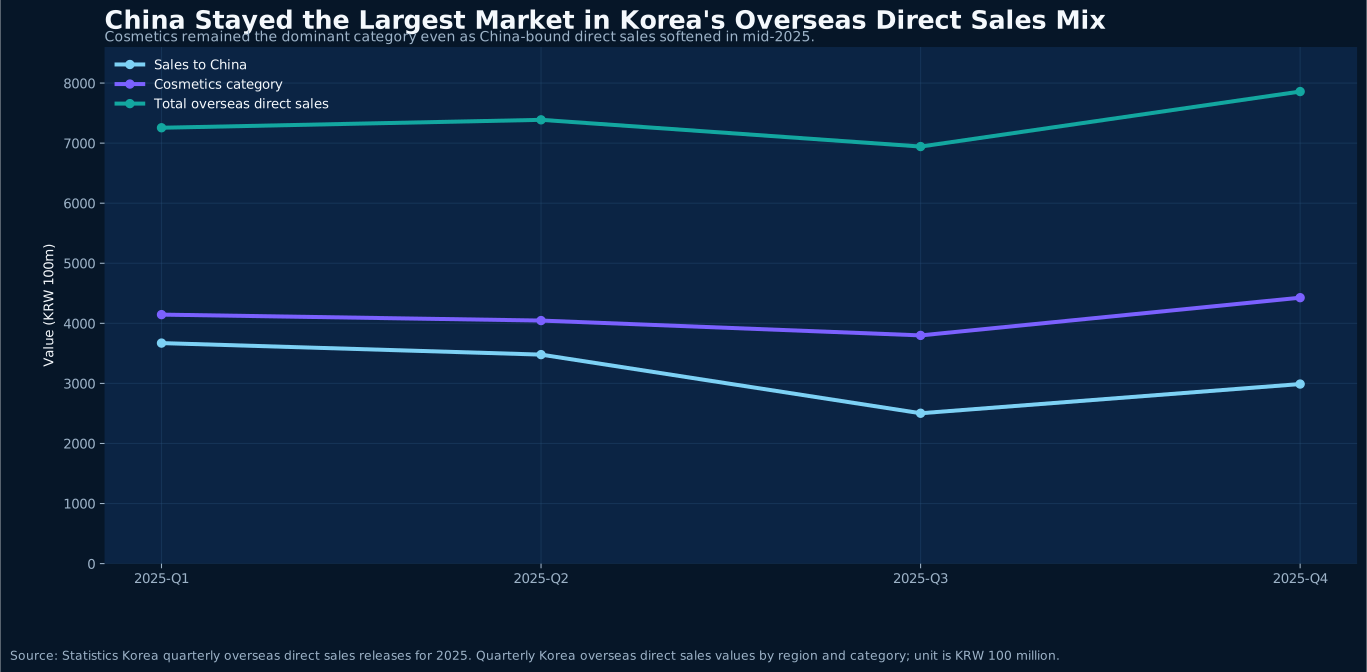
If we look only at Q4 2025 totals, Korea's overseas direct sales are not in retreat. Statistics Korea reported KRW 785.9 billion in direct sales, up 12.2% year on year. Korean brands and channel operators are still selling abroad. The issue is not whether demand exists, but that demand is no longer concentrated in one China-centered market and is now being redistributed across more destinations.
This matters for China-Korea trade because many observers once treated performance in China as the same thing as Korea's overall overseas direct-sales performance. That assumption now breaks down. China is still the largest destination, but it no longer absorbs every new unit of traffic automatically. For suppliers and packaging partners, this means Korean brands increasingly evaluate vendors on multi-region shipping capability, platform rule adaptability, and flexible response to different consumer rhythms rather than designing everything around one market alone.
2. China is still No.1, but defending the base now matters more than chasing breakout growth
The quarterly path shows that China's importance has not disappeared, but its rhythm has changed. Korea's overseas direct sales to China were KRW 367.1 billion in Q1 2025 and fell to KRW 298.9 billion in Q4. That is still higher than the U.S. and Japan, yet it clearly shows that China is no longer a market where simple traffic buying and product launches automatically scale results. Platform competition, traffic costs, rule reviews, and fragmented consumer preferences are narrowing the room for coarse growth.
That is why more Korean brands are redefining China's role. It remains a market too large to abandon, but it now has to be managed as a precision-operations market rather than an unlimited volume market. For packaging, gifts, sample formats, refill packs, and livestream fulfillment support, this means SKU combinations will become more fragmented, lead times more frequent, and individual orders not necessarily larger, even though total turnover pressure rises.
3. Rising sales to Japan and the U.S. show Korean channels are reallocating resources
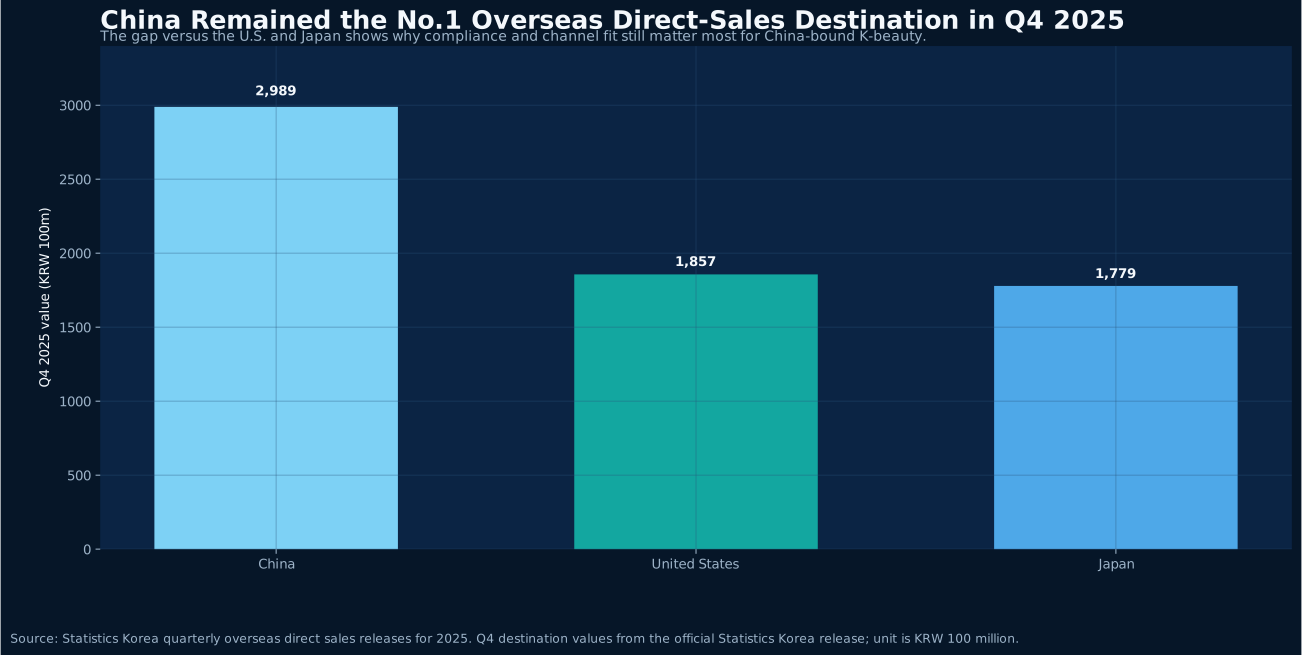
In Q4 2025, the U.S. and Japan became much more visible in Korea's overseas direct-sales mix. Sales reached KRW 185.7 billion to the U.S. and KRW 177.9 billion to Japan, sharply narrowing the gap with China. The signal here is not that China is being replaced. It is that Korean brands are distributing operating resources more evenly across several markets to reduce the annual impact of volatility in any one destination.
Once a brand enters a multi-market parallel model, supply-chain requirements change with it. In the past, one packaging format, one livestream script, and one fulfillment rhythm might have supported most growth. Now a single brand often has to handle China's platform cadence, Japan's aesthetic expectations, U.S. compliance documents, and different warehousing nodes at the same time. Chinese suppliers that only handle bulk runs and uniform specifications will find it harder to capture new business, while factories capable of versioned packaging, fast sampling, and regional support become more valuable.
4. Cosmetics and duty-free still anchor the business, but the transaction logic has shifted gears
Statistics Korea also shows cosmetics remained the largest category in Korea's overseas direct sales, reaching KRW 442.7 billion in Q4 2025, while the duty-free-linked online direct-sales channel contributed KRW 249.0 billion. On the surface, the category mix looks stable. But when combined with public industry signals, the underlying mechanism is changing: the old model driven by daigou, group-buying, and explosive volume on a few platforms is giving way to brand-operated stores, official channels, membership management, and traceable fulfillment.
The implication for the China side is direct. Stable cooperation in the next phase will depend less on the lowest price and fastest shipment alone, and more on the ability to match official brand-channel rhythms: small-format gift sets, unified visual language with market-specific copy, parallel event packs and regular packs, and packaging plus delivery design that supports returns and reshipments. Channels are moving from rough distribution to operable systems, and supply chains have to upgrade from merely making product to enabling the channel itself.
5. The next key metric is no longer one blockbuster SKU, but stable channel turnover
From a China-Korea trade perspective, the next thing to watch is not whether one blockbuster item will suddenly reignite China-bound direct sales. It is whether Korean brands can build steadier replenishment and healthier repeat-purchase structures across China, Japan, and the U.S. As long as brand strategy keeps moving toward multi-market operation, lighter inventory, and higher launch frequency, the supporting supply chain will also move away from the old big-order model.
That is why the most valuable capability for Chinese packaging and supporting factories is no longer landing one huge order, but continuously absorbing many smaller yet steadier orders. The suppliers that handle compliance, fast response, version management, and cross-region delivery more smoothly will be the ones best positioned to capture the next wave of upside from Korea's channel rebalancing.