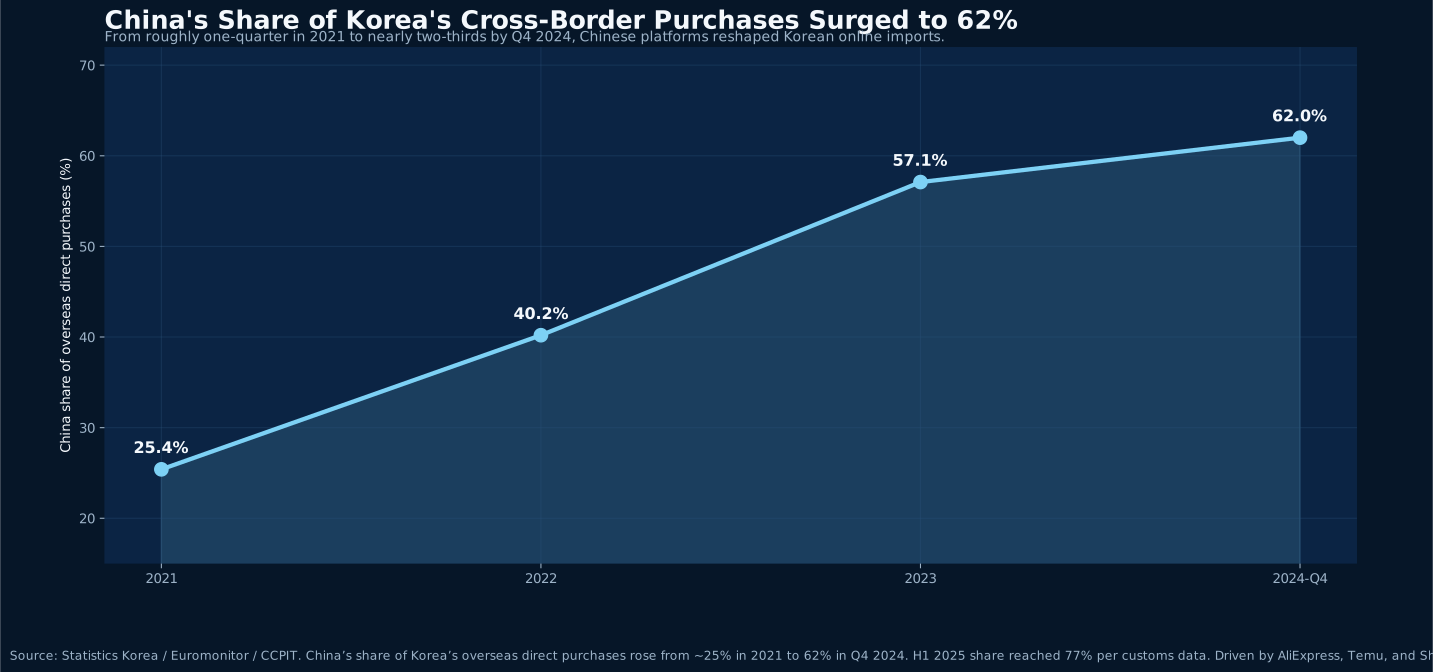
1. Not Gradual, but Explosive: China’s Share of Korea’s Online Imports Doubled in Three Years
When we look at the country-level breakdown of Korea’s overseas direct purchases in 2021, China accounted for roughly 25.4%, with the United States and EU close behind. That ratio did not seem exceptional at the time—Korean shoppers had always spread their cross-border spending across multiple origins including the US, Europe, and Japan. But from 2022 onward, AliExpress’s renewed push in Korea and Temu’s aggressive entry fundamentally reshaped the landscape. By Q4 2024, China’s share had reached 62%, nearly two and a half times the level from just three years earlier.
This shift was not driven by a single factor. Three forces converged: first, Chinese platforms invested heavily in logistics, cutting delivery times to 3–5 days for many items; second, price advantages in fashion, daily essentials, and small electronics created clear pull; third, marketing spend in Korea began matching or exceeding that of local e-commerce players. When all three conditions are met simultaneously, rapid market-share concentration becomes understandable.
2. Temu’s Global Rise: From 1% to 24% in Three Years, With Korea as a Key Battlefield
The International Postal Corporation (IPC) reported that Temu’s share of global cross-border e-commerce sales reached 24% in 2025, tying with Amazon. Together, the two platforms account for nearly half of all cross-border e-commerce. This was unimaginable just three years ago—when Temu launched in 2022, its global share was merely 1%. Going from 1% to 24% in three years is an almost unprecedented growth trajectory in e-commerce history. Meanwhile, AliExpress maintained an 8% global share and Shein held roughly 9%.
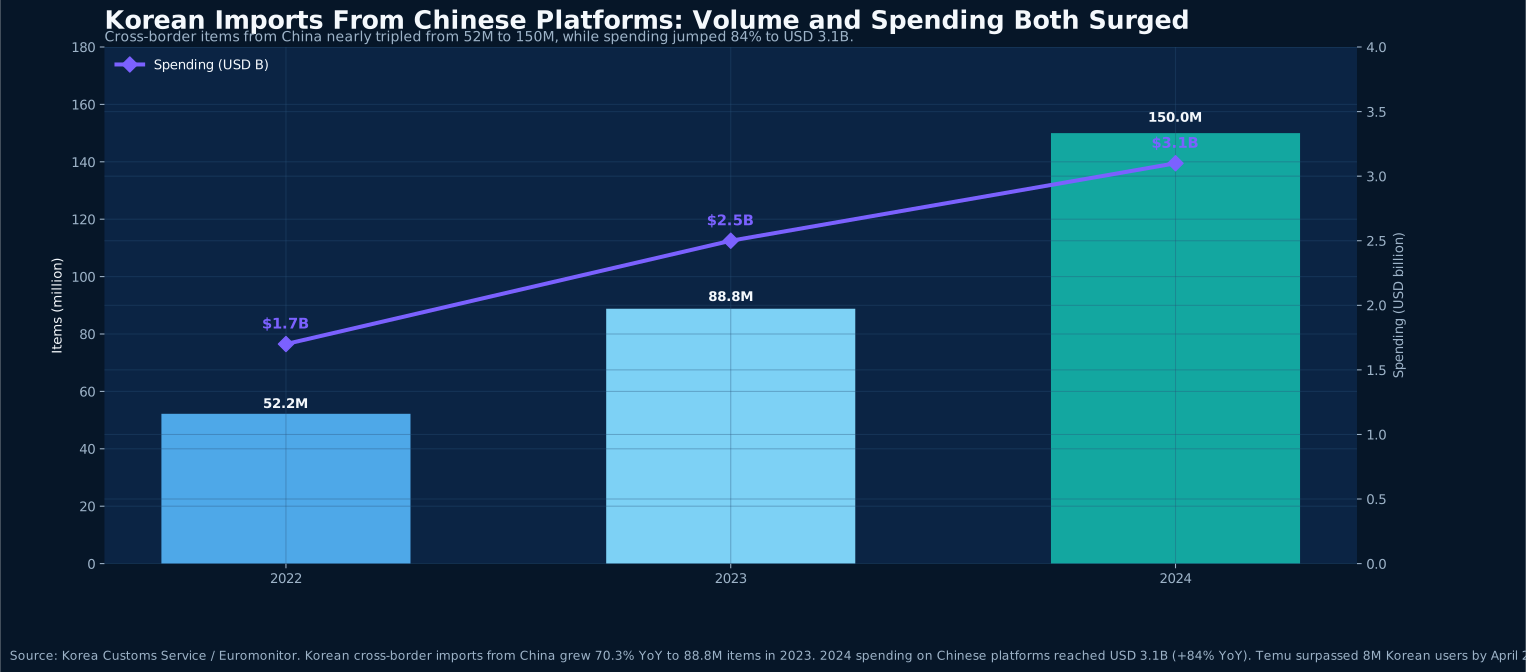
In Korea specifically, Temu’s user base quickly exceeded 8 million, making it one of the most downloaded apps among Korean adults. Together with AliExpress’s 8.88 million Korean users, they formed a “dual giant” structure behind only Coupang. The two platforms’ combined annual payment volume in Korea is estimated at KRW 4.28 trillion (roughly USD 3.2 billion), a 300% increase from two years prior. Chinese cross-border e-commerce is no longer a marginal player in Korea’s e-commerce ecosystem—it is a core participant.
3. Category Structure: Fashion and Food Are the Two Pillars
Statistics Korea data shows fashion apparel holds roughly 45.5% of Korea’s overseas direct purchases, followed by food and grocery (17.2%) and home and automotive (9%). This category distribution is significant for Chinese suppliers—apparel and daily essentials are precisely the areas where China’s supply chain is most mature and price-competitive. Platform algorithms and recommendation engines are also steering Korean consumers toward discovering more “unbranded” products from Chinese suppliers, often priced at one-third to one-fifth of Korean local brands.
Notably, the growth of food and daily essentials means Chinese cross-border e-commerce has moved beyond “optional cheap goods” into Korean consumers’ daily replenishment routines. When Korean residents habitually purchase everyday food and household items through AliExpress or Temu, it is no longer a price-hunting behavior but a channel migration. For Chinese suppliers, this raises the bar on product quality and compliance—daily-use scenarios tolerate far less risk in safety and reliability than occasional impulse purchases.
4. Safety and Compliance Concerns: Korean Regulatory Tightening Is Underway
The rapid concentration of market share has raised concerns on two fronts. First, product safety. KATS inspection data shows that overseas e-commerce product non-compliance rates have been consistently higher than domestic products, though the gap is narrowing (from 21.1% in H1 2024 to 9.0% in H2 2025). Second, tax fairness. Korea’s current de minimis threshold for cross-border parcels (duty-free below USD 150) is seen as giving Chinese platforms an unfair competitive advantage, and Korean domestic retailers and industry associations have repeatedly called for lowering or eliminating this threshold.
The Korean government is already acting on multiple fronts: increasing inspection frequency for cross-border parcels, requiring platforms to assume product quality responsibility, and considering changes to the de minimis threshold. The regulatory environment is tightening. For Chinese suppliers and cross-border platforms, future competitiveness will depend not just on price but on building compliance systems that meet Korean local standards.
5. Supply-Chain Takeaway: The Channel Is Open — the Question Is How to Hold It
The rise of Chinese cross-border e-commerce in Korea has irreversibly changed the micro-structure of China-Korea trade. In the past, Chinese exports to Korea relied primarily on B2B channels and bulk trade; now, an increasingly large B2C channel has formed. This channel presents both opportunity and challenge for Chinese suppliers. The opportunity lies in the fact that Korean consumers have developed the habit of purchasing through Chinese platforms, meaning product reach costs are far lower than traditional trade. The challenge is that competition within platform ecosystems is extremely fierce, margins are compressed, and compliance thresholds are rising.
For businesses watching China-Korea trade, the core conclusion is this: Korean market acceptance of Chinese goods has already far exceeded many expectations. But high acceptance does not equal large margins. The suppliers who will earn stable returns in this market are those who can build quality reputation and compliance capability beyond price competitiveness alone. This is not merely an e-commerce trend—it is a microcosm of the structural transformation in China-Korea trade.
6. Outlook: Disciplined Entrants Will Win in the End
When a trade channel has been opened at scale, the center of competition naturally shifts from “can we get in” to “can we stay.” In Korea’s cross-border e-commerce market, the next critical node for Chinese suppliers will be: how to build store-level reputation within platform ecosystems, how to prepare for potential de minimis threshold changes, and how to position early for KC certification, food safety, and cosmetics compliance. In short, price can get you into the Korean market, but only compliance and quality can keep you there.
Written by Minghao, published by Shanghai MO-TEK International Trade (MO-TEK).