1. The 76% Drop: How One Export Licensing Move Froze Korea’s Rare Earth Supply
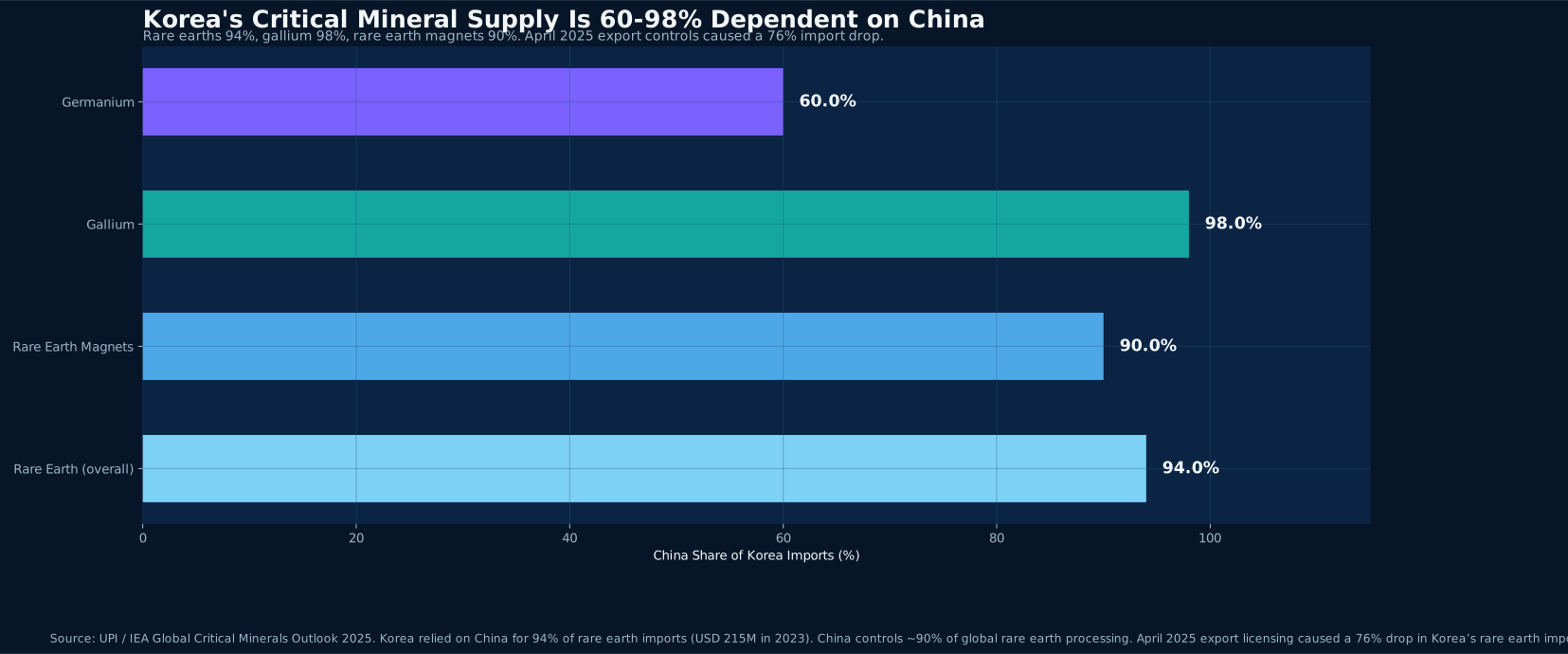
In April 2025, China’s Ministry of Commerce imposed national-security-based export licenses on seven rare earth elements: samarium, gadolinium, terbium, dysprosium, lutetium, scandium, and yttrium. The immediate consequence was staggering—Korea’s rare earth imports plunged 76% in a short period. For an economy that relies on China for 94% of its rare earth supply (roughly $215 million in imports in 2023), this was not merely a change in trade statistics but a stress test for the entire manufacturing supply chain.
More concerning, this was not an isolated event. It was part of a series of export control measures China has imposed on critical minerals since 2025, covering gallium, germanium, graphite, and more. In October 2025, MOFCOM issued an even more comprehensive rare earth regulatory framework—described by industry as “the most extensive tightening ever.” While China temporarily suspended some controls from November 2025 (through November 2026), the licensing system itself remains, meaning the policy lever can be reactivated at any time.
2. What 94% Dependency Really Means: Not Just a Number, but Structural Lock-In
Korea’s 94% dependency on Chinese rare earths is not a trade relationship that can be quickly substituted. Rare earths are not like oil or natural gas, where suppliers can be switched in the short term. China controls not only over 60% of global mining but, more critically, 90% of processing and refining capacity. Even if Korea finds alternative ore sources, the processing bottleneck still runs through China. This “mineable elsewhere, processable only in China” structure is the real strategic dilemma.
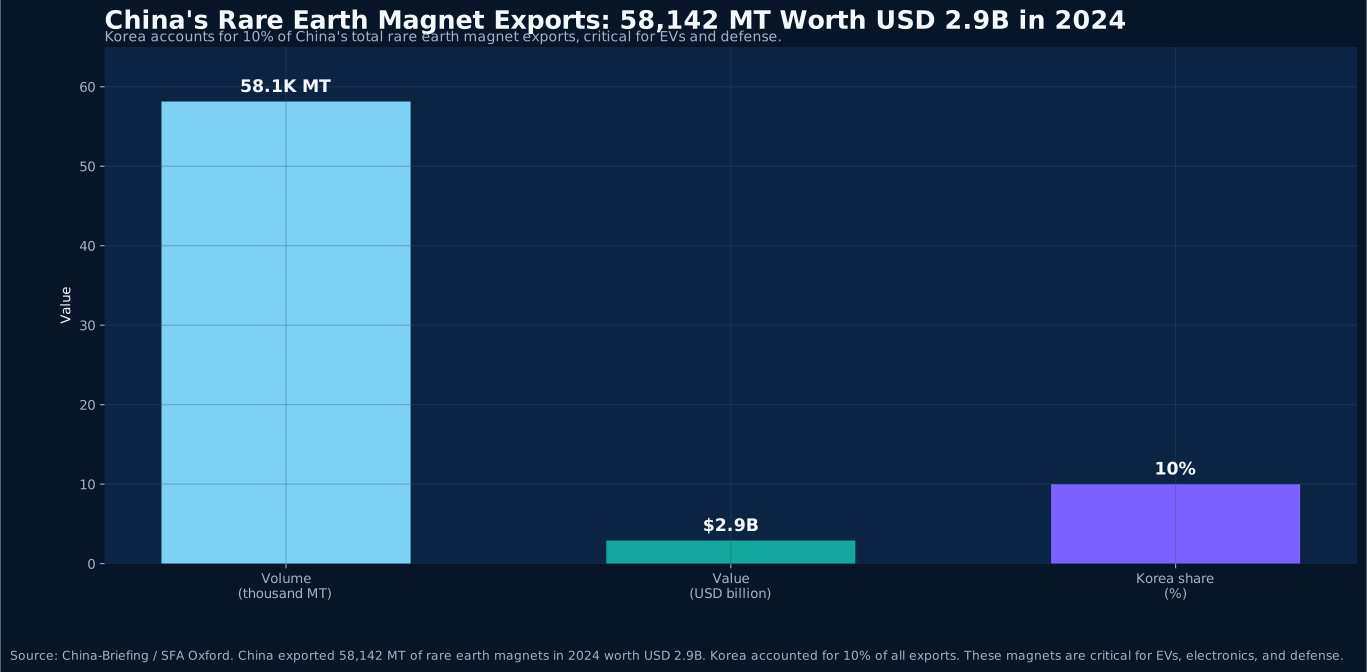
For Korea’s industrial impact specifically, rare earth magnets are the most critical link. In 2024, China exported 58,142 metric tons of rare earth magnets worth $2.9 billion, with Korea accounting for 10%. These magnets are used extensively in EV motors, wind turbines, smartphone speakers, and—most sensitive of all—defense equipment. Korean companies supply roughly 15-20% of specialized components for the US F-35 fighter, and these components rely heavily on rare earth materials. When rare earth supply drops 76%, not only does manufacturing face rising costs, but defense supply chain security comes under scrutiny.
3. Gallium, Germanium, Graphite: Rare Earths Are Just the Tip of the Iceberg
Focusing solely on rare earths would underestimate the breadth of supply chain risk Korea faces. Korea’s critical mineral dependency on China extends far beyond rare earths. For gallium, dependency reaches 98%—gallium is essential for semiconductors, optoelectronic devices, and 5G base station equipment. For germanium, it is roughly 60%—germanium is widely used in infrared optics, fiber optic communications, and solar cells. China had already imposed export controls on gallium and germanium in 2023, even before the rare earth measures.
This multi-category, multi-stage dependency means China’s export control toolkit is far richer than outsiders may realize. For Korean manufacturing, a supply disruption in any single critical mineral could halt production lines. More importantly, these minerals have cross-dependencies—for example, EVs simultaneously need rare earth magnets (for motors) and lithium (for batteries), and China dominates both. This “full-spectrum” control makes supply chain decoupling extraordinarily costly.
4. Korea’s Strategic Response: Deep-Sea Exploration and Recycling
Korea is not entirely unprepared. In January 2026, the Korea Institute of Geoscience and Mineral Resources announced that its research vessel identified high-grade rare earth deposits at approximately 5,800 meters depth in international waters of the western Pacific, with concentrations reaching 3,100 ppm. While deep-sea mining technology and commercialization still require considerable time, this discovery at least provides a possible direction for long-term supply diversification. Meanwhile, both Japan and Korea are increasing investment in rare earth recycling technology, seeking to extract rare earth elements from discarded electronics and industrial waste.
The reality, however, is that diversification comes at a significant cost. Industry estimates suggest that if Korean manufacturers completely bypass Chinese rare earth processing, manufacturing costs could rise 20-35%. For Korea’s battery, semiconductor, and EV industries—already under intense global competitive pressure—this is a cost burden that cannot be ignored. Korea’s current strategy therefore leans toward a “dual track”: maintaining trade relations with China while accelerating alternative supply development. This balance will be a core industrial policy issue for years to come.
5. Implications for China-Korea Trade: Dependency Isn’t the Mistake — Unpreparedness Is
From the perspective of China-Korea trade, rare earth supply chain tensions do not mean the two countries will fully decouple. Rather, they remind both sides of the need for more resilient trade mechanisms. For Chinese suppliers, export controls may enhance short-term bargaining power, but in the long run they are accelerating alternative investments and “de-China” processes globally. For Korea, 94% dependency is not a “mistake”—it is the result of two decades of economically rational choices. The real risk lies in the lack of contingency planning.
For businesses watching China-Korea trade, the core lesson from rare earths is this: in any highly concentrated supply chain, building buffer inventory and alternative channels is no longer optional but mandatory. This logic applies not only to rare earths but also to battery materials, semiconductor inputs, and other strategic materials. The future of China-Korea trade will increasingly depend on both sides’ investments in supply chain resilience rather than simple price comparison. Written by Minghao, published by Shanghai MO-TEK International Trade (MO-TEK).