1. NMPA registration surge: what’s behind the 10,000-filing milestone for special cosmetics
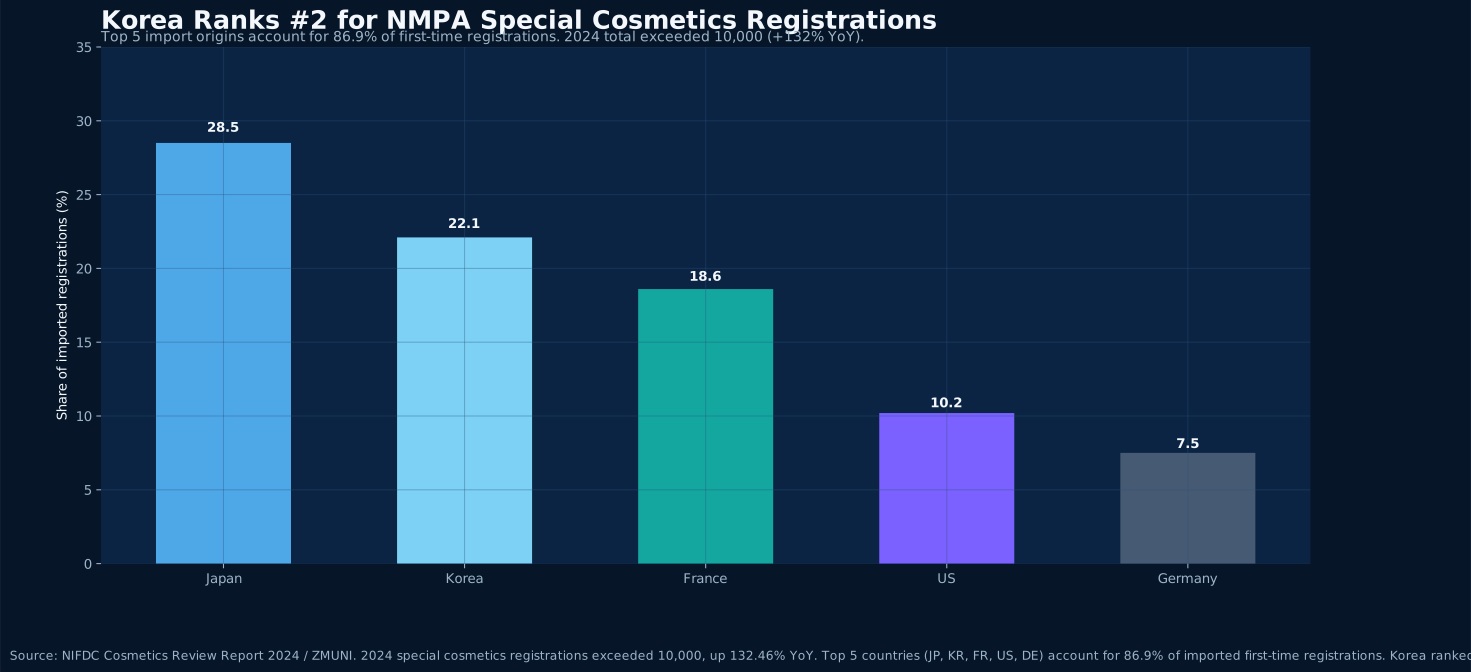
In 2024, the number of special cosmetics registrations accepted by China’s National Medical Products Administration (NMPA) exceeded 10,000 for the first time, growing 132.46% year-over-year. This surge was not a random fluctuation but a milestone reflecting China’s ongoing cosmetics regulatory reform under the streamlined approval framework. Since the full implementation of the Cosmetics Supervision and Administration Regulation in 2021, special cosmetics registration has transitioned from confusion to standardization, and the 2024 data shows that market adaptation to the new framework has entered an acceleration phase.
Among countries of origin for first-time imported cosmetics registrations, the top five — Japan, Korea, France, the US, and Germany — account for 86.9% of the total. Korea holds approximately 22.1%, ranking second behind Japan. This reflects Korean cosmetics companies’ sustained attention to the Chinese market and their willingness to invest in compliance. Particularly in functional skincare, whitening, and sunscreen categories, K-beauty brands have built a relatively stable presence within the NMPA registration system through accumulated technical expertise and brand recognition.
2. E-labeling pilot: a new compliance option for imported cosmetics labeling
From February 1, 2026, NMPA launched a three-year cosmetics electronic labeling pilot program across six provinces and cities: Beijing, Shanghai, Zhejiang, Shandong, Guangdong, and Chongqing. The pilot allows cosmetics and toothpaste products to use electronic labels to display Chinese labeling information. Consumers can scan a QR code on the product to access the complete label content. The QR code must be at least 9×9mm, clearly marked as a cosmetics e-label, and must link directly to the full label information page without pop-ups or extra navigation steps.
For Korean cosmetics brands, the e-labeling pilot means labeling compliance is becoming more flexible. Previously, imported cosmetics had to carry complete Chinese-language labels on physical packaging, creating practical burdens for brands with limited packaging design space or frequent SKU updates. E-labeling offers an alternative path, allowing brands to preserve their original packaging design while meeting Chinese regulatory requirements. However, the pilot’s scope remains limited, and companies need to monitor specific city coverage and category eligibility conditions while preparing for the formal policy that will follow the pilot period.
3. Imports down 9%: K-beauty’s competitive position in a contracting market
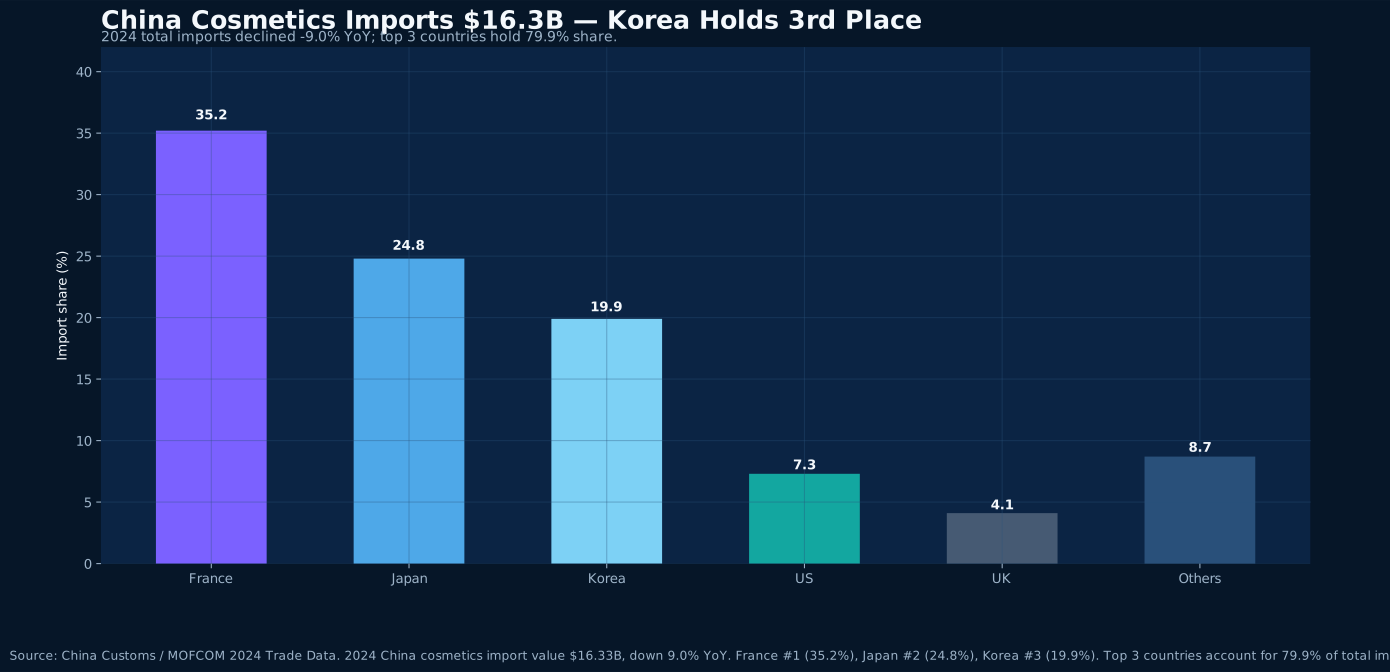
In 2024, China’s total cosmetics imports reached $16.33 billion, down 9.0% year-over-year. Despite the overall market contraction, the share structure among source countries remained largely stable: France held first place at 35.2%, Japan second at 24.8%, and Korea maintained third at 19.9%, with the top three accounting for 79.9%. This means Korea’s relative position in the Chinese cosmetics market has not been significantly eroded despite the smaller total, but the absolute dollar decline creates margin pressure for K-beauty companies that relied on China-market growth.
The decline in imports has multiple layers: more cautious Chinese consumer spending, domestic Chinese brands closing the quality and marketing gap, and the substitution effect of cross-border e-commerce channels on traditional general trade imports. For K-beauty brands, the era of relying solely on price advantage or channel placement is fading. Brands need to understand Chinese consumers’ functional needs more deeply while building faster regulatory response capabilities to maintain share in a contracting competitive environment.
4. China-Korea cosmetics regulatory dialogue signals: from conversation to convergence
In September 2025, a China-Korea cosmetics regulatory system exchange event was held in Beijing, with representatives from Korea’s Ministry of Food and Drug Safety and the Korea Cosmetic Association engaging in in-depth discussions on functional cosmetics definitions, personalized and customized cosmetics regulation, online cosmetics sales supervision, progress on animal testing alternatives, and post-market surveillance. The signal from this exchange is worth noting: communication between China and Korea on cosmetics regulation has moved beyond principles to explore convergence on specific institutional details.
Of particular interest is the e-labeling domain, where Korea already has practical experience with cosmetics electronic labeling. If China and Korea can achieve some degree of coordination on e-labeling standards, data formats, or mutual recognition mechanisms, the labeling compliance cost for Korean cosmetics entering China could be significantly reduced. The actual pace of progress depends on regulatory priorities and policy windows on both sides, but the direction is clear: deeper regulatory dialogue will eventually translate into improved trade efficiency.
5. K-beauty compliance strategy: register fast, plan early, adapt deeply
In China’s continuously evolving cosmetics regulatory environment, K-beauty brands need to shift their compliance strategy from reactive response to proactive positioning. First, speed of registration matters. NMPA approval timelines carry inherent uncertainty, and the earlier a brand initiates the registration process, the better its chances of capturing market windows. The explosive registration growth in 2024 shows that competitors are all accelerating — hesitation means disadvantage. Second, forward-looking preparation for new regulations is essential. Whether it is e-labeling, new testing methods, or updated ingredient safety assessments, brands need to begin adjusting product formulations and packaging design before formal implementation dates.
Third is deep adaptation — a dual understanding of Chinese consumer trends and regulatory direction. Chinese consumers are becoming increasingly specific about efficacy demands — not broad claims of “whitening” or “anti-aging,” but precise solutions targeting specific skin concerns. This requires brands to incorporate Chinese market regulatory requirements and consumer preferences at the product development stage, rather than simply registering domestic Korean bestsellers for export. Brands that can “build products for the Chinese market” rather than “sell products to China” will hold a stronger position in the next phase of competition.
6. Outlook: regulatory reform is both a barrier and a filter
China’s ongoing cosmetics regulatory reform does not mean the market is closing — it means the conditions for entry are being upgraded. From the e-labeling pilot to new testing methods, from registration system optimization to strengthened post-market oversight, each step raises compliance requirements while also improving the transparency and predictability of market order. For K-beauty brands that have already built compliance systems, these changes present more opportunity than obstacle — higher thresholds filter out competitors lacking compliance investment, creating a cleaner competitive landscape for capable brands.
Over the next 12 to 18 months, signals worth close attention include: actual adoption of e-labeling in the six pilot cities, further simplification moves in NMPA’s registration and filing system, changes in new ingredient approval speed, and follow-through on the China-Korea cosmetics regulatory dialogue. Each signal may affect the compliance rhythm and commercial decisions of K-beauty brands in China. Maintaining high-frequency tracking of regulatory developments is no longer an exclusive compliance department task — it is a core strategic capability at the brand level.