1. From heavy plate to hot-rolled coil: anti-dumping coverage is expanding fast
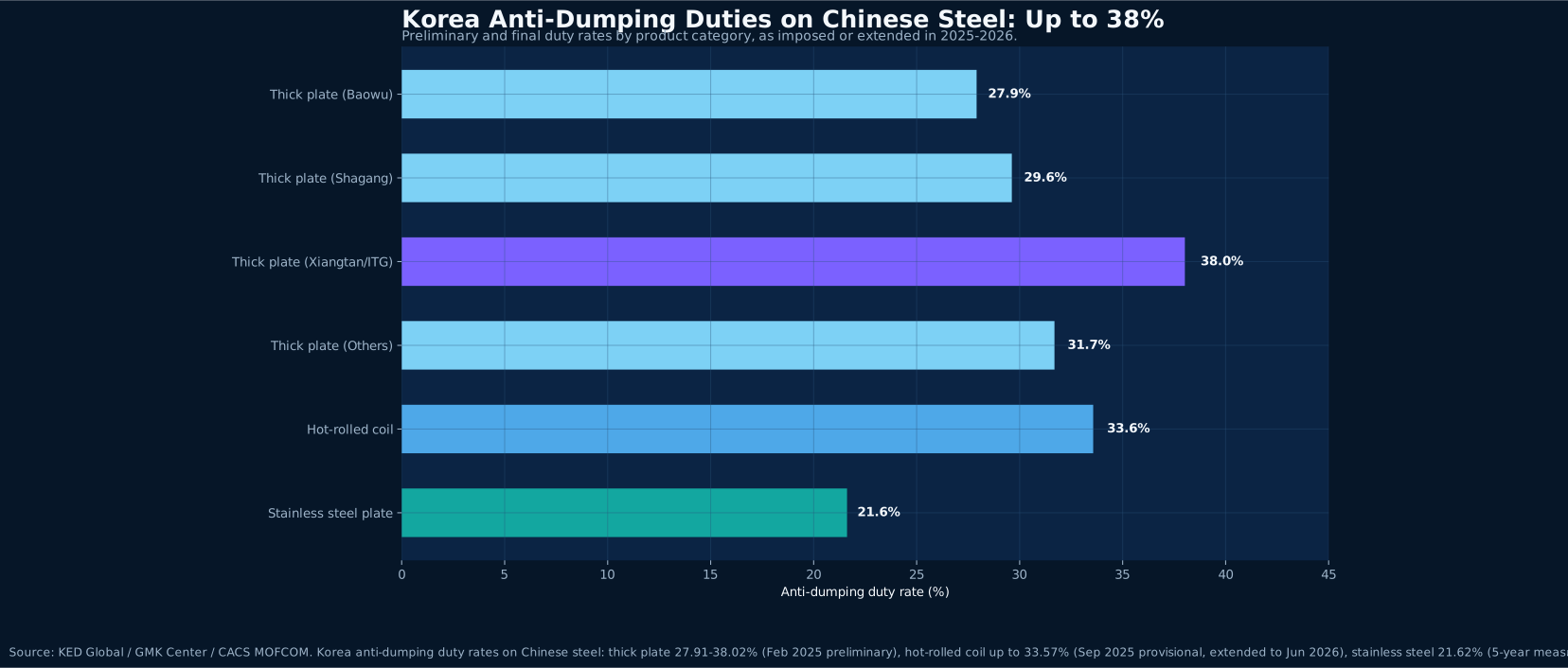
In February 2025, Korea’s Trade Commission issued a preliminary ruling on hot-rolled carbon steel heavy plate originating from China, imposing provisional anti-dumping duties ranging from 27.91% to 38.02% on different Chinese producers. This was not an isolated action but part of an intensifying wave of steel trade remedy measures over the past two years. From heavy plate to hot-rolled coil to stainless steel sheet, Korea’s anti-dumping investigations now cover the major categories of Chinese steel exports to Korea. Each round brings published company-specific duty rates, provisional measures and extensions, and a deeper reshaping of market expectations.
Notably, duty rates vary significantly across product categories. For heavy plate, Xiangtan Steel and ITG Holding face the highest rate of 38.02%, while Baowu Steel is at 27.91% and Shagang at 29.62%. Hot-rolled coil duties reach 33.57%, while stainless steel sheet carries a uniform 21.62% rate for five years. This tiered duty structure means the trade barrier varies greatly depending on the exporter and the product, directly affecting export strategy and pricing models.
2. Why export volumes are rising despite tariffs: Korea’s structural dependency
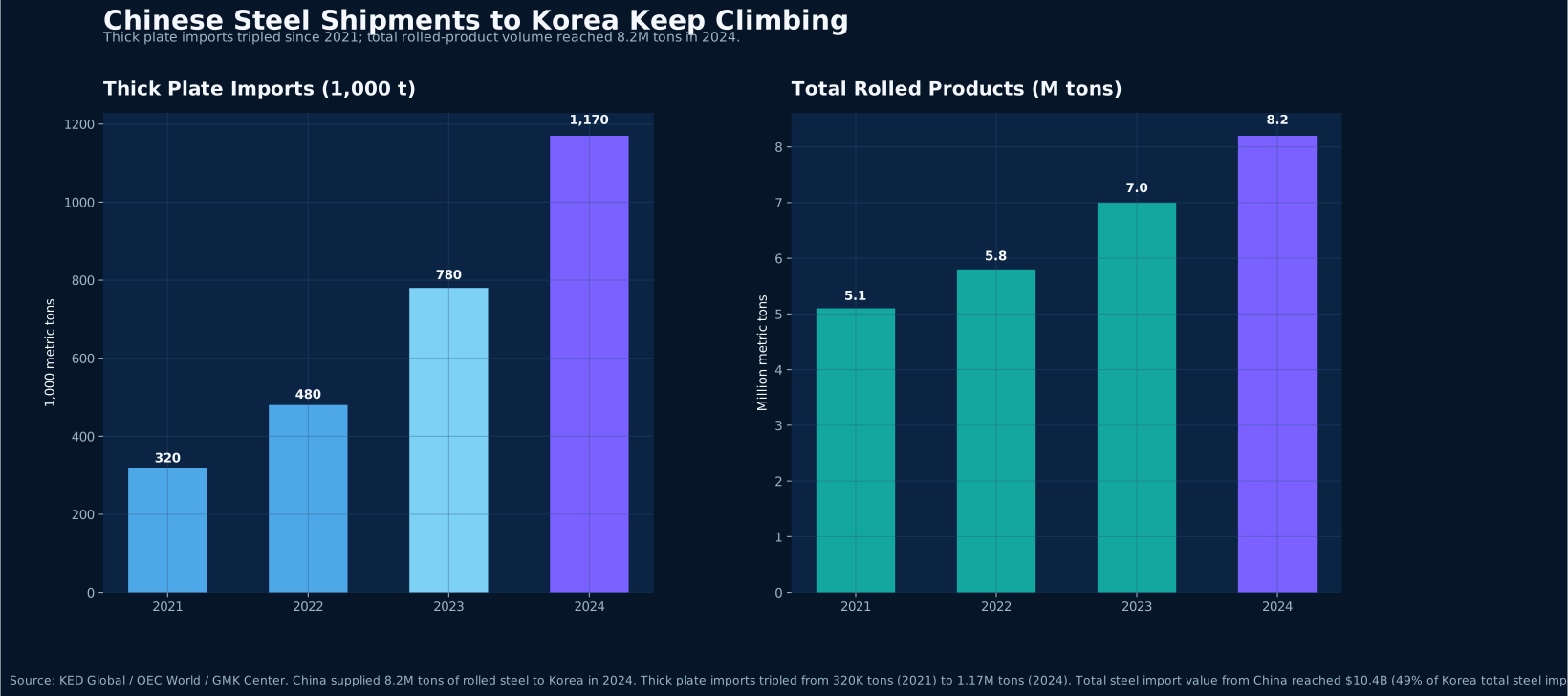
Conventional trade logic suggests that higher anti-dumping duties should suppress import volumes. Yet the data tells a different story. In 2024, China shipped 8.2 million tons of rolled steel products to Korea, worth $10.4 billion and representing 49% of Korea’s total steel imports. Heavy plate imports surged from 320,000 tons in 2021 to 1.17 million tons in 2024, more than tripling in three years. This phenomenon of rising volumes alongside rising tariffs is not simple price arbitrage — it reflects deep structural demand in Korea’s shipbuilding, construction, and infrastructure sectors.
Korea’s shipbuilding industry is in a global order boom, and heavy plate demand cannot easily be replaced by domestic capacity in the short term. At the same time, construction and infrastructure investment cycles sustain ongoing demand for hot-rolled coil. Chinese overcapacity keeps export pricing competitive in certain categories even after anti-dumping duties are added, especially as Korean domestic mills shift more capacity toward higher-margin automotive sheet and specialty steel, widening the supply gap for standard construction-grade material.
3. Tariff circumvention and enforcement tightening: new compliance risks emerge
As duty rates rise, tariff circumvention has drawn heightened attention from Korean customs authorities. Korea is amending its Customs Act to extend anti-dumping duties to products that undergo minor processing after import to change their form. This means practices that previously avoided duties through light processing in third countries or within Korea will face stricter oversight. Circumvention investigations involving categories such as color-coated steel plate are already underway, and the amendments are expected to take effect on September 22, 2025.
For Chinese steel exporters, this shift means compliance costs are rising quickly. Models that previously relied on trader reclassification or third-country transshipment now carry significantly higher risk. Companies need to re-examine their product classification, origin documentation, and trade routing to ensure they do not trigger additional penalties under Korea’s increasingly strict enforcement environment. Meanwhile, the timing and rhythm of Korean investigations and rulings also need to be factored into export planning.
4. Changes on Korea’s steel consumption side: who is buying and why
The key to understanding Korea’s steel market lies in the consumption structure. Korean steel demand is heavily concentrated in four sectors: shipbuilding, automotive, construction, and machinery. Shipbuilding has been riding a wave of strong orders in recent years, with heavy plate demand that is not only large in volume but also complex in specification — one of the core reasons domestic capacity cannot fully satisfy it. In 2024, Korea’s three major shipbuilders set new records for order intake, directly pulling up heavy plate import demand.
Construction is also a major demand base for hot-rolled coil and structural steel. Although Korea’s real estate market is in an adjustment phase, government-led infrastructure projects and urban renewal programs continue to sustain baseline demand for standard steel grades. In this context, anti-dumping duties have raised import costs but have not fundamentally changed the demand logic for price-sensitive categories. The critical point is that Korean domestic steel capacity is tilting toward premium products, leaving less room for standard construction material and general-purpose plate production.
5. Supplier strategies: from price competition to compliance and differentiation
Under a regime of steadily escalating anti-dumping duties, the core question for Chinese steel suppliers is no longer whether they can keep exporting, but how. The traditional high-volume, low-price export model faces pressure from multiple directions: rising duty costs, tighter compliance scrutiny, and competitive responses from Korean domestic mills. Sustainable export strategies need to develop along three axes: product differentiation, compliance infrastructure, and deeper customer relationships.
At the product level, moving from standard commodity plate toward specialized dimensions, surface treatments, or processed configurations can help sidestep the most duty-intensive categories while lifting unit value. On compliance, establishing complete origin traceability, product classification documentation, and trade route records is not only necessary for penalty avoidance but also a prerequisite for building long-term partnerships with major Korean end users. On the relationship side, providing Korean shipyards, construction contractors, and steel traders with reliable delivery rhythms, technical support, and flexible specification adjustments locks in orders more effectively than price advantage alone.
6. Medium-term outlook: anti-dumping will not end China-Korea steel trade, but will reshape it
Over a longer time horizon, Korea’s anti-dumping measures against Chinese steel are unlikely to cause a sharp contraction in bilateral steel trade. Korea’s manufacturing structure ensures ongoing demand for external steel supply, and China’s combined advantages in scale, product range, and pricing as the world’s largest steel producer cannot be easily replaced by alternative sources in the near term. What will change is the structure and mode of trade participation: steel categories entering Korea will diversify further, compliance thresholds will keep rising, and suppliers that adapt to the new rules will secure more stable market positions.
For companies engaged in China-Korea steel trade, the current phase calls not for panic or retreat but for a clear-eyed assessment of competitive positioning under the new tariff environment, identification of categories that remain export-viable, and early investment in compliance and differentiation capabilities. The essence of anti-dumping is not to close a market but to raise the conditions of entry. Participants who can meet higher conditions are typically the ones who earn more durable returns.