1. Korea: The Third-Largest Battlefield for Chinese Game Exports
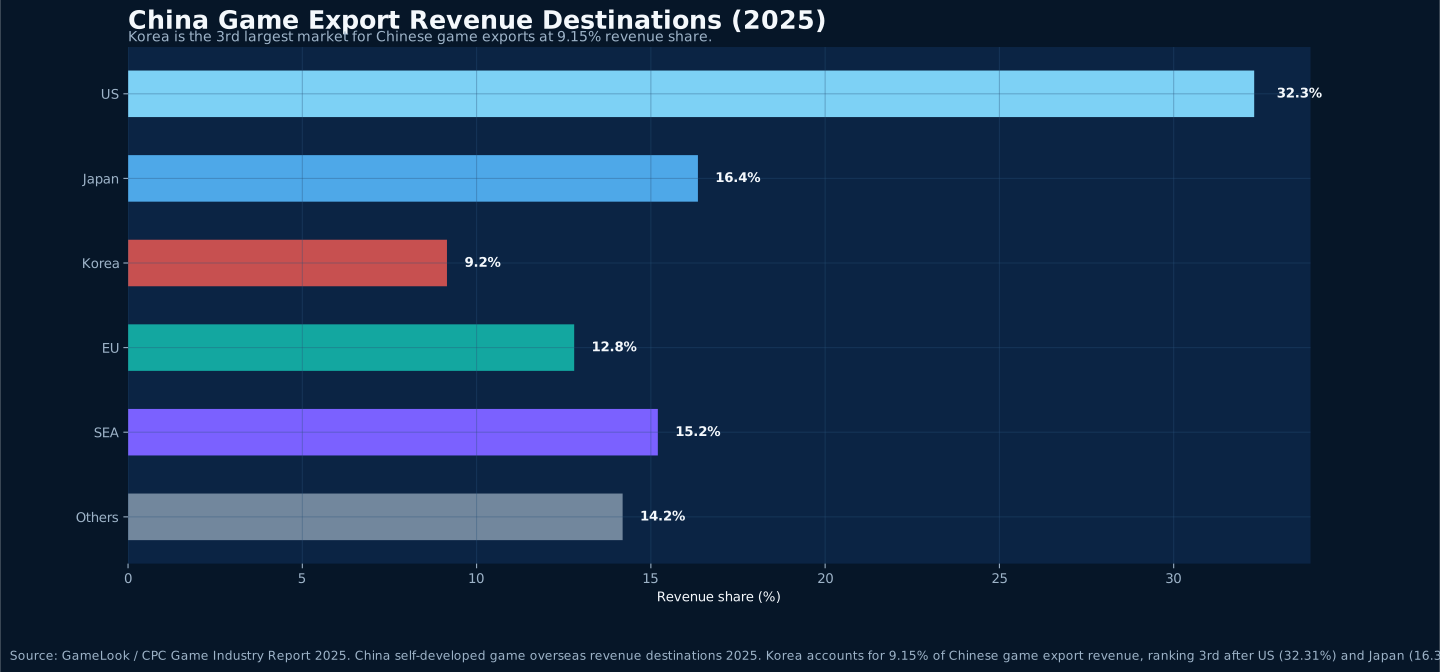
In 2025, overseas revenue from China-developed games continued its double-digit growth, surpassing RMB 204.5 billion. Within this vast overseas revenue map, Korea holds a steady 9.15% share as the third-largest market, trailing only the US (32.31%) and Japan (16.35%). While Korea’s absolute share is smaller than the US and Japan, considering its population of approximately 52 million and its status as the world’s fourth-largest gaming market, Chinese games’ penetration in Korea is actually quite significant. This means roughly 1 out of every 11 KRW spent on games in Korea goes to a China-developed product.
In terms of genre distribution, Chinese games in Korea display distinct differentiation characteristics. Korea’s domestic market has long been dominated by MMOs (massively multiplayer online games), with local publishers like NCsoft, Nexon, and Krafton holding dominant positions. However, Chinese developers have chosen not to compete head-on in MMOs but instead entered through SLG (strategy), idle/merge, and anime-style sub-genres, identifying genre gaps in the Korean market. For example, FunPlus’s Whiteout Survival saw a 70% revenue increase in the Korean market in 2025, demonstrating the strong appeal of Chinese SLG products in Korea.
2. Two Regulatory Turning Points: Loosened Censorship, Tightened Gacha
In 2025, Korean game regulation underwent its most significant overhaul in a decade. On one hand, the decade-old pre-release game censorship system was officially abolished, replaced by a negative-list management model. This means games no longer need individual government approval before launch — as long as they do not cross red lines on the negative list (such as gambling and violence ratings), they can be released directly. For Chinese game developers, this dramatically reduces the time cost and administrative barriers to entering the Korean market, allowing faster product iterations and version updates.
On the other hand, Korea simultaneously tightened regulations on loot boxes (gacha). Under the revised Game Industry Promotion Act, all games with paid random items must disclose drop probabilities, and per-pull spending is capped at 50,000 KRW (approximately USD 38). Under the previous industry self-regulation model, 90 of the 100 highest-grossing iPhone games contained paid loot boxes, but only 84.4% disclosed probabilities. The new mandatory enforcement far exceeds the previous self-regulatory approach. For Chinese game developers, this requires dedicated adjustments to monetization design for Korean versions — especially products relying on high-spending gacha models, which need redesigned monetization strategies for the Korean market.
3. Structural Opportunities in a USD 14.5 Billion Market
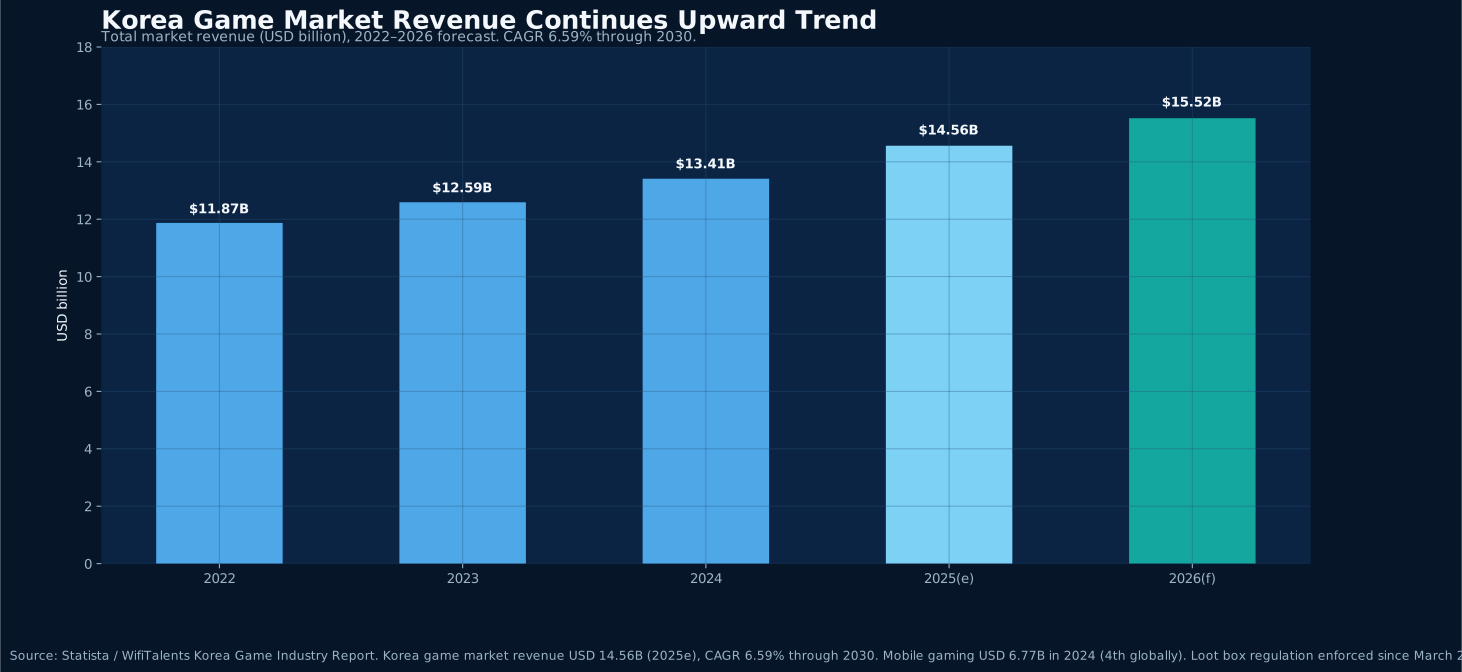
Korea’s game market is projected to reach USD 14.56 billion in 2025, expanding at a 6.59% CAGR and expected to hit USD 20 billion by 2030. Mobile gaming now exceeds 50% of the total, with 2024 mobile revenue of USD 6.77 billion ranking fourth globally. On mobile, Google Play contributes nearly 80% of revenue, which aligns closely with Chinese developers’ Android ecosystem operational experience. This structural characteristic of the Korean market provides a natural fit advantage for Chinese game companies strong in mobile and Android operations.
In terms of genre trends, the Korean market is transitioning from MMO dominance toward multi-genre coexistence. Traditional PC and mobile MMOs still hold significant share, but emerging genres such as SLG, casual merge, anime-style, and survival-building are growing more vigorously. Chinese developers have accumulated rich global operational experience in precisely these emerging genres. Additionally, Korean gamers have extremely high quality expectations, which forces Chinese overseas products to invest more in localization translation, art-style adaptation, and customer service response. However, once accepted, user loyalty and willingness to pay are correspondingly higher.
4. Localization Challenges and Countermeasures
The biggest challenge Chinese games face in Korea is not technology or product quality but the depth of localization operations. Korean gaming communities are highly active, public opinion reacts swiftly, and cultural adaptation requirements are strict. If a game shows issues in translation quality, cultural details, or customer service response, negative word-of-mouth can spread within hours. In recent years, several Chinese games have suffered collective negative reviews from Korean players due to obvious machine-translation artifacts or event content conflicting with Korean cultural sensitivities, causing sharp drops in downloads and revenue.
Successful Chinese developers have developed an effective Korea localization methodology. First, establishing a local Korean operations team rather than managing remotely from Chinese headquarters. Second, building deep partnerships with Korean KOLs and gaming media, leveraging Korea-specific community platforms like Naver Cafe and DC Inside for user operations. Third, respecting Korean market specifics in monetization design — given the 50,000 KRW per-pull cap, designing more diversified payment touchpoints rather than over-relying on high-ticket gacha. While these localization investments increase short-term costs, they are necessary conditions for long-term success in the Korean market.
5. Spillover Effects of China-Korea Game Trade
Game exports involve more than cross-border digital product transactions — they drive a cascade of related industry trade. The expansion of Chinese games in the Korean market has generated sustained demand for Korean voice actors, localization translation services, Korean-style art outsourcing, and Korean marketing agencies. Conversely, Korean game companies are actively adopting Chinese technology and operational models — particularly in areas where Chinese developers excel, such as livestream-commerce-game integration, short-video marketing, and private traffic operations.
From a broader perspective, game trade is becoming an important component of China-Korea digital economy cooperation. The bilateral cooperation framework in cross-border e-commerce, digital payments, and digital content provides institutional support for game trade. Chinese web literature has over 3.5 billion overseas users, with Korea as a key market, and the adaptation of web-literature IP into games is creating new cross-sector trade opportunities. For firms engaged in China-Korea trade services, digital content trade is a rapidly emerging new track — unlike traditional goods trade constrained by logistics and tariffs, it is driven by intellectual property licensing, service outsourcing, and technology cooperation. Author: Minghao, MO-TEK International Trade (Shanghai)