1. Why Korea is suddenly feeling China's biotech presence much more strongly
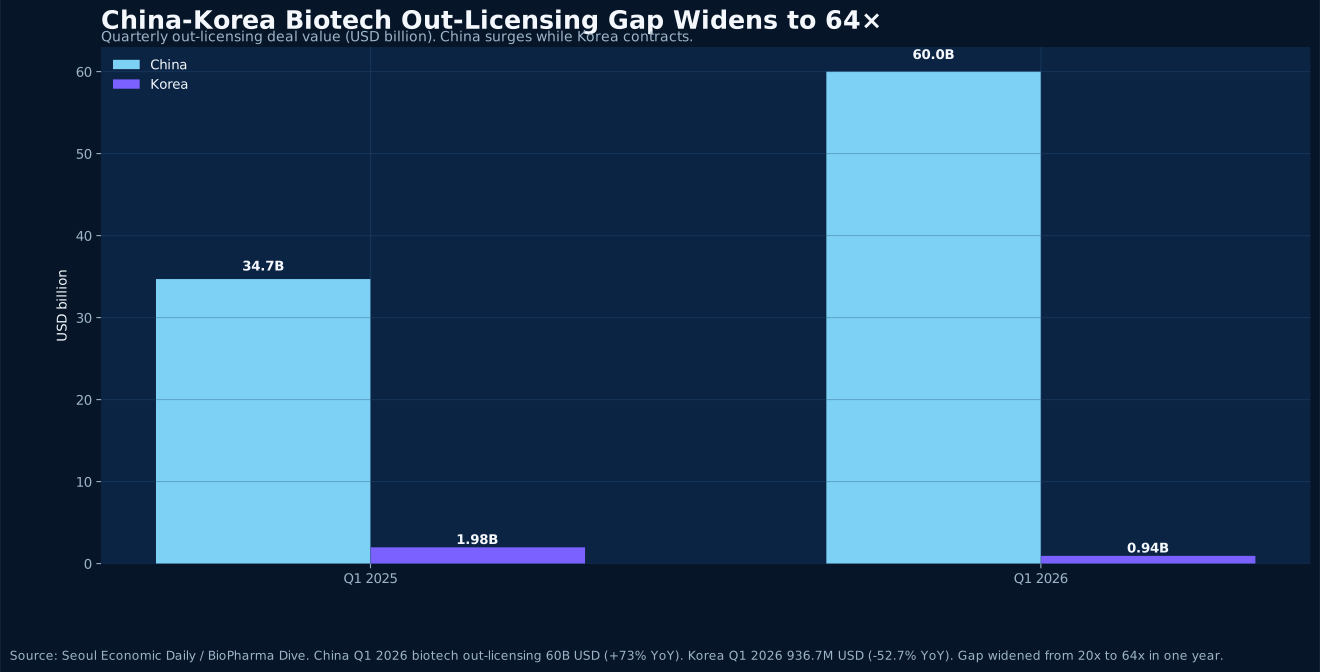
Viewed only from within Korea, the weak out-licensing numbers in Q1 2026 could be dismissed as a temporary lull or a timing issue. But the picture changes when China and Korea are put on the same chart. China's quarterly out-licensing value rose to USD 60 billion while Korea dropped below USD 1 billion, widening the gap again within a year. That is not just a numerical contrast. It reflects a deeper redistribution of attention among global buyers, investors, and multinational pharma companies.
More importantly, this shift is not confined to licensing tables or capital markets. It is increasingly shaping how Korean companies plan market development, choose partners, and allocate overseas business-travel budgets. In the past, Korea often looked at China through registration, manufacturing, ingredients, or clinical-resource lenses. Now public discussions are increasingly treating China as a source of projects, a pool of potential assets, and a dense networking environment. That is exactly why large Chinese biopharma events are regaining strategic pull for Korean companies.
2. Korea's first BIO China pavilion is not just an expo move, but a resource reallocation
Public reports in March showed that KOTRA, KHIDI, and the Korea Pharmaceutical and Bio-Pharma Manufacturers Association jointly organized Korea's first pavilion at BIO China 2026. The importance is not the word 'first' itself. It is the signal that Korean public agencies and industry groups are raising the priority of offline China-facing events again. If Korean companies only wanted to maintain existing contacts, they could keep relying on U.S. and European conferences, online roadshows, and legacy BD networks. A coordinated move into a Chinese expo suggests they want exposure to a larger stream of new projects and more frequent face-to-face matching.
It also suggests that the center of gravity in Korea-China biopharma relations is being adjusted. The old shorthand of 'China for production, Korea for R&D' is no longer sufficient. The more realistic picture now is that Chinese participants are seeking broader clinical expansion, co-development, platform technologies, and global partnerships, while Korean players want earlier access to Chinese innovation assets, project demand, and local industrial resources. The pavilion is therefore less about brand display than about getting closer to where new flows are forming.
3. Korea's USD 10 billion export milestone does not mean it is free from transaction pressure
Korean biopharma is not without strengths. Public data show Korea's pharmaceutical exports exceeded USD 10 billion for the first time in 2025, confirming the sector's weight in manufacturing, scale-up, CDMO, certain innovative products, and global supply execution. But export momentum and licensing momentum are not the same thing. Strong exports show delivery capability. Weak licensing shows limits in how quickly assets are being identified, priced, and amplified by global capital and strategic buyers. Korea is dealing with a widening gap between those two curves.
That is exactly why Korean companies need to look for new transaction interfaces in high-flow markets. China matters not because it replaces the U.S. or Europe, but because it offers a different pool of opportunities at larger scale, faster feedback speed, and higher interaction density. If Korean companies keep circulating only within familiar meetings and comfortable networks, it becomes harder to win early positioning in the new deal structure. Re-engaging China is therefore not an abandonment of Western routes, but the completion of an increasingly necessary piece of the map.
4. What draws Korea to China is project density and industrial organization capacity
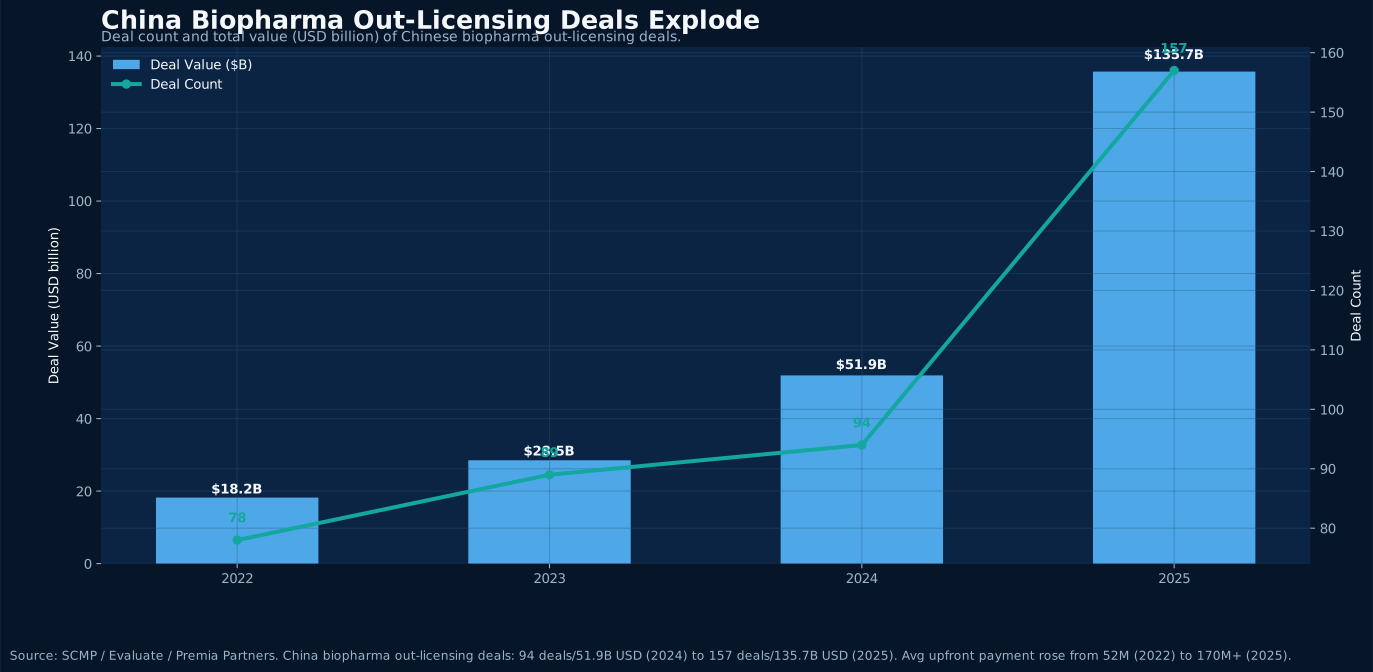
China's pull on Korean biopharma is no longer about a single cost advantage. The more realistic attraction comes from three layers. First, a larger project pool that includes innovative molecules, platform technologies, co-development demand, and industrial-park support resources. Second, faster market feedback, where many relationships begin with immediate filtering at expos, roadshows, and industry events rather than through multiple slow rounds before a first meeting. Third, a stronger layer of organized support involving local governments, parks, service providers, and investors, which reduces information friction for Korean firms entering unfamiliar territory.
For Korea-China cooperation, that means the contest is no longer only about whose science is better, but about who can connect science, regulation, BD, and execution services into one working path. Korean firms looking for Chinese partners will increasingly care whether the counterpart can move trials, registration, manufacturing, supply, and commercialization in sequence. Chinese partners, in turn, will care whether the Korean side has international BD capability and can carry a project onward toward Western capital and markets. Both sides are asking more concrete questions.
5. The next thing to watch is not rhetoric, but three types of public signals
First, watch whether Korean public agencies and industry groups continue adding China-facing expos, matchmaking events, and investment programs. If the frequency rises, China is not a one-off trial, but a restored medium-term route. Second, watch whether Chinese innovative drug companies, platform firms, and biotech parks keep raising the visibility of Korea-related cooperation. Once bilateral event agendas contain more two-way matching content, cooperation can move faster from exhibition level to project level. Third, watch whether Korean media and research organizations increasingly describe China in terms of deal density and asset opportunity rather than only cost manufacturing. That reveals whether the mental model is truly changing.
From a Korea-China trade perspective, the importance of this shift is that it can lift an entire chain of supporting demand. After expos come samples, materials, translation, local regulatory explanation, online meetings, park introductions, site visits, and cross-border contracting support. Once a project enters the middle stage, demand expands further into clinical, registration, CMC, packaging, cold chain, and compliance services. In other words, biopharma cooperation is not an isolated headline. It is a long chain that can pull both service trade and industrial coordination forward together.